Choosing the right steel profile is critical for structural integrity, cost efficiency, and project timelines—whether you're specifying I-beams for load-bearing frames, C-purlins for roof support, or Z-purlins for optimal overlap and strength. As a trusted structural steel manufacturer & exporter from China, Hongteng Fengda delivers high-quality steel profiles, steel rails, steel tubes, steel roof sheets, steel conduits, steel bars, steel piles, steel rebars, steel sheets, and carbon steel—all compliant with ASTM, EN, JIS, and GB standards. This guide helps engineers, procurement teams, project managers, and distributors match section types precisely to real-world load requirements.
Definition & Structural Role of Key Steel Profiles
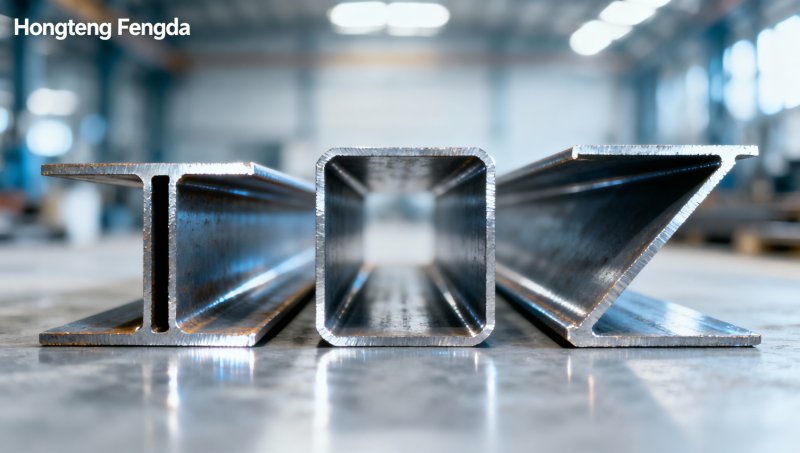
Steel profiles are standardized cross-sectional shapes manufactured through hot-rolling or cold-forming processes. Their geometry directly governs load-carrying capacity, bending resistance, torsional stiffness, and connection compatibility. Among the most widely used in global construction and industrial infrastructure are I-beams (also known as H-beams or universal beams), C-purlins, and Z-purlins—each engineered for distinct mechanical roles.
I-beams serve as primary structural members in columns, beams, and trusses where high moment resistance and axial load capacity are essential. Their symmetrical flange-web configuration offers superior strength-to-weight ratio under vertical and lateral loads. In contrast, C- and Z-purlins are secondary cold-formed components designed specifically for roof and wall cladding support. While both transfer wind, snow, and dead loads to main frames, their asymmetry enables optimized self-weight distribution and efficient fastening patterns.
Understanding how geometry influences performance—such as web slenderness affecting buckling, or flange width impacting lateral-torsional stability—is foundational for accurate selection. Misalignment between section type and loading condition can compromise safety margins, accelerate fatigue, or necessitate costly redesigns mid-project.
Technical Performance Comparison: I-Beam vs. C-Purlin vs. Z-Purlin
Load behavior varies significantly across these three profile families. To clarify functional differences, the table below compares key technical parameters under standard design assumptions (ASTM A6/A6M, EN 10025, and GB/T 700).
Application Scenarios & Load Matching Principles
Selecting the correct profile begins with defining the dominant load regime. For example, I-beams dominate in multi-story commercial buildings where gravity loads exceed 15 kN/m and lateral wind forces demand torsional rigidity. Their deep web resists shear deformation, while broad flanges stabilize against buckling during seismic events.
C-purlins excel in low-rise industrial sheds with uniform roof sheeting and moderate snow loads (< 2.0 kPa). Their open shape allows easy integration with insulation layers and concealed fasteners. However, they exhibit reduced resistance to uplift forces near eaves—making them less ideal for cyclonic zones without supplemental bracing.
Z-purlins outperform C-sections in long-span roofs (>9 m) and high-wind regions. The asymmetric geometry shifts the centroid toward the top flange, increasing effective section modulus under downward loading. When lapped, Z-purlins form a quasi-continuous beam that redistributes point loads more evenly—reducing deflection by up to 22% compared to C-types (per EN 1993-1-3 test data). This makes them especially valuable for projects using Rolled Coil–based roofing systems requiring extended service life and minimal maintenance.
Standards & Certification: Ensuring Global Compliance
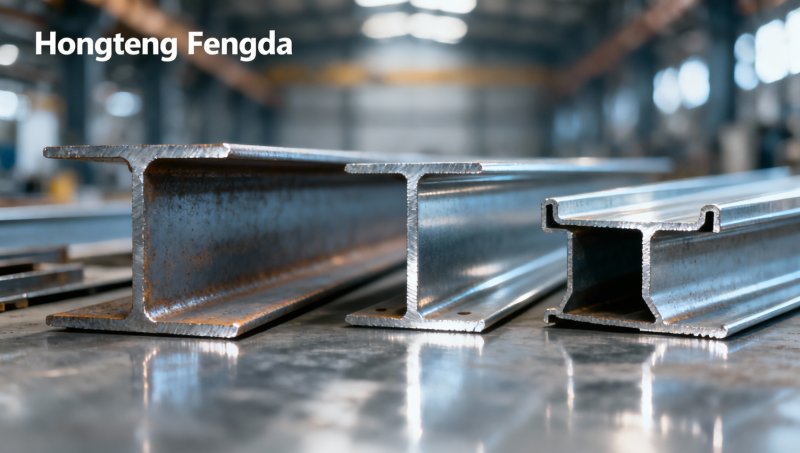
Hongteng Fengda’s steel profiles undergo full certification per international benchmarks—including ASTM A6/A6M (USA), EN 10025 & EN 10147 (Europe), JIS G3101/G3136 (Japan), and GB/T 700/GB/T 11263 (China). Each batch receives mill test reports verifying chemical composition, tensile properties, bend testing, and dimensional tolerances.
For instance, our Q235 and Q345 Rolled Coil products meet GB/T 700-2006 and ASTM A283 specifications, with carbon content tightly controlled between 0.12%–0.20%, manganese at 0.30%–0.70%, and sulfur/phosphorus capped at ≤0.045%. These controls ensure consistent weldability, cold-forming reliability, and thermal stability during fabrication—critical for OEM partners and EPC contractors managing tight QA/QC workflows.
All export shipments include third-party inspection certificates from SGS, BV, or TÜV upon request—supporting seamless customs clearance and compliance audits across North America, EU, GCC, and ASEAN markets.
Why Choose Hongteng Fengda?
As a professional structural steel manufacturer & exporter from China, Hongteng Fengda bridges global sourcing needs with localized engineering insight. Our vertically integrated production—from raw material sourcing to precision rolling, cutting, and surface treatment—ensures stable lead times (typically 25–35 days), consistent dimensional accuracy (±1%), and traceable quality control at every stage.
We specialize not only in standard sections but also in customized cold-formed steel profiles, OEM solutions, and hybrid assemblies integrating steel rail, steel tube, steel roof sheet, steel conduit, steel bar, steel pile, steel rebar, steel sheet, and carbon steel components. Whether you require ASTM-certified I-beams for a U.S. highway bridge or EN-compliant Z-purlins for a solar farm in Spain, our team provides technical consultation, BIM-ready modeling support, and logistics coordination tailored to your project phase.
Partner with us to reduce procurement risk, avoid specification mismatches, and accelerate time-to-completion—without compromising on structural integrity or international compliance.
Please give us a message


Please enter what you want to find