When evaluating Steel Construction Material for industrial or building projects, procurement teams must look beyond the initial price and consider long-term service life, maintenance needs, and total ownership cost. Choosing the right structural steel supplier can directly affect project durability, budget control, and delivery reliability, especially in global sourcing where quality consistency and standards compliance matter most.
Why service life matters more in some Steel Construction Material scenarios
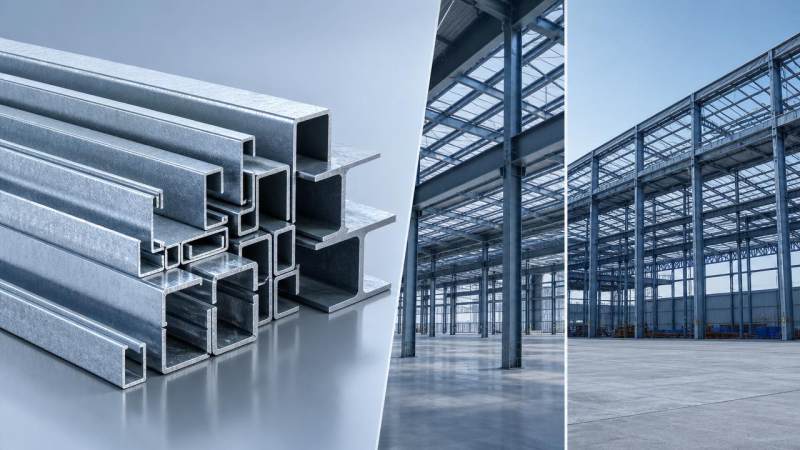
Not every project should evaluate Steel Construction Material in the same way. A dry indoor workshop, a coastal logistics terminal, and a high-humidity agricultural building can all use structural steel, but the cost logic is very different. In one case, the lowest purchase price may be reasonable. In another, the cheapest option can create higher lifecycle expense through coating failure, corrosion, rework, or early replacement.
This is why service life must be matched to application conditions. Exposure to rain, salt spray, industrial chemicals, vibration, roof load, and maintenance access all influence how Steel Construction Material performs over time. A project that expects twenty years of stable use with minimal downtime should not be evaluated by the same standards as a temporary structure or a lightly loaded internal frame.
For global buyers, another layer of judgment is required: consistency. Even if nominal grades look similar on paper, actual quality control, dimensional tolerance, coating uniformity, and compliance with ASTM, EN, JIS, or GB standards affect both installability and service life. Reliable supply is therefore part of lifecycle value, not just a logistics issue.
How different project environments change the true cost of Steel Construction Material
Indoor industrial buildings with controlled conditions
In enclosed factories, warehouses, and production support buildings, Steel Construction Material often faces lower corrosion risk. Here, buyers can prioritize structural stability, fabrication precision, and cost efficiency. Surface treatment may still matter, but the pressure for premium corrosion resistance is lower than in outdoor or marine conditions.
In these scenarios, lifecycle performance depends heavily on accurate section selection and processing quality. If the steel profile is poorly formed, difficult to align, or inconsistent in thickness, installation losses rise quickly. A component such as Metal C Beam can be a practical choice for purlins, wall beams, lightweight roof trusses, brackets, and light-industry structural members when dimensional accuracy and coating quality are stable. Available materials such as Q195, Q235, Q345, A36, SS400, and S235JR also give flexibility for different load and code requirements.
Outdoor commercial and logistics structures
For canopies, open storage structures, distribution centers, and exposed steel framing, Steel Construction Material must balance initial cost with weather resistance. Galvanized or coated steel usually delivers better long-term economics than untreated alternatives, even when the unit price is higher. Water retention points, perforations, cut edges, and connection areas should also be assessed, because these become early corrosion zones.
The true cost driver in outdoor use is often maintenance access. If replacing corroded members requires shutdowns, lifting equipment, or partial roof removal, repair cost can exceed the original material savings. In such cases, a longer-lasting coating system and tighter manufacturing tolerance provide real financial value.
Coastal, humid, or chemically aggressive sites
In marine-adjacent projects, fertilizer storage, wastewater support systems, or high-humidity processing areas, Steel Construction Material should be selected with corrosion as a primary factor. A lower-cost steel section may still be acceptable, but only if paired with suitable surface treatment, proper detailing, and realistic maintenance planning.
Buyers should verify whether galvanized coating, powder coating, or black varnish is appropriate for the service environment. It is also important to confirm tolerance, edge condition, and fabrication services such as punching, cutting, bending, and welding, because post-processing can damage protective surfaces if not managed correctly. In aggressive environments, the cheapest delivered quote is rarely the lowest total-cost solution.
Light manufacturing frames and secondary structural members
Mechanical light-industry applications often use Steel Construction Material for columns, beams, arms, support members, and equipment-related structures. These applications may involve repeated loading, vibration, and frequent modifications during the equipment lifecycle. Here, machinability, consistent profile geometry, and dependable lead times are just as important as corrosion resistance.
Cold formed and hot rolled profiles should be compared not only on price per ton, but also on fabrication efficiency and fit-up performance. A properly specified Metal C Beam with thickness from 1mm to 12.mm, lengths such as 6m, 9m, and 12m, and customized large-quantity options can support efficient assembly where lightweight structural sections are preferred.
Key differences in Steel Construction Material needs by scenario
How to choose Steel Construction Material based on lifecycle value
A practical sourcing decision should compare at least five factors instead of focusing only on unit price:
- Expected service environment: dry indoor, open outdoor, marine, chemical, or mixed-use.
- Required design life: temporary, medium-term, or long-term fixed infrastructure.
- Structural role: main load-bearing member, secondary support, roof system, wall beam, or equipment frame.
- Maintenance accessibility: easy periodic repainting versus difficult replacement conditions.
- Supply reliability: consistency in material grade, coating, dimensions, certifications, and delivery time.
For steel projects supplied internationally, certification and production control are especially important. Steel Construction Material that meets CE, SGS, BV, or ISO-backed quality expectations can reduce the risk of disputes, reinspection, and project delay. When products are manufactured under recognized standards such as ASTM, EN, JIS, and GB, design verification and cross-market acceptance also become easier.
Common mistakes when comparing cost vs service life
One common mistake is comparing steel sections only by price per ton. This ignores yield loss during cutting, fabrication complexity, coating performance, and installation speed. Two offers may look similar in weight and grade, but one may save more through lower site labor, less rework, and fewer replacement cycles.
Another mistake is treating all coatings as equivalent. Galvanized Coated surfaces, powder coating, and black varnish have different performance profiles depending on climate and usage. If the selected Steel Construction Material will be perforated, cut, or welded after delivery, the protection strategy for exposed areas should be clarified before ordering.
A third issue is overlooking manufacturing capability. Modern forming lines, strict tolerance control, and value-added processing services can significantly improve field efficiency. This is particularly relevant for C-shaped sections automatically formed to target sizes, where consistency supports fast assembly in purlins, wall beams, and lightweight structural systems.
Scenario-based recommendations for better Steel Construction Material sourcing
- For indoor steel buildings, prioritize dimensional accuracy, processing quality, and stable supply over premium corrosion systems that may not be necessary.
- For exposed roofing, wall systems, and secondary framing, select Steel Construction Material with suitable galvanized or coated surfaces and verify edge protection after processing.
- For humid or coastal installations, calculate replacement and maintenance cost over the full design period before accepting a lower initial quote.
- For manufacturing support frames, confirm section tolerance, available lengths, fabrication support, and compatibility with project-specific standards.
- For international procurement, choose suppliers with proven export experience, compliance documentation, and dependable lead times to reduce sourcing risk.
Hongteng Fengda supports these sourcing needs as a structural steel manufacturer and exporter from China, supplying angle steel, channel steel, steel beams, cold formed profiles, and customized structural steel components for global construction and industrial use. With modern production facilities and strict quality control, the company helps reduce lifecycle risk through consistent quality, standards compliance, and reliable delivery performance.
Next step: evaluate Steel Construction Material with a full-project view
The best Steel Construction Material choice is rarely the one with the lowest upfront number. It is the option that fits the service environment, meets the required design standards, installs efficiently, and maintains performance over the intended lifespan. A project with clear application conditions, realistic maintenance assumptions, and verified supplier capability will usually achieve better cost control than one driven by purchase price alone.
Before placing an order, review the operating environment, target service life, required grades, surface treatment, tolerances, and fabrication needs. Then compare quotations based on total ownership value rather than material cost only. This approach leads to better durability, fewer site problems, and stronger long-term returns from every Steel Construction Material decision.
Please give us a message


Please enter what you want to find