Choosing the right stainless steel sheet for kitchen use matters for hygiene, durability, and cost. This guide compares 304 and 316 stainless steel sheet for kitchen applications in daily environments, helping buyers, fabricators, and project teams understand corrosion resistance, maintenance needs, and long-term value before making a practical sourcing decision.
In commercial kitchens, residential projects, food preparation areas, and light industrial canteens, stainless steel is often selected because it combines cleanability, impact resistance, and a professional finish. Yet many buyers still ask the same question: is 304 enough for everyday kitchen use, or is 316 worth the premium?
The answer depends on the operating environment, chloride exposure, cleaning chemicals, fabrication requirements, and budget control. For procurement teams and technical evaluators, the right choice is rarely about buying the highest grade available. It is about matching performance to the actual service condition over 5–15 years of use.
For global buyers sourcing from China, this decision also affects specification clarity, inspection criteria, and total project cost. A reliable supplier with stable processing quality, standard compliance, and practical grade guidance can reduce rework, avoid over-specification, and support consistent project delivery.
304 vs 316 Stainless Steel Sheet: What Really Changes in Kitchen Use?
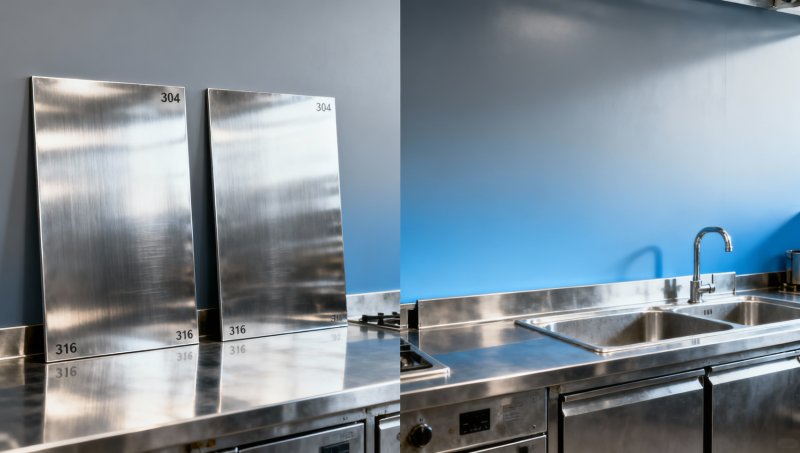
304 and 316 are both austenitic stainless steel grades widely used for sheet fabrication. In daily kitchen applications, both offer good corrosion resistance, an attractive surface, and reliable formability for sinks, backsplashes, worktables, wall panels, and equipment housings. However, their difference becomes more important when moisture, salt, and aggressive cleaners are part of routine use.
Grade 304 is commonly treated as the standard kitchen stainless steel. It performs well in most indoor kitchens where cleaning is regular and chloride exposure is moderate. Grade 316 contains molybdenum, which improves resistance to pitting and crevice corrosion, especially in environments with higher salt content, coastal humidity, or stronger sanitation chemicals.
For many indoor kitchens, 304 delivers the right balance between cost and performance. In contrast, 316 is often selected for seafood processing lines, coastal resort kitchens, high-end outdoor cooking stations, and medical or laboratory-adjacent food spaces where corrosion risk is above average. The price difference can vary by market, but 316 often costs around 15%–35% more than 304 depending on thickness, finish, and nickel-molybdenum fluctuations.
This comparison table helps technical teams and buyers review the practical differences before finalizing a specification.
The practical takeaway is straightforward: if the kitchen is indoors, dry between cleaning cycles, and not exposed to seawater or high-chloride chemicals, 304 is usually the sensible choice. If the site is within a coastal belt, handles salty food daily, or uses more aggressive sanitation routines, 316 can lower long-term corrosion risk and reduce replacement frequency.
Why the environment matters more than the grade label
Buyers sometimes assume that 316 is always better because it is more corrosion resistant. In reality, that only creates value when the operating environment justifies the extra spend. In a dry interior kitchen with ordinary detergents and routine wiping, the performance gap may remain small for years.
On the other hand, even high-quality stainless steel can stain or pit if surface contamination is ignored. Fingerprints, iron particles from nearby carbon steel tools, and chloride residue left for 24–72 hours can affect appearance. Grade choice should therefore be paired with correct fabrication, passivation when needed, and suitable cleaning practices.
How to Choose the Right Grade by Kitchen Scenario and Risk Level
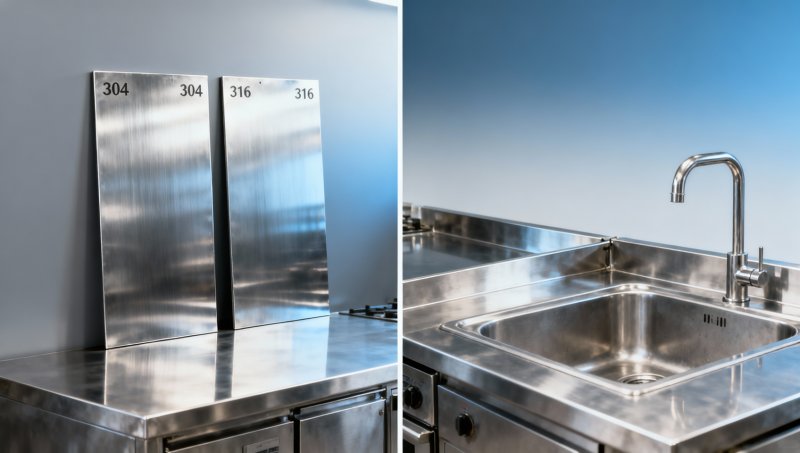
A practical selection process starts with the actual kitchen environment, not only the material datasheet. For engineering teams, distributors, and project managers, at least 4 factors should be checked before choosing between 304 and 316: location, food type, cleaning method, and expected service life.
Indoor household kitchens, standard restaurants, bakery production rooms, and school canteens usually operate well with 304 stainless steel sheet. In these conditions, humidity is present but often controlled, salt accumulation is limited, and cleaning agents are relatively mild. For these applications, 304 can perform effectively over 8–12 years when surfaces are maintained properly.
316 becomes more relevant when one or more risk factors increase. Examples include open-air kitchens near the sea, fish or brine preparation zones, institutional kitchens using chloride-based cleaners, and washdown areas with frequent chemical exposure. Here, 316 may reduce pitting risk and improve surface stability over a 10–15 year service cycle.
Procurement teams can simplify grade selection by mapping the kitchen against exposure conditions and cleaning intensity. The table below offers a practical decision framework.
The key conclusion is that “daily use” does not automatically mean 304 or 316. It means understanding the stress level of the environment. When the risk is ordinary, 304 is often enough. When chloride exposure is repetitive or severe, 316 usually provides a more reliable long-term result.
A 5-point selection checklist for buyers and fabricators
- Check whether the kitchen is indoor, semi-outdoor, or exposed to marine air within a few kilometers of the coast.
- Review contact with salt, vinegar, sauces, and acidic or chlorinated cleaning agents used weekly or daily.
- Confirm surface finish requirements such as 2B, BA, or No.4, because finish affects appearance retention and cleanability.
- Define thickness by application, such as 0.8–1.2 mm for panels and 1.2–2.0 mm for counters or heavier fabricated components.
- Estimate service life and replacement cost over 5, 10, or 15 years instead of comparing raw material price only.
Common specification mistake
One common mistake is specifying 316 for every kitchen project to avoid questions later. This can increase project cost without measurable operating benefit. Another mistake is choosing 304 for coastal or salt-heavy applications without defining cleaning intervals, edge finishing, and weld treatment. The better approach is to link grade, finish, thickness, and maintenance plan as one package.
Surface Finish, Thickness, and Fabrication Details That Influence Daily Performance
Kitchen durability depends on more than alloy grade. Surface finish, sheet thickness, edge condition, and fabrication quality all affect hygiene, visual appearance, and maintenance effort. In many projects, these factors explain the performance difference more clearly than the jump from 304 to 316 alone.
For example, a No.4 brushed finish is commonly chosen for visible kitchen surfaces because it hides fingerprints and light scratches better than mirror-like finishes. BA and 2B finishes are also used depending on the component and fabrication process. For counters, splash zones, and tabletops, selecting the right finish can reduce visible wear over thousands of cleaning cycles.
Thickness also matters. Light decorative panels may use thinner gauges, while counters, sink surrounds, and heavy-use fabrication often require thicker material to resist denting and improve rigidity. Typical kitchen sheet selections often fall between 0.8 mm and 2.0 mm for fabricated parts, while some industrial or support-related applications go thicker depending on the structure beneath.
In some projects, buyers also compare alternative grades for cost-sensitive decorative or low-corrosion applications. A practical example is 430 Stainless Steel Coil, which is used in various tabletops, countertops, kitchenware, urban decoration, low-grade household products, and selected automotive or medical components. Available finishes include BA, 2B, NO.1, NO.4, 4K, HL, and 8K, with size ranges such as thickness 2.5mm–10.0mm, width 610mm–2000mm, and lengths up to 6000mm.
For technical teams evaluating alternatives, ferritic 430 can offer good formability and broad usability in less aggressive environments, while material data such as tensile strength ≥ 520MPa, yield strength ≥ 275MPa, elongation around 55%–60%, and hardness up to 183HB provide a baseline for process planning. Even so, for kitchen areas where corrosion resistance and food-contact expectations are higher, 304 remains the more common default than 430.
Fabrication details that should not be ignored
- Use smooth weld finishing on visible or food-contact surfaces to reduce dirt traps and simplify cleaning.
- Avoid carbon steel contamination during cutting, polishing, and storage, because embedded particles can lead to staining.
- Consider folded or reinforced edges on counters to improve stiffness without excessive sheet thickness.
- Specify protective film requirements during transport if appearance grade surfaces are exposed to scratches.
Why supplier capability affects end use
A supplier’s production stability matters because flatness, finish consistency, dimensional tolerance, and packaging quality influence fabrication yield. For exporters serving construction, industrial, and manufacturing projects, compliance with standards such as ASTM, EN, JIS, and GB helps procurement teams align drawings, inspection plans, and downstream acceptance. This is especially important when projects involve multiple batches, OEM processing, or international shipment schedules of 2–6 weeks.
Cost, Maintenance, and Total Value Over the Service Life
The most economical choice is not always the lowest purchase price per ton or per sheet. Buyers should compare initial material cost, expected maintenance frequency, corrosion risk, and replacement timing. A kitchen worktop that requires early replacement after 3–5 years can become more expensive than a better-suited material that lasts 10 years or longer.
In ordinary indoor kitchens, 304 often provides the strongest value because it avoids unnecessary material premium while still delivering cleanability and durability. If the kitchen team follows a simple maintenance routine, such as wiping after use and using non-abrasive cleaners, 304 surfaces can maintain appearance and function well for many years. For these conditions, paying 15%–35% more for 316 may not improve return on investment.
In high-salt or coastal environments, the equation changes. Surface pitting, tea staining, or corrosion around joints can lead to sanitation concerns, brand image issues, and early replacement. In these cases, 316 may lower maintenance pressure and reduce the risk of localized failure, especially on exposed work surfaces and fabrication seams.
The table below compares grade choice from a total-value perspective rather than a simple purchase-price view.
The main conclusion is simple: 304 usually wins on cost-efficiency for normal daily use, while 316 wins on risk control in more corrosive settings. For financial approvers and project owners, the best decision is based on lifecycle value, not only the invoice price of the raw sheet.
A practical maintenance routine for longer service life
- Clean surfaces daily with neutral or manufacturer-approved cleaners instead of highly abrasive powders.
- Rinse and dry after contact with salt, acidic food residue, or chloride-based chemicals.
- Inspect welds, corners, and fastener zones every 1–3 months in commercial settings.
- Avoid steel wool or contaminated tools that can embed iron and create surface rust staining.
Procurement, Quality Control, and Common Questions Before Ordering
When sourcing stainless steel sheet for kitchen fabrication, procurement teams should define more than grade alone. A complete purchasing specification usually includes grade, thickness, finish, sheet size, applicable standards, surface protection, quantity tolerance, and inspection requirements. This reduces disputes and supports smoother production.
For exporters and project suppliers, stable production capacity and quality control are essential. Buyers often need confidence that each batch matches the approved sample in flatness, finish, and dimensional consistency. For international projects, dependable lead times can be as important as material selection, especially when installation schedules are fixed and replacement lead times can extend 2–8 weeks.
Companies serving global construction, manufacturing, and industrial buyers typically support this process through standard-compliant production, OEM options, and coordinated shipment planning. A supplier able to work with ASTM, EN, JIS, and GB references can help technical evaluators and commercial teams align specifications faster across regions.
Below are common questions that buyers, operators, quality teams, and end users often raise before confirming an order.
Is 304 stainless steel enough for most daily kitchen applications?
Yes, in most indoor residential kitchens, standard restaurants, and ordinary food preparation spaces, 304 stainless steel sheet is sufficient. It provides a good combination of hygiene, formability, corrosion resistance, and cost control. It becomes less suitable only when chloride exposure, salt concentration, or coastal humidity is consistently high.
When should 316 be specified instead of 304?
316 should be considered when the kitchen is coastal, semi-outdoor, seafood-oriented, or cleaned with more aggressive chemicals on a frequent basis. It is also a practical upgrade when the replacement cost of a failed surface is high, such as in premium hospitality kitchens or sanitation-sensitive facilities.
What should buyers inspect before shipment?
At minimum, review 6 points: material grade confirmation, thickness tolerance, finish consistency, sheet flatness, edge quality, and packaging protection. If the material will be fabricated into visible kitchen components, request sample confirmation for the finish before bulk production.
Final decision guidance
For daily kitchen use, 304 is the practical first choice in most indoor environments because it balances performance and cost effectively. 316 is the better fit when corrosion exposure is materially higher and the operating conditions justify the extra investment. The most reliable result comes from evaluating grade, finish, thickness, fabrication quality, and maintenance as one complete specification.
If you are sourcing stainless steel or structural steel products for kitchen-related fabrication, industrial equipment, or broader project supply, working with an experienced Chinese manufacturer and exporter can help reduce sourcing risk, improve consistency, and support on-time delivery. Contact us now to discuss your application, request product details, or get a customized solution for your next project.
Please give us a message


Please enter what you want to find