When reviewing an order for sst plate, small specification details can quickly turn into costly approval delays, quality disputes, or sourcing risks. For business evaluators, the real issue is not simply whether the quoted plate looks acceptable on paper. The issue is whether the full specification package is complete, comparable, and contract-safe across standards such as ASTM, EN, JIS, or GB.
In practice, the plate specs that most often cause trouble at order approval are grade equivalency, thickness tolerance, surface finish, edge condition, flatness, test documentation, heat treatment status, and corrosion-related requirements. These points may seem routine, but they directly affect commercial risk, delivery reliability, downstream fabrication, and the likelihood of claims after shipment.
This article focuses on what business evaluators actually need to check before approving an sst plate purchase: where specifications become ambiguous, why suppliers and buyers often interpret the same requirement differently, and how to reduce approval friction without slowing the procurement cycle.
Why sst plate approvals get delayed even when the quotation looks complete
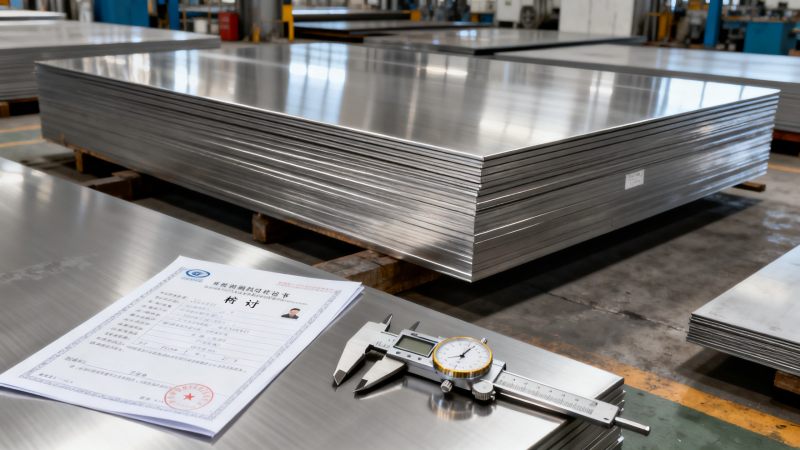
Many order approvals fail at the final stage not because the supplier lacks capability, but because the specification is only partially defined. A quotation may list grade, size, and quantity, yet still leave out details that determine whether the material is truly fit for the project, fabrication route, and destination market.
For business evaluators, this creates a familiar problem: two suppliers appear to offer the same sst plate, but one price is lower, one lead time is shorter, and one compliance statement is broader. Without checking the hidden variables behind those offers, approval decisions can easily favor the wrong option.
The most common hidden variables are standard version, tolerance class, plate processing state, inspection scope, and certificate type. These are the areas where sourcing risk hides. They are also the reasons why a “technically acceptable” quotation may later trigger revision requests from engineering, QA, or the end client.
The grade mismatch problem: same stainless family, different commercial risk
One of the biggest approval issues with sst plate is grade confusion. Buyers often see broad descriptions such as 304, 316, 430, or duplex equivalents and assume cross-standard interchangeability. In reality, equivalent grades across ASTM, EN, JIS, and GB may have small chemistry or mechanical differences that matter in corrosion performance, welding behavior, or end-use compliance.
For example, a plate approved under one standard may not satisfy a client specification written around another standard’s composition limits, impact requirements, or test expectations. This becomes especially risky when the order is for export projects, pressure-related applications, food-contact environments, or marine exposure.
A business evaluator should never approve based only on a familiar grade name. The review should confirm the exact standard designation, material number if applicable, and any additional requirements tied to corrosion resistance, low-temperature performance, or fabrication method. If the buyer’s internal team says “304 is fine,” the next question should be “304 to which standard, and with what certification and finish?”
This is where supplier transparency matters. A reliable structural steel manufacturer or exporter should be able to explain not only what grade is being offered, but also how it maps to the customer’s required standard and where the differences may affect downstream use.
Thickness and tolerance: the small numbers that create big disputes
Thickness is one of the most frequent causes of order approval trouble because buyers often focus on nominal thickness while overlooking the tolerance rule behind it. An sst plate quoted as 10 mm is not enough information by itself. The key question is what minimum actual thickness is allowed under the governing standard and whether that tolerance is acceptable for the project.
This matters commercially in several ways. First, actual delivered weight may differ from estimate, affecting cost comparison. Second, fabrication performance may change if the material runs near the lower tolerance limit. Third, customer inspection may reject the plate if expectations were based on nominal rather than permissible thickness variation.
Business evaluators should also watch for tolerance differences between mill standard supply and customer-imposed tighter tolerances. Tighter thickness control can significantly affect pricing and lead time. If not clearly stated at approval stage, it often becomes a dispute later, especially after the mill has already scheduled production.
Flatness tolerance is another overlooked issue. For laser cutting, welding assemblies, cladding, or decorative use, a plate can meet thickness requirements but still create downstream problems if flatness is poor. Approval documents should therefore confirm not only size and thickness, but also the applicable tolerance standard for shape and dimensional accuracy.
Surface finish and appearance: where technical acceptance meets customer expectation
Surface finish sounds simple, but it is one of the easiest ways for an sst plate order to go wrong. Terms like 2B, No.1, BA, brushed, pickled, or polished are often used loosely in inquiries. Yet these finishes differ in roughness, reflectivity, process route, and suitability for fabrication or visible applications.
If appearance matters, a vague finish description is not enough. Business evaluators should confirm whether the finish requirement is functional, visual, or both. A buyer sourcing plate for hidden structural use can usually approve a broader finish range than a buyer sourcing for elevator panels, kitchen equipment, façade trims, or decorative fabrication.
Protective film requirements also deserve attention. Some buyers assume film is standard; some mills treat it as optional; some only provide temporary transport protection. If a project requires a specific film thickness, adhesive type, or branded masking, that should be written into the order approval package.
Even edge condition can affect perception and usability. Mill edge versus slit edge, deburred versus non-deburred, and cut-to-size versus full plate supply all influence reprocessing cost and customer acceptance. These details are especially important when the receiving customer judges quality visually before checking paperwork.
Documentation and test certificates: approval is not complete without proof
In many international purchases, documentation issues cause more trouble than the steel itself. A supplier may be able to produce compliant sst plate, but if the certificate format, inspection statements, or traceability records do not match contract expectations, order approval may stall or post-shipment claims may arise.
The most common problem is assuming that a standard mill test certificate is enough. In some projects, the buyer needs EN 10204 3.1 certification, full heat number traceability, PMI support, third-party inspection, or explicit reporting of chemistry, tensile values, and corrosion-related properties. In regulated industries, these are not optional extras. They are approval-critical items.
Business evaluators should therefore verify four things before approval: what certificate type is included, whether the issuing mill is identified, whether traceability to heat and batch is maintained, and whether any third-party witness or destination-specific compliance document is required. If these requirements are clarified early, the sourcing team avoids expensive retroactive document requests.
For buyers comparing multiple steel suppliers, documentation quality is often a better risk indicator than headline pricing. A lower quote with weak traceability may become the most expensive option once approval revisions, inspection delays, and claim exposure are considered.
Heat treatment, processing condition, and fabrication compatibility
Another source of trouble is incomplete information about the plate’s manufacturing and delivery condition. Not every buyer needs deep metallurgical detail, but business evaluators should still confirm whether the material is hot rolled, cold rolled, annealed, pickled, quenched, solution treated, or supplied in another defined condition required by the standard.
This is important because processing condition affects surface quality, dimensional consistency, weldability, and mechanical properties. A plate intended for pressure, marine, chemical, or precision fabrication use may require a more specific supply condition than a general-purpose structural application.
Welding and forming plans should also influence approval. If the customer will bend, stamp, machine, or weld the sst plate extensively, the supplier’s standard offering may not be enough without confirming ductility, hardness range, or heat treatment route. This is where business evaluation intersects with downstream cost control: approving the wrong processing condition can increase scrap, rework, and fabrication time even if the plate itself technically passes basic inspection.
In related metal sourcing categories, similar logic applies. For example, when a buyer evaluates auxiliary materials for construction, mesh, packaging, decoration, or industrial use, performance often depends on overlooked processing details rather than headline dimensions alone. A product such as Galvanized Stainless Steel Wire may look straightforward, yet actual suitability depends on wire diameter range, zinc coating thickness, tensile strength, ductility, and packaging condition. The same approval discipline used for plate specifications should be applied across steel product categories to reduce sourcing surprises.
Corrosion environment and end-use assumptions buyers should never leave unstated
The term sst plate often leads to a dangerous assumption: if it is stainless, corrosion resistance is automatically sufficient. In reality, stainless performance depends on grade, environment, fabrication method, surface condition, and maintenance exposure. Approval trouble starts when the intended service environment is not clearly translated into technical requirements.
For example, indoor dry conditions, coastal environments, chloride exposure, acidic processing areas, or food-contact surfaces all create different material expectations. If the order is approved without linking grade and finish to the actual use environment, later complaints may be framed as supplier quality issues when the root cause was incomplete specification.
Business evaluators do not need to become corrosion engineers, but they should ask a simple set of approval questions: Where will the plate be used? What media will contact it? Will it be welded or polished after delivery? Is appearance retention important? Is the customer following a project specification that overrides generic grade selection?
These questions are especially relevant for export business. A stainless plate acceptable in one market may be challenged in another if local project consultants, EPC contractors, or end users apply stricter expectations based on climate, hygiene, or service life assumptions.
How to compare suppliers without being misled by price or lead time
From a commercial standpoint, order approval should not reward the supplier that simply answers fastest or quotes lowest. It should reward the supplier whose offer is the most complete, transparent, and low-risk for the actual application. In stainless sourcing, an incomplete cheap quote can create more internal cost than a slightly higher but better-defined offer.
A practical comparison method is to review quotations against a fixed approval checklist. This should include grade standard, chemical and mechanical compliance, plate size and tolerance, finish, edge condition, supply state, certificate type, inspection scope, packaging, marking, traceability, and delivery terms. If one supplier leaves five of these items open, their quotation is not truly comparable.
It is also wise to assess whether the supplier regularly exports under ASTM, EN, JIS, and GB frameworks. Suppliers with cross-standard experience are generally better at identifying equivalency risks before production begins. They are also more likely to provide clear pre-approval communication, which reduces internal back-and-forth for procurement, QA, and project teams.
For global buyers, consistent lead time can be more valuable than a nominally short lead time that depends on unresolved specification details. Approval should therefore consider not only the promised schedule, but also the supplier’s ability to lock specifications early and issue documentation correctly the first time.
A practical approval checklist for business evaluators reviewing sst plate orders
Before approving an sst plate order, confirm the exact grade designation and governing standard, not just the generic stainless type. Check whether any project-specific substitutions or equivalency assumptions have been made and whether the customer has formally accepted them.
Verify nominal thickness, width, length, and quantity, then confirm the applicable thickness and dimensional tolerance standard. If flatness, squareness, or cut-to-size accuracy matters, make sure these are written into the order instead of being assumed.
Review the required surface finish, edge condition, and any protective film or appearance standard. If the plate is for visible or decorative use, ask for representative finish confirmation rather than relying on a short text description.
Confirm the supply condition and any heat treatment or processing requirements relevant to fabrication. If the material will be welded, formed, or used in a corrosive environment, ensure those end-use conditions have been reflected in the specification review.
Finally, lock in document requirements: certificate type, heat traceability, inspection reports, and any third-party witness needs. If these are not confirmed before order approval, they often become the reason a shipment cannot be accepted smoothly.
Final takeaway: the safest approval decision is the most clearly defined one
The sst plate specs that most often cause trouble at order approval are rarely dramatic. They are usually small omissions, vague assumptions, or standard references left undefined. Yet these details drive the most expensive problems: supplier disputes, delayed release, project nonconformity, and unexpected cost after delivery.
For business evaluators, the best approach is not to review stainless plate as a simple commodity item. Review it as a risk package. Grade, tolerance, finish, processing condition, documentation, and service environment should all align before approval is given. When these points are clarified early, purchasing decisions become faster, safer, and easier to defend internally.
In global steel sourcing, a dependable supplier adds value not only through manufacturing capacity, but through specification clarity and honest pre-order communication. That is what helps buyers reduce sourcing risk, control total cost, and approve with confidence.
Please give us a message


Please enter what you want to find