Choosing between ss sheet 304 and 316 is not just a material decision—it directly affects corrosion resistance, maintenance costs, and long-term service life. For project owners, contractors, and industrial buyers, understanding this difference helps reduce sourcing risks and improve lifecycle value. In this article, we break down the key distinctions to support smarter steel selection for demanding applications.
For business decision-makers in construction, fabrication, processing, and industrial equipment procurement, stainless steel grade selection is rarely about price alone. A small gap in alloy chemistry can lead to large differences in corrosion behavior, shutdown frequency, replacement cycles, and total cost over 5–15 years of service. That is why ss sheet 304 remains a common baseline material, while 316 is often selected when chloride exposure, chemical washdown, or coastal conditions raise the corrosion threshold.
From a sourcing perspective, the key question is simple: when is 304 sufficient, and when does 316 justify the premium? The answer depends on environment, fabrication requirements, maintenance strategy, and expected design life. Buyers who define these factors early can avoid over-specification on one hand and premature material failure on the other.
Why ss sheet 304 and 316 behave differently in real service
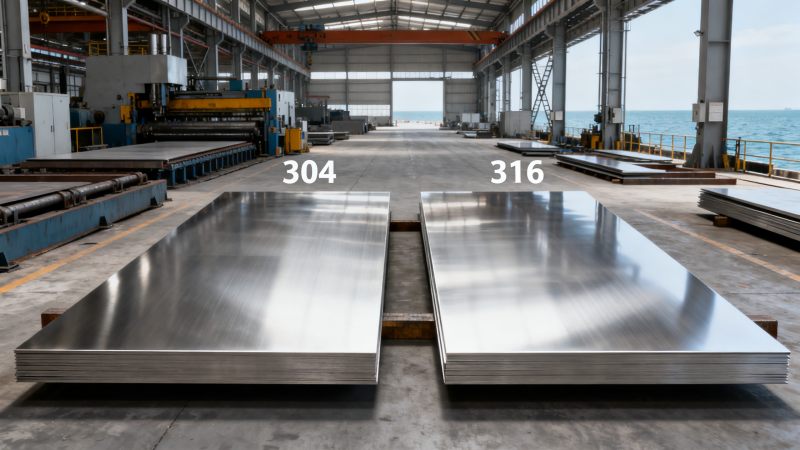
Although both grades belong to the austenitic stainless steel family, their field performance is not identical. The most important difference is that 316 contains molybdenum, typically around 2%–3%, which improves resistance to pitting and crevice corrosion. In practical terms, this means 316 usually performs better in marine air, salt-bearing splash zones, food processing wash areas, and mildly aggressive chemical environments.
By comparison, ss sheet 304 is widely used because it balances corrosion resistance, formability, weldability, and cost. In indoor applications, dry industrial conditions, general architectural components, equipment covers, and many standard processing systems, 304 often delivers stable service for 8–12 years or longer when the design and maintenance conditions are appropriate.
Chemical composition and what it means for buyers
A procurement team does not need a metallurgical deep dive, but it should understand the performance logic. Grade 304 typically contains about 18% chromium and 8% nickel, while 316 usually includes a similar chromium-nickel base plus molybdenum. That additional alloying element is what helps 316 resist localized attack in environments where chlorides can break down the passive film on stainless steel surfaces.
- 304: strong general-purpose option for standard indoor or low-corrosion service
- 316: stronger resistance in coastal, saline, or chemical-cleaning environments
- Decision point: lifecycle cost matters more than initial sheet price in long-duration projects
Service life is shaped by environment, not grade name alone
One common purchasing mistake is assuming that any stainless steel will remain stain-free in all conditions. In reality, performance depends on 4 main factors: chloride level, humidity cycle, surface finish, and cleaning frequency. A 304 sheet installed 1 km from the sea with poor drainage may fail faster than expected, while a 316 sheet in a dry interior plant may be more than the project actually needs.
Surface condition also matters. No. 4, 2B, or polished finishes can behave differently in contaminant retention and cleanability. Rougher or damaged surfaces are more likely to hold chloride residue, especially in weld-adjacent zones. For long service life, buyers should evaluate not just the base grade but also finish specification, fabrication quality, and site exposure class.
The table below gives a practical comparison for procurement and engineering teams evaluating ss sheet 304 against 316 in common industrial scenarios.
The key conclusion is not that 316 is always better, but that it offers a wider safety margin when corrosion drivers are strong. For many standard fabrication projects, ss sheet 304 remains commercially and technically sound. The correct choice depends on exposure severity and the expected replacement cycle.
How to choose the right stainless sheet for cost, durability, and risk control
For procurement managers and project owners, material selection should be linked to measurable project criteria. A useful approach is to assess 5 items before placing an order: service environment, contact media, cleaning method, design life, and maintenance access. If at least 2 of these factors indicate chloride or chemical exposure, 316 often deserves closer evaluation.
A practical 5-step selection method
- Define exposure: indoor, outdoor, coastal, humid, chemical, or food-grade washdown.
- Estimate design life: 3–5 years, 5–10 years, or 10+ years.
- Confirm surface finish and fabrication method, including welding and post-treatment needs.
- Calculate maintenance frequency and shutdown cost if corrosion appears.
- Compare initial price gap against lifecycle replacement and service risk.
This method helps buyers move beyond unit price. A sheet that saves 20% at purchase can become more expensive if it causes premature replacement, surface remediation, or unplanned downtime within 24–36 months.
When 304 is usually the right commercial choice
SS sheet 304 is typically a strong option for indoor architectural use, machinery casing, dry storage systems, HVAC covers, commercial kitchen components away from direct salt exposure, and general fabrication where cleaning chemicals are mild. It is also favored when projects require reliable forming and welding across medium to large volumes with strict budget control.
When 316 is worth the premium
316 becomes easier to justify in offshore-adjacent works, wastewater equipment, pharmaceutical facilities, food plants with frequent sanitizing cycles, and processing lines exposed to chlorides or acidic residues. In these situations, the added alloy cost may be offset by fewer repairs over a 7–12 year operating window.
Many industrial buyers who source stainless sheet also purchase carbon steel products for reinforced concrete and structural work. In integrated supply planning, it can be efficient to align stainless procurement with other steel items such as Wire rod for broader project execution. Available grades such as HRB335, HRB400, and HRB500, common diameters from 6 mm to 50 mm, and processing options including bending, welding, decoiling, cutting, and punching support civil engineering construction, bridges, roads, tunnels, beams, columns, slabs, and rebars. Buyers handling mixed steel packages often benefit from unified quality review against ASTM, JIS, GB, ISO, or BS-related requirements.
For large construction and industrial developments, this kind of coordinated sourcing reduces interface risk between stainless components and structural steel deliveries. It also helps teams manage tolerances such as ±1%, plan lengths from 5 m to 14 m, and choose surface treatment approaches like galvanized, black, PVC-coated, or anti-rust oil finishes where the project scope includes multiple steel categories.
Common decision mistakes that shorten service life
- Using 304 in chloride-rich outdoor exposure without reviewing washdown frequency
- Selecting 316 only by habit, even where low-corrosion indoor service makes 304 sufficient
- Ignoring weld cleaning and passivation after fabrication
- Comparing sheet prices without including maintenance labor and shutdown costs
- Failing to specify finish, thickness tolerance, and inspection points in the purchase order
In B2B steel procurement, these mistakes are usually more expensive than the grade difference itself. A well-written technical purchase specification can prevent disputes, reduce rework, and improve installation efficiency across the full project timeline.
What enterprise buyers should ask suppliers before ordering
For serious sourcing decisions, supplier communication should go beyond “304 or 316.” Buyers should confirm the product standard, thickness range, surface finish, flatness expectations, tolerance limits, inspection documents, and export packing method. These details affect installation fit, corrosion performance, and downstream fabrication yield.
Six checkpoints for technical and commercial evaluation
Before issuing a purchase order, decision-makers should review the following checkpoints. This is especially important for cross-border projects where lead time may range from 2–6 weeks depending on grade, finish, and volume.
This checklist allows purchasing teams to compare suppliers on measurable criteria rather than broad sales claims. In stainless sheet procurement, execution reliability often matters as much as material grade, especially for OEM fabrication, industrial installations, and export projects with fixed commissioning windows.
Why supplier capability affects material performance
Even the correct grade can underperform if delivered with inconsistent finish, improper packing, or unclear traceability. An experienced structural steel manufacturer and exporter can help buyers coordinate standards, custom processing, and shipment planning across multiple product lines. That matters when a project requires not just stainless sheet, but also angle steel, channel steel, steel beams, cold formed profiles, or customized structural steel components under one procurement schedule.
For global buyers, practical support includes stable production capacity, responsive communication, and quality control aligned with major standards such as ASTM, EN, JIS, and GB. These factors reduce the risk of mismatched specifications, delivery delays, or avoidable replacement costs after installation.
Final selection guidance for long-term value
If the service environment is mild, dry, and easy to maintain, ss sheet 304 is often the most economical and practical choice. If the application includes salt, humidity cycling, aggressive cleaning, or chemical exposure, 316 can provide a more secure lifecycle return despite a higher initial cost. The decision should be based on service life, maintenance burden, and failure risk rather than purchase price alone.
For enterprise buyers managing construction, industrial, or manufacturing projects, the best results come from matching grade selection with technical review, fabrication planning, and dependable supply execution. Hongteng Fengda supports global customers with structural steel products, customized solutions, and export-focused quality control designed to reduce sourcing risk and improve project efficiency.
If you are evaluating ss sheet 304 for your next project, or comparing it with 316 for a higher-corrosion environment, contact us to discuss specifications, related steel supply needs, and a sourcing plan that fits your service conditions and commercial goals.
Please give us a message


Please enter what you want to find