When comparing S355JR with standard steel, the real question is not just price, but performance, compliance, and long-term project value. For buyers sourcing Steel Beam, Steel Sheet Pile, Galvanized products, or checking steel beam factory price, understanding where S355JR offers a measurable upgrade can reduce risk and improve structural efficiency. This guide helps engineers, procurement teams, and project decision-makers evaluate whether S355JR is truly worth the investment.
What does “standard steel” really mean in project sourcing?
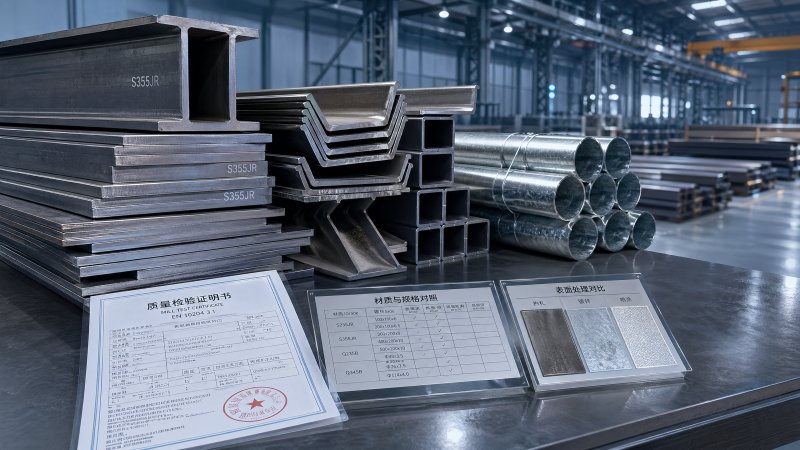
In real procurement work, “standard steel” is often a vague term. It may refer to lower-grade carbon steel, commonly available structural steel, or local-market material chosen mainly for price. That creates risk because two quotations can look similar on paper while delivering very different yield strength, weldability, and compliance performance. For technical evaluators and purchasing teams, this is where many cost overruns begin.
S355JR, by contrast, is a clearly defined European structural steel grade under EN standards. The key point is not that it is always better in every case, but that it provides a more predictable mechanical profile for load-bearing applications. In practical terms, this means engineers can design around known values instead of relying on assumptions about generic steel quality.
For project managers working across 2–4 procurement stages, clarity matters as much as metallurgy. If the material description in the RFQ is weak, downstream teams may face drawing revisions, inspection delays, or substitution disputes. A higher-grade structural steel such as S355JR often supports cleaner communication between design, sourcing, QC, and site installation teams.
This is especially relevant for global buyers comparing ASTM, EN, JIS, and GB supply channels. Hongteng Fengda supports this type of cross-standard sourcing by manufacturing and exporting structural steel products under strict quality control, helping buyers reduce mismatch risk when projects involve multiple regions, contractors, or approval bodies.
Why generic naming causes commercial and technical problems
- Generic steel descriptions can hide differences in yield strength, impact properties, and dimensional tolerance.
- Lower initial unit cost may lead to 3 hidden expenses: heavier section design, extra fabrication work, and higher inspection rejection rates.
- For distributors and resellers, unclear grade definitions increase after-sales disputes and traceability pressure.
S355JR vs standard steel: where is the measurable upgrade?
The main upgrade is structural efficiency. S355JR is generally selected when designers need higher strength than basic mild structural steel grades. While exact “standard steel” properties vary by market and specification, S355JR is widely recognized for a minimum yield strength around 355 MPa in relevant thickness ranges under EN 10025-2, making it suitable for more demanding load-bearing applications.
That difference can influence beam size, section weight, and fabrication strategy. In some projects, using a higher-strength grade allows the engineer to optimize cross-sections instead of simply adding more material. The result is not always lower total cost, but it can improve the balance between performance, fabrication practicality, and transport efficiency over a full project cycle of several weeks or months.
For procurement officers, the upgrade is most valuable when the steel must satisfy 4 conditions at once: structural reliability, documented compliance, stable supply, and predictable downstream processing. If one of these conditions is not critical, a lower-grade steel may still be commercially acceptable. The decision should follow application need, not marketing language.
The table below gives a practical comparison framework. Since “standard steel” differs by country and stock source, the comparison reflects common purchasing logic rather than claiming a single universal baseline.
The commercial takeaway is simple: the upgrade becomes worthwhile when section optimization, compliance, and project accountability matter more than the lowest ex-works price. For low-load secondary uses, the premium may not pay back. For primary structural members, the value is often easier to justify.
Three areas where the upgrade often pays back
1. Design efficiency
Higher-strength structural steel may reduce the need for oversized sections, especially in beams, frames, and fabricated supports. This can also reduce welding length and improve handling efficiency during installation.
2. Compliance control
For export projects or multi-party approvals, standardized grades simplify technical submittals, mill documentation, and buyer inspections across 3 key checkpoints: pre-production, final inspection, and shipment release.
3. Risk reduction
When material expectations are clear, teams spend less time resolving grade substitution issues, tolerance disputes, and fabrication incompatibility after delivery.
Which applications justify S355JR, and where can standard steel still work?
Not every job needs an upgrade. The right choice depends on load path, environment, design life, and approval complexity. In structural steel sourcing, the most expensive mistake is not choosing a premium grade; it is choosing a grade that does not match the actual service conditions. Procurement and engineering should therefore assess use cases together rather than separately.
S355JR is commonly more suitable for load-bearing frames, industrial platforms, steel beams, machinery supports, transportation-related structures, and export projects where documentation must align with EN-based expectations. Standard steel can remain practical for non-critical brackets, lightly loaded frames, temporary structures, or cost-sensitive components where local code acceptance is straightforward.
Another factor is environment. Strength alone does not solve corrosion exposure. In coastal, humid, or outdoor service, buyers also need to consider galvanizing, coating systems, and lifecycle maintenance intervals. This is why material grade and surface protection should be reviewed as one package during selection.
For example, if a project involves ancillary steel components, towers, poles, or fabricated round sections in corrosive environments, a galvanized solution may be more critical than a simple grade upgrade. In such cases, Galvanized Round Steel can be relevant for applications such as electric power towers, communication towers, railway works, highway protection systems, street light poles, and marine-related components, especially where long anti-corrosion life is required.
Application-based decision table
The table below helps project teams match steel choice to project priority, approval burden, and operating environment.
This comparison shows why many buyers should not ask only “Which steel is cheaper?” but also “Which steel meets the duty requirement with the lowest total project risk?” In many tenders, that second question is the one that protects schedule, quality, and budget at the same time.
Where galvanized round steel fits into the decision
For outdoor and infrastructure projects, corrosion protection can be as important as base material selection. Galvanized round steel made from iron, available in diameter ranges such as 16–250 mm or customized lengths, is commonly used when buyers need glossy, durable surfaces and anti-corrosion performance across broad environments.
Typical technical data may include tensile strength in the 570–820 MPa range for the supplied product information, with specifications such as ISO h8 for diameters below 10.00 mm and ISO h9 for diameters above 10.00 mm in cold-drawn condition. For OEM buyers, tighter tolerances and out-of-roundness control can also matter during assembly and machining stages.
How should buyers evaluate cost, compliance, and long-term value?
The real financial comparison is not only per ton. Finance approvers and business evaluators should look at total delivered value across at least 5 factors: steel usage volume, fabrication cost, coating or galvanizing requirement, inspection burden, and schedule risk. A lower upfront price can be offset quickly if the project requires heavier sections or extra corrective work after inspection.
For many international projects, compliance is also a cost variable. If the customer requires EN, ASTM, JIS, or GB alignment, the supplier must control documentation, manufacturing consistency, and test traceability. Material that is cheap but difficult to certify can become expensive once approval cycles stretch by 7–15 days or more.
Lead time should be reviewed early. Buyers often focus on unit price first and discover later that the real problem is fragmented supply, unstable rolling schedules, or poor dimensional consistency. Hongteng Fengda helps reduce those sourcing risks with stable production capacity, customized structural steel solutions, and export experience serving North America, Europe, the Middle East, and Southeast Asia.
A disciplined procurement review usually includes a cross-functional decision between engineering, QA, purchasing, and project management. This process does not need to be complicated, but it should be structured enough to prevent late-stage surprises.
Five-point procurement checklist before approving the grade
- Confirm whether the component is primary structural, secondary structural, or non-critical fabricated steel.
- Check the required standard system, such as EN, ASTM, JIS, or GB, and whether equivalency is acceptable.
- Review environmental exposure for indoor, outdoor, humid, marine, or chemically aggressive service.
- Compare lifecycle cost over the expected maintenance interval, not only the purchase order value.
- Verify the supplier’s ability to support tolerances, test documentation, packaging, and shipment timing.
A practical rule for budget-sensitive projects
If the structure is lightly loaded and code acceptance is simple, standard steel may remain the correct commercial choice. If the project depends on optimized load-bearing performance, formal documentation, or reduced section weight, S355JR often delivers better value despite a higher initial material cost.
What common mistakes do teams make when comparing S355JR and standard steel?
One common mistake is assuming all “structural steel” is interchangeable. In practice, even small differences in declared grade, thickness range, or tolerance can affect fabrication, welding procedures, and acceptance testing. This matters most when the project has 3 approval layers: internal QA, third-party inspection, and client sign-off.
Another mistake is treating corrosion protection as a separate afterthought. Buyers may spend time debating base steel grade while overlooking galvanizing, coating system selection, or service environment exposure. For towers, highway facilities, light poles, or marine-adjacent components, corrosion strategy should be discussed at the same time as strength requirements.
A third mistake is sourcing only by quotation headline. The lower quote may exclude testing scope, tolerance control, packaging standard, or OEM details. This is especially risky for distributors and contractors who must resell or install the steel without reworking it. The real benchmark should include delivered conformity, not just ex-works cost.
Finally, teams often forget the communication gap between design intent and factory execution. A reliable structural steel manufacturer should be able to discuss grade substitution limits, processing feasibility, and documentation needs before production begins. That early coordination can save 1–2 rounds of revision and avoid avoidable shipment delays.
FAQ for engineers, buyers, and project owners
Is S355JR always better than standard steel?
No. It is better only when the project benefits from its defined structural performance, documentation clarity, and potential section optimization. For low-demand applications, standard steel may be enough and more economical.
Does higher grade steel always reduce total steel consumption?
Not always. The outcome depends on design code, connection details, fabrication method, and whether the engineer can actually reduce section size. In some cases, the design remains unchanged and the premium brings little savings.
What should procurement ask the supplier first?
Start with 4 items: grade and standard, size and tolerance range, corrosion protection requirement, and documentation package. After that, confirm lead time, quantity range, and whether OEM customization is needed.
How long is a typical supply review cycle?
For many export orders, technical review and quotation alignment may take several working days, while full production and shipment planning often follow a 2–6 week window depending on tonnage, processing depth, and inspection scope.
Why work with a structural steel manufacturer that understands both specification and delivery?
When buyers compare S355JR with standard steel, the decision is rarely just about metallurgy. It is about whether the supplier can support the full path from specification review to shipment execution. That includes standard matching, production stability, QC control, and practical communication with engineers, purchasers, and project teams.
Hongteng Fengda manufactures and exports structural steel products from China with a focus on angle steel, channel steel, steel beams, cold formed steel profiles, and customized structural steel components. For buyers managing global construction and industrial projects, this means one partner can support both standard specifications and OEM-based requirements under recognized systems such as ASTM, EN, JIS, and GB.
If you are deciding whether S355JR is worth the upgrade, the best next step is a technical-commercial review instead of a simple price comparison. You can discuss section requirements, project environment, corrosion protection, documentation expectations, delivery schedule, and inspection needs before placing the order.
Contact us to confirm parameters, compare steel grade options, review galvanized or customized solutions, check typical lead times, request sample support where applicable, and align quotation details with your project specification. This approach helps reduce sourcing risk and makes the upgrade decision practical, measurable, and easier to approve internally.
Please give us a message


Please enter what you want to find