Choosing the right galvanized pipe manufacturer can directly affect product quality, delivery reliability, and overall project cost. For procurement professionals, asking the right questions before placing an order helps reduce sourcing risks, avoid compliance issues, and ensure long-term supply stability. This article highlights the key points buyers should evaluate to make a smarter and more confident purchasing decision.
In the steel industry, procurement decisions are rarely based on unit price alone. A galvanized pipe supplier may offer attractive quotations, but hidden risks often appear in coating consistency, dimensional tolerance, documentation quality, packing standards, or production lead time. For importers, contractors, distributors, and industrial buyers, those issues can quickly translate into installation delays, claims, or cost overruns.
For buyers sourcing from China or other export markets, structured supplier evaluation is especially important. A capable manufacturer should not only produce galvanized pipe to the required standard, but also support quality verification, technical communication, packaging control, and shipment planning. The following questions will help procurement teams assess a galvanized pipe manufacturer from a commercial, technical, and operational perspective.
What standards, materials, and production controls does the manufacturer actually follow?
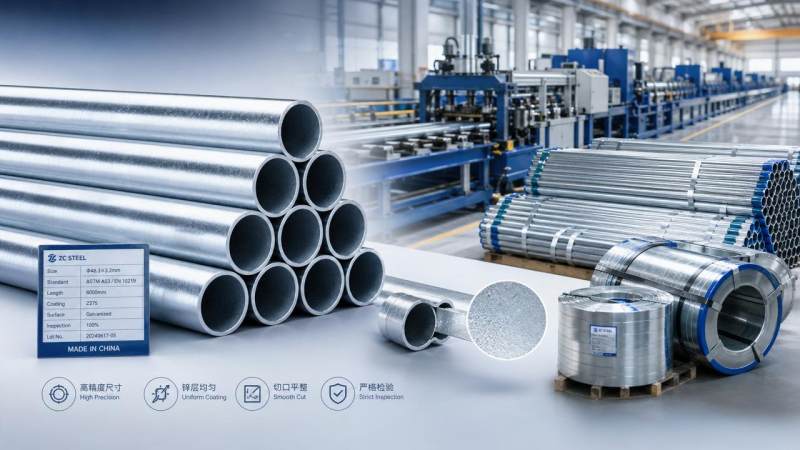
The first question to ask any galvanized pipe manufacturer is simple: what standards are you producing to, and how do you verify compliance? In steel procurement, vague answers are a warning sign. Buyers should request clear references to ASTM, EN, BS, JIS, or GB standards, along with details on steel grade, wall thickness range, zinc coating method, and inspection points.
A reliable supplier should be able to explain whether the pipe is produced by hot-dip galvanizing, pre-galvanizing, or another surface treatment route. This matters because coating performance, corrosion resistance, and service life can vary significantly. In many structural and outdoor applications, even a small deviation in coating thickness or adhesion can shorten usable life by several years in humid, marine, or industrial environments.
Procurement teams should also ask how raw materials are controlled. Good manufacturers usually track incoming steel by heat number, chemical composition, and mechanical properties. For example, it is common to review tensile strength, yield performance, dimensional tolerance, and surface condition before galvanizing. A supplier that cannot explain its incoming inspection process may also struggle with batch consistency during full-scale production.
Key technical questions to raise early
At the RFQ or pre-order stage, buyers should document technical questions instead of relying on verbal promises. This helps prevent specification drift between quotation, production, and shipment. It also makes internal approval easier when multiple procurement, engineering, and quality teams are involved.
- Which production standards apply to the galvanized pipe, and can the supplier provide mill test documentation for each batch?
- What is the available outside diameter range, wall thickness range, and length tolerance? Typical project orders may require tolerance control within agreed limits rather than commercial tolerance only.
- Is the galvanizing process hot-dip or pre-galvanized, and what coating requirement is normally supplied for export orders?
- How are weld seams, pipe ends, surface defects, and zinc layer uniformity inspected before packing?
These questions are especially relevant when the material will be used in scaffolding, fencing, fluid transfer, infrastructure support, or fabricated structural assemblies. In such applications, consistent geometry and coating quality can affect both site efficiency and downstream fabrication yield.
A practical comparison framework
The table below shows what procurement teams should compare when reviewing potential manufacturers. It can be used as a quick screening tool before moving to sample approval or trial orders.
The strongest suppliers are usually specific, not generic. If a galvanized pipe manufacturer can explain process details, tolerances, and inspection records within 1 or 2 business days, that is often a good indicator of operational maturity.
Can the manufacturer meet your quantity, customization, and delivery requirements?
The second major question is whether the supplier’s production setup matches your actual purchasing pattern. Some manufacturers are efficient only for high-volume standard pipe, while others are better at mixed-size export orders, cut-to-length requirements, or OEM fabrication. Procurement teams should confirm MOQ, monthly capacity, standard lead time, and flexibility for urgent schedules before placing a formal order.
Lead time should be broken down into at least 3 stages: raw material preparation, production and galvanizing, and packing plus shipment booking. For common export steel products, the total factory lead time may range from 15 to 35 days depending on size mix, coating route, and order volume. A supplier that only gives one headline delivery date without stage details may create avoidable planning risk.
Customization is another critical point. Many projects need more than standard pipe dimensions. Buyers may require special lengths, bundled packing, end treatment, marking, or compatibility with fabricated structural components. If the manufacturer also serves broader structural steel needs, that can simplify sourcing by combining pipe-related products with channels, beams, profiles, or custom parts under one supply plan.
Questions that reveal real delivery capability
A procurement checklist should test how well the manufacturer handles production planning, not just sales communication. Ask for examples of average lead time for one-container, two-container, and multi-specification orders. Also ask what happens if a zinc bath schedule changes, a raw material size becomes tight, or port booking is delayed by 5 to 7 days.
- What is the typical MOQ for standard galvanized pipe and for customized sizes?
- How many specifications can be mixed in one order without extending the lead time significantly?
- Can the supplier coordinate inspection, packing photos, and shipping documents within 48 to 72 hours before dispatch?
- What is the contingency process if production falls behind the agreed delivery week?
Manufacturers with export experience usually answer these questions in operational terms. That matters because delivery reliability is often more valuable than saving a small percentage on the quoted ton price.
Inserted product example for broader sourcing planning
For buyers managing multi-item steel procurement, it is useful to work with suppliers that can support related corrosion-resistant steel products beyond pipe alone. One example is Galvanized Round Steel, which is used in electric power towers, communication towers, railway systems, highway protection, street light poles, marine components, and building steel structure components.
This product is available in DC01 material with diameters from 16–250 mm or customized lengths, galvanized surface treatment, tensile strength of 570–820 MPa, and tolerance levels such as ISO h8 for diameters below 10.00 mm and ISO h9 for diameters above 10.00 mm. It also supports tighter tolerances on request, which is helpful for projects involving machining, stamping, or precision assemblies.
For procurement teams, the value of such products is not only technical. It also shows whether a supplier has broader processing capability, including straightening, milling and chamfering, ultrasonic inspection, packaging and marking, heat treatment options, and anti-mixing control. Those capabilities often reflect stronger manufacturing discipline across the supplier’s steel product range.
How does the supplier manage inspection, documentation, and export packaging?
Even when product quality is acceptable, poor documentation or weak packing can still create serious procurement problems. That is why buyers should ask a galvanized pipe manufacturer how inspection records are issued, how products are identified, and how export packing is designed for sea freight, inland trucking, or project-site unloading.
Inspection should cover more than visual appearance. Depending on project requirements, buyers may need dimensional checks, coating verification, surface review, weight control, marking confirmation, and quantity reconciliation by bundle. For many export orders, pre-shipment verification at 3 points is useful: after production, during packing, and before container sealing.
Documentation quality is equally important. Procurement personnel should confirm whether the supplier can prepare mill test certificates, packing lists, commercial invoices, certificates of origin if needed, and photo records. Delays in paperwork can hold customs clearance for several days, even if the cargo itself is ready on time.
What good export control looks like
The table below summarizes the documentation and packaging items that should be checked before confirming a steel order. This is especially useful when comparing a newer galvanized pipe manufacturer with a more experienced export-oriented supplier.
For steel cargo, packing quality is often underestimated. Pipes that shift during loading or unloading may suffer coating damage, end deformation, or quantity confusion. A supplier that provides clear loading plans and packing photos offers a higher level of control for overseas buyers.
Red flags buyers should not ignore
- No clear answer on whether test reports are based on actual batches or standard templates.
- Only generic promises about “good packing” without bundle method, labeling plan, or moisture protection details.
- Inability to confirm document timing, especially when original shipping papers are required within 3 to 5 days after vessel departure.
- No inspection photos, no bundle counts, and no pre-shipment communication from the factory side.
When these issues appear early, buyers should slow down and verify more carefully. In international steel procurement, weak process control usually shows up before the order is placed, not after.
Is the quoted price truly competitive when total procurement cost is considered?
Price matters, but experienced procurement professionals know that the lowest ex-works or FOB quote is not always the best purchasing decision. A competitive galvanized pipe manufacturer should offer value across at least 4 dimensions: compliant quality, stable lead time, efficient communication, and predictable after-sales handling. If one of those areas fails, the apparent savings can disappear quickly.
Total procurement cost includes more than steel price per ton. Buyers should evaluate scrap risk, delay exposure, re-inspection cost, packaging damage, container utilization, payment terms, and internal coordination time. For example, a 2% lower quote can be offset by a single delivery delay that causes site idle time or emergency local replenishment at a higher cost.
Another useful question is whether the supplier can help optimize order structure. A manufacturer familiar with export steel sourcing may recommend length combinations, bundle configurations, or product substitutions that improve loading efficiency and reduce wastage. Those adjustments often create more savings than aggressive unit-price negotiation alone.
How procurement teams should compare quotations
When reviewing offers from different suppliers, use a weighted evaluation approach instead of selecting by price rank only. This creates a stronger decision record and reduces the chance of choosing a high-risk supplier for a time-sensitive project.
A disciplined quotation review also helps in negotiations. Instead of asking only for a lower number, buyers can request measurable improvements such as shorter lead time, more precise tolerance control, stronger export packing, or better document turnaround.
Questions about commercial terms
Before final approval, procurement managers should confirm payment structure, claim handling process, and the timeline for replacement or corrective action if any issue is found. A well-prepared galvanized pipe manufacturer should define how discrepancies are reviewed and resolved within a practical response window, often 24 to 72 hours for initial feedback after evidence is submitted.
This is also where supplier professionalism becomes visible. Strong exporters typically provide clear communication, stable documentation, and realistic commitments rather than overly aggressive promises that become difficult to maintain once production starts.
What long-term partnership signals should buyers look for?
The best procurement outcomes usually come from suppliers that can support repeat business, not just a single shipment. When evaluating a galvanized pipe manufacturer, buyers should consider whether the supplier has the discipline to handle forecast planning, recurring specifications, technical changes, and multi-region compliance needs over time. This is especially important for distributors, EPC contractors, and manufacturers with ongoing steel consumption.
Long-term partnership strength often shows up in routine details. Does the supplier keep quotation records clear? Can the sales and technical teams answer consistently? Are changes in coating requirement, packing method, or delivery batch documented properly? If the manufacturer supports a wider structural steel portfolio, procurement teams may also gain consolidation benefits by sourcing compatible products from one coordinated supplier base.
Companies such as Hongteng Fengda, which focus on structural steel manufacturing and export from China, reflect the kind of supplier profile many global buyers look for: stable production capacity, compliance with widely used standards such as ASTM, EN, JIS, and GB, and the ability to support both standard specifications and OEM-oriented solutions. For procurement teams, this combination can reduce sourcing risk and improve supply continuity across multiple steel categories.
FAQ for procurement professionals
How many suppliers should be compared before selecting one?
For most project purchases, comparing at least 3 qualified suppliers is a practical starting point. That gives buyers enough visibility on price, lead time, and process quality without creating unnecessary evaluation burden. For high-value or recurring purchases, a shortlist of 4 to 5 suppliers may be more appropriate.
What delivery lead time is typical for export galvanized pipe?
A common factory lead time is around 15–35 days, depending on quantity, size range, and coating schedule. If the order includes customized lengths, mixed specifications, or third-party inspection, buyers should allow extra time and ask for milestone-based updates rather than one final ship date only.
Should buyers request samples or trial orders?
Yes, especially when working with a new galvanized pipe manufacturer. A sample review or small trial order can validate surface quality, tolerance control, document accuracy, and communication efficiency before larger commitment. This is often a low-cost way to reduce risk in international steel sourcing.
What is the most common procurement mistake?
A frequent mistake is choosing based on price without verifying specification clarity and delivery control. In steel purchasing, incomplete technical confirmation is one of the fastest ways to create claims, delays, or rework. The better approach is to align standard, dimensions, coating, packing, and documents before deposit payment.
Choosing the right galvanized pipe manufacturer requires more than checking a quotation sheet. Buyers should verify standards, coating process, capacity, lead time, inspection practice, export packing, and total procurement cost before placing an order. The most dependable suppliers combine technical clarity, production discipline, and responsive service, helping procurement teams reduce supply risk while supporting project performance.
If you are sourcing structural steel products or need a reliable export partner for customized steel solutions, working with an experienced manufacturer can simplify quality control and delivery planning across your supply chain. To discuss your requirements, request product details, or obtain a tailored sourcing solution, contact us today and learn more about available steel product options for your next project.
Please give us a message


Please enter what you want to find