When selecting pipe stainless or carbon steel for wet environments, project teams must balance corrosion resistance, lifecycle cost, and structural performance.
The right choice reduces maintenance, avoids early failure, and improves reliability in coastal, industrial, and humid conditions.
This guide answers common questions about pipe stainless versus carbon pipe, helping you compare materials by exposure level, budget, and service expectations.
What makes pipe stainless different from carbon pipe in wet environments?
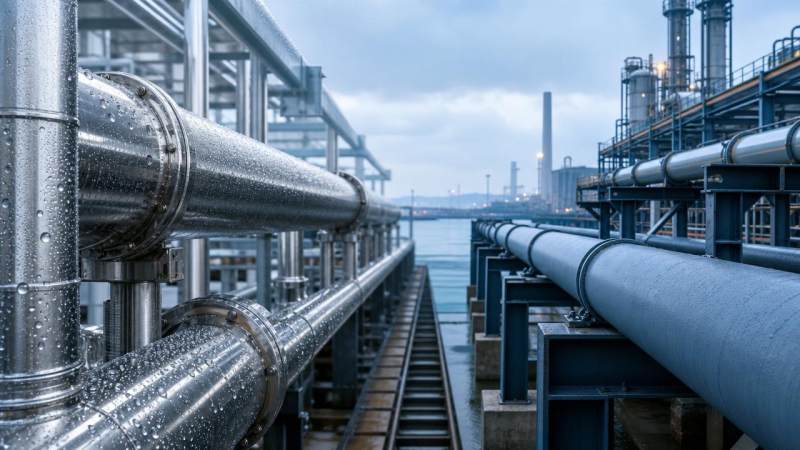
The main difference is corrosion behavior. Pipe stainless contains chromium, which forms a passive layer that helps resist rust when moisture is present.
Carbon pipe has no comparable self-healing surface. In wet service, it usually depends on paint, galvanizing, lining, or regular maintenance.
This does not mean carbon steel is weak. It often offers good strength, broad availability, and lower initial material cost.
However, pipe stainless usually performs better where water, condensation, salt spray, or chemical residue remain on the surface for long periods.
In simple terms, pipe stainless is selected for resistance first, while carbon steel is often selected for economy first.
Which wet conditions favor pipe stainless most clearly?
Not all wet environments are equal. Light indoor humidity creates different risks than seawater splash zones or chemical washdown lines.
Pipe stainless is usually the stronger option in the following conditions:
- Coastal projects exposed to salt-laden air
- Food, beverage, or pharmaceutical areas with frequent cleaning
- Water treatment facilities with constant splash or condensation
- Industrial plants where moisture combines with mild chemicals
- Outdoor systems where standing water cannot be avoided
In these settings, corrosion can spread faster than expected on unprotected carbon steel, especially at welds, cut edges, and damaged coatings.
Pipe stainless also fits areas where surface appearance matters, because staining and rust marks can create quality or hygiene concerns.
Can carbon pipe still work well in damp or wet service?
Yes, carbon pipe can work very well when the exposure is moderate and protection systems are correctly designed and maintained.
Typical protection methods include hot-dip galvanizing, epoxy coatings, internal linings, insulation barriers, and scheduled inspection.
For indoor utility lines, structural supports, or low-corrosion industrial zones, carbon steel may deliver acceptable performance at lower upfront cost.
The key issue is not whether carbon steel can survive moisture. The issue is how much maintenance the system will need over time.
If coatings are scratched, bolted joints trap water, or drainage is poor, corrosion risk increases quickly.
So carbon pipe remains practical, but it demands more discipline in detailing, surface treatment, and follow-up care.
How should you compare lifecycle cost, not just purchase price?
Many buying decisions focus only on the first quotation. That approach can be misleading in wet environments.
Pipe stainless usually costs more at the beginning. Yet it may lower total ownership cost by reducing repainting, shutdowns, inspection labor, and replacement frequency.
Carbon pipe often wins on initial budget. Still, repeated coating repair and corrosion-related downtime can narrow that advantage over several years.
A practical comparison should include these factors:
- Material and fabrication cost
- Surface protection cost
- Inspection frequency
- Expected maintenance labor
- Service life before replacement
- Risk of leakage, contamination, or staining
Where access is difficult, pipe stainless often gains value because maintenance work itself becomes expensive and disruptive.
What technical risks are often missed when choosing pipe stainless or carbon steel?
One common mistake is assuming all stainless grades perform equally. In chloride-rich conditions, grade selection matters greatly.
Another mistake is believing carbon steel protection lasts forever. Coatings age, suffer impact damage, and fail earlier at joints and field cuts.
Poor drainage is another hidden problem. Even pipe stainless can suffer when crevices hold contaminated water for long periods.
Fabrication quality also affects results. Rough welds, trapped moisture, dissimilar metal contact, and contaminated surfaces increase corrosion risk.
Environmental details should always be checked before final selection:
- Is exposure continuous, intermittent, or splash-based?
- Does water contain salt, chlorine, or cleaning chemicals?
- Will the pipe be insulated, buried, or hard to inspect?
- Are welds and supports likely to retain water?
These questions often matter more than the basic stainless-versus-carbon label.
How do you decide which option fits your project better?
A simple decision path can make selection easier. Start with exposure severity, then review maintenance access, design life, and cost tolerance.
Choose pipe stainless when corrosion resistance is mission-critical, cleaning is frequent, appearance matters, or failure consequences are high.
Choose protected carbon steel when the environment is only mildly wet, budgets are tight, and inspection access is easy.
If conditions are uncertain, compare both options using a service-life model rather than only a material price sheet.
What is the most practical conclusion for wet-environment steel selection?
If the environment is truly wet, corrosive, or difficult to maintain, pipe stainless usually fits better and lasts with fewer interventions.
If moisture is limited and protective systems are realistic, carbon steel can still be the economical answer.
The best decision comes from matching exposure, grade, coating strategy, fabrication quality, and expected service life.
For broader steel structures around wet-service piping, supporting members should be assessed with the same logic.
For example, Carbon Steel Angle is widely used in construction, fabrication, framework, bracing, corner reinforcement, shipbuilding, bridging, and automobile chassis applications.
It is available in equal or unequal shapes, thicknesses from 0.8mm to 25mm, lengths from 1m to 12m, and processing options such as hot rolled, cold drawn, bending, and welding.
With compliance options including ASTM, EN, JIS, and GB, this structural solution can support wet-environment projects when proper corrosion protection is included.
Review the full specification of Carbon Steel Angle to coordinate piping, supports, and structural steel within one practical sourcing plan.
Please give us a message


Please enter what you want to find