When sourcing structural steel, the discussion around mill MOQ vs trader MOQ steel has a direct impact on total landed cost, stock pressure, delivery rhythm, and project flexibility. A lower offer price does not always mean a lower final cost, because minimum order quantity affects freight utilization, packaging, warehouse turnover, cash flow, and the ability to match exact project specifications. In steel purchasing, the smarter choice often comes from understanding where mill MOQ creates scale advantages and where trader MOQ reduces operational friction.
Understanding mill MOQ vs trader MOQ steel in practical terms
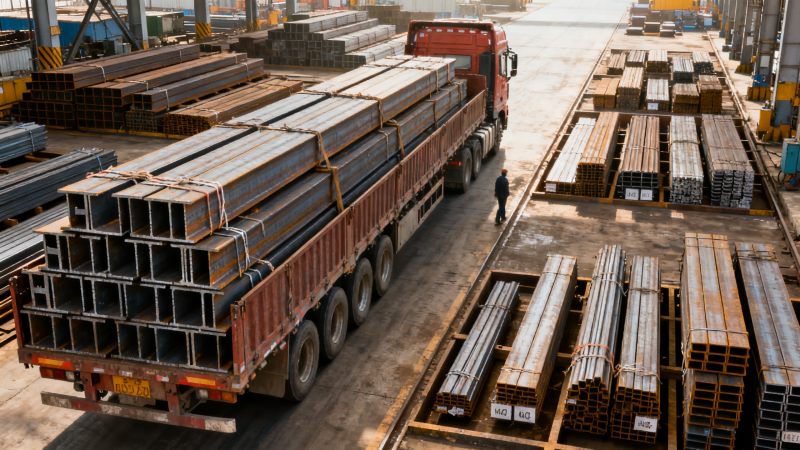
In the structural steel industry, MOQ means the minimum quantity a supplier is willing to produce or sell under a given price structure. In the context of mill MOQ vs trader MOQ steel, a mill usually refers to the original producer, while a trader works as a stockholder, distributor, or intermediary that can split, combine, or reallocate inventory from multiple sources.
Mill MOQ is generally higher because production lines are optimized for long rolling runs, stable material grades, and efficient batching. A steel mill may require a certain tonnage per size, grade, or section to keep conversion cost under control. Trader MOQ is often lower because stock is already available, mixed loading is possible, and the trader can serve smaller demand with existing warehouse inventory.
However, the comparison in mill MOQ vs trader MOQ steel is not simply “high MOQ versus low MOQ.” The real issue is how MOQ changes the full cost structure: ex-works price, inland transport, port handling, ocean freight efficiency, quality consistency, lead time risk, and inventory holding cost after arrival.
Why MOQ has become a key cost variable in structural steel sourcing
Steel buyers today face more volatile freight rates, tighter project schedules, and wider specification diversity than in the past. That makes mill MOQ vs trader MOQ steel a strategic issue rather than a simple purchasing detail. For standard sections such as angle steel, channel steel, beams, and cold formed profiles, MOQ often determines whether a purchase is cost-efficient or operationally burdensome.
Several market signals explain why MOQ matters more now:
- Projects increasingly require mixed sizes, mixed grades, and staged delivery.
- Ocean freight rewards container or breakbulk utilization, so underfilled shipments raise per-ton cost.
- Warehousing, financing, and insurance costs make excess inventory more expensive.
- Certification and compliance needs favor reliable mills, but flexibility often comes from traders.
- Customization such as cutting length, coating, or special grades may shift the ideal MOQ threshold.
How mill MOQ vs trader MOQ steel changes total landed cost
The biggest mistake in evaluating mill MOQ vs trader MOQ steel is focusing only on quoted price per ton. Total landed cost includes all expenses from factory to final use point. In many cases, a lower mill price can become more expensive if the order exceeds actual project consumption, ties up capital, or requires additional warehouse handling.
A direct mill order often makes sense when sizes are standard, tonnage is stable, and shipment planning can fully utilize a container or vessel space. For example, repeated demand for beam sections under ASTM, EN, JIS, or GB standards can justify mill MOQ because production consistency and scale pricing improve the overall supply equation.
By contrast, trader MOQ can reduce hidden cost when the requirement includes many sizes in low volume, urgent replenishment, or partial loads. Instead of overbuying one size to satisfy a mill’s rolling minimum, a trader can consolidate multiple profiles into a practical shipment lot. That may raise the invoice price per ton but lower the final cost per usable ton.
A useful example is H Section Beam sourcing for steel structures, shipbuilding, bridging, and automobile chassis. This product is available in grades such as Q235, Q345B, Q460C, SS400, S275JR, S355JR, A572, and A992, with flange thickness from 8-64mm, web thickness from 5-36.5mm, flange width from 50-400mm, web width from 100-900mm, and length from 1m-12m or as required. For recurring projects with standard hot rolled specifications and certifications including JIS G3101, EN10025, ASTM A36, ASTM A572, and ASTM A992, mill MOQ can support better base pricing. But when the order requires mixed dimensions, shorter lengths, or a balance between light weight and strong bending resistance across multiple applications, trader MOQ may deliver lower total operating cost.
Main cost levers to compare
- Price per ton versus price per usable ton
- Container fill rate and freight efficiency
- Storage time before installation or resale
- Capital occupation and payment terms
- Rework, cutting loss, and non-moving stock risk
Typical sourcing scenarios in structural steel
The best answer to mill MOQ vs trader MOQ steel depends on demand pattern rather than theory. In structural steel, the following scenarios are common and each favors a different route.
For structural applications, supply reliability is often as important as initial price. A manufacturer and exporter with stable production capacity, major international standard compliance, and customized processing capability can reduce sourcing risk when the order is substantial and technically defined. On the other hand, smaller lots or diversified project schedules often benefit from the lower commitment of trader MOQ.
Practical evaluation framework before placing steel orders
A sound comparison of mill MOQ vs trader MOQ steel should use a full-cost decision model. This avoids choosing the lowest visible quote while missing major downstream expenses. For steel beams, channels, angles, and cold formed sections, the evaluation should combine technical fit, logistics efficiency, and commercial flexibility.
Checklist for decision quality
- Confirm actual consumption by size, grade, and delivery phase.
- Calculate landed cost under both MOQ structures, including freight and warehousing.
- Check whether mixed loading can improve shipment utilization.
- Review standards, mill certificates, and traceability requirements.
- Assess whether processing such as cutting, galvanizing, or custom length is needed.
- Compare lead time certainty, not only nominal production days.
- Measure the cost of slow-moving stock if the order exceeds near-term demand.
In many cases, the best result is not purely mill or purely trader. A split strategy can work well: standard high-volume sections are purchased against mill MOQ, while non-standard, low-volume, or urgent items are sourced through trader MOQ. This balanced approach improves both price discipline and supply responsiveness.
What to do next when comparing supply options
The real value of understanding mill MOQ vs trader MOQ steel lies in making cost decisions that align with project rhythm, not just with quotations. Start by mapping demand into standard repeat items, mixed low-volume items, and urgent buffer items. Then request parallel offers that show MOQ assumptions, standards, processing scope, lead time, and packing method clearly.
For structural steel sourcing from China, it is also useful to work with suppliers that combine manufacturing strength, export experience, and customization support. This helps align product quality, documentation, and shipping execution across markets in North America, Europe, the Middle East, and Southeast Asia. Where standard sections and OEM requirements exist together, a reliable supply partner can reduce the gap between mill efficiency and trader flexibility.
In short, mill MOQ vs trader MOQ steel is a total-cost decision. Mill MOQ often wins on scale and consistency, while trader MOQ often wins on flexibility and inventory control. The better choice is the one that minimizes waste, matches specification needs, protects delivery timing, and keeps structural steel procurement economically efficient from order placement to final use.
Please give us a message


Please enter what you want to find