When comparing mill MOQ vs trader MOQ steel, small-order buyers often face a trade-off between lower unit cost and greater purchasing flexibility. For distributors, agents, and stockists, understanding these differences is key to reducing inventory pressure, improving cash flow, and responding faster to customer demand. This article explains which option fits small orders better and how to choose the right sourcing model.
Why MOQ comparison matters in structural steel sourcing
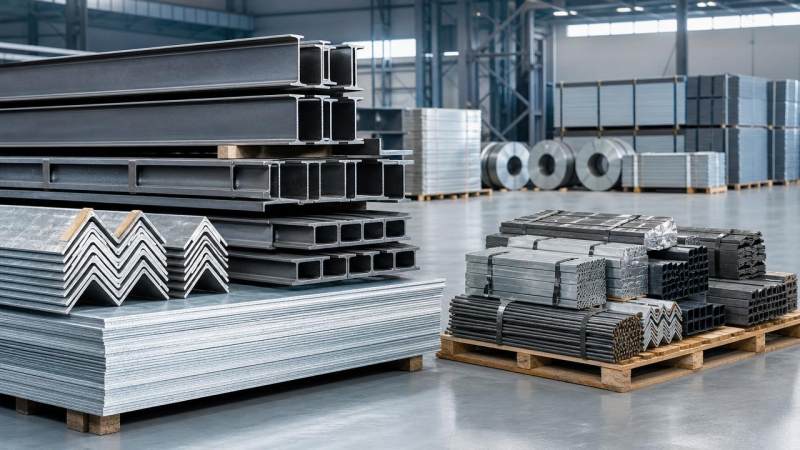
In steel purchasing, MOQ means the minimum order quantity a supplier is willing to accept. The real question behind mill MOQ vs trader MOQ steel is not simply “who sells cheaper,” but “which channel matches the order size, delivery urgency, processing needs, and stock risk.” For small-volume orders, the wrong choice can create excess inventory, delayed delivery, or a unit cost that erodes margin.
This is especially important in structural steel, where products such as angle steel, channel steel, steel beams, cold formed steel profiles, and customized components often vary by grade, length, coating, and standard. A mill may prefer full-size production runs for efficiency, while a trader may split stock and support mixed specifications. That difference sits at the center of the mill MOQ vs trader MOQ steel decision.
For global steel buyers, MOQ affects more than order quantity. It influences packaging, shipping mode, customs cost allocation, production lead time, and whether customized fabrication is practical. A clear comparison helps reduce sourcing errors and supports better planning for small projects and fast-moving demand.
A practical checklist for choosing between mill MOQ and trader MOQ steel
Use the following checklist before placing a small steel order. It helps identify whether direct mill supply or trader stock supply is the better fit.
- Check your real required quantity by item, grade, and size, not only total tonnage, because small mixed orders may look large overall but still fail a mill’s MOQ per specification.
- Compare total landed cost instead of ex-works price alone, since mill MOQ vs trader MOQ steel often shifts freight efficiency, packing charges, documentation cost, and warehouse handling.
- Confirm lead time tolerance before choosing a source, because mills may need production scheduling while traders can often supply available stock faster for urgent shipments.
- Review whether customization is essential, including cutting, punching, special lengths, coating, or drawing-based fabrication, since this can favor either a mill or an experienced processing supplier.
- Assess inventory pressure after arrival, because a low mill price becomes expensive if excess steel remains unsold or tied up in storage for months.
- Verify standard compliance by market, such as ASTM, EN, JIS, or GB, because substitute stock from traders may be acceptable in some cases but not in all regulated projects.
- Ask how many SKUs can be consolidated into one shipment, since trader MOQ models often support mixed loading better than a mill-focused production order.
- Calculate the cash flow effect of payment terms, deposit ratio, and replenishment frequency, because small steel sourcing decisions are often financial decisions as much as pricing decisions.
When mill MOQ works better
Direct mill supply usually becomes attractive when the order is large enough to meet production efficiency requirements. In the mill MOQ vs trader MOQ steel comparison, mills often offer stronger unit pricing for repeat orders, standard sizes, and steady-volume demand. If the same beam, channel, or angle specification will be reordered regularly, the higher MOQ may be justified by lower cost per ton.
Mill sourcing can also be ideal when quality traceability, mechanical property consistency, and customized production are central to the order. A qualified structural steel manufacturer with modern facilities and strict quality control can support standard-compliant production under ASTM, EN, JIS, or GB requirements while maintaining stable output and dependable delivery schedules.
When trader MOQ works better
Trader supply generally fits small orders better when flexibility matters more than the absolute lowest factory price. In many mill MOQ vs trader MOQ steel cases, traders can split inventory, combine multiple sizes, and ship faster from stock. This is useful when demand is uncertain, projects are fragmented, or customers require several items in modest quantities.
A trader MOQ model can also reduce operational complexity. Instead of reaching several mill minimums across different profiles, buyers may purchase a mixed bundle from one source. The price per ton may be higher, but the reduced stock burden and faster turnover can improve overall profitability.
Key cost factors that change the result
The best answer to mill MOQ vs trader MOQ steel often changes once hidden costs are included. Small orders are sensitive to every extra handling step, so a structured cost review is essential.
- Production setup cost: mills spread setup cost across larger output, so very small runs may carry a surcharge or may not be accepted at all.
- Stock premium: traders charge for inventory holding, but that premium may be cheaper than buying excess tonnage from a mill.
- Freight utilization: full-container or bulk efficiency can favor mills, while partial loads and mixed products often favor traders.
- Cutting and processing fees: stock-based supply may include easier access to cut-to-length or small fabrication support.
- Capital occupation: larger orders may lower price but increase cash tied up in slow-moving steel stock.
For example, a small order of galvanized steel components for light construction may not justify full-mill production. In such cases, an insertive product option like Galvanized Expanded Metal Sheet can fit flexible sourcing needs when applications require corrosion resistance, customizable dimensions, and compliance with standards such as ASTM, DIN, JIS, GB, and EN. Available in grades including DX51D+Z, SGCC, and S350GD+Z, with thickness from 0.12mm to 6.00mm and zinc coating from 60g/m² to 275g/m², this type of product illustrates how specification flexibility can influence the mill MOQ vs trader MOQ steel decision. When mixed widths, shorter lengths, or varied end-use sectors are involved, stock availability and customization support become highly practical advantages.
How the decision changes by order scenario
Scenario 1: Small repetitive orders of standard structural steel
If order sizes are small today but stable and repetitive over time, direct mill cooperation can still make sense. The key is to discuss rolling forecasts, call-off delivery, or consolidated production planning. In this version of mill MOQ vs trader MOQ steel, the buyer does not necessarily need all tonnage shipped at once, but production can be arranged more efficiently when demand visibility is clear.
Scenario 2: Mixed specifications for distribution stock
When the order includes multiple SKUs with uneven demand, trader MOQ often performs better. Mixed lots reduce the need to commit to full MOQ per size. This matters for stockists who need breadth of inventory rather than deep stock of one item. Here, mill MOQ vs trader MOQ steel becomes a question of assortment efficiency.
Scenario 3: Urgent project replenishment
For urgent replenishment, traders usually have the edge because stock can move immediately. Even if direct mill pricing is lower, production lead time may create project delay costs that far exceed the savings. In urgent orders, the practical winner in mill MOQ vs trader MOQ steel is often the source that can ship now.
Scenario 4: Customized steel components
Custom components require a more careful review. If the requirement involves dedicated fabrication, mechanical property control, or drawing-based production, a capable mill or integrated manufacturer-exporter may be superior. If customization is limited to simple cutting or splitting, a trader with processing support may still be enough. The answer depends on technical depth, not only MOQ.
Commonly overlooked risks in mill MOQ vs trader MOQ steel
One overlooked risk is assuming that lower ex-works price means lower final cost. It often does not. Extra stock, extra storage time, and slower turnover can turn a cheap mill order into an expensive sourcing decision.
Another common issue is ignoring specification-level MOQ. A supplier may accept the total tonnage, but still require a minimum for each grade, size, or thickness. This creates mismatched inventory and can force substitution later.
Documentation is also easy to underestimate. For export steel orders, mill test certificates, coating data, dimensional tolerances, and standards compliance should be verified before ordering. In a mill MOQ vs trader MOQ steel comparison, traceability requirements can quickly change the preferred option.
Finally, some buyers overlook supplier reliability under changing demand. Stable production capacity, consistent quality, and dependable lead times matter just as much as MOQ. A flexible order means little if replenishment performance is inconsistent.
Action steps for better small-order steel sourcing
- List required steel items by exact specification and forecast actual consumption over the next one to three purchasing cycles.
- Request both mill-direct and trader-based quotations using the same technical details and delivery destination.
- Calculate final cost per usable ton, including freight, cut charges, storage burden, and expected slow-moving inventory risk.
- Check whether standard compliance, mechanical properties, coating thickness, or dimensional tolerance require closer mill-level control.
- Choose the sourcing model that protects cash flow and delivery reliability, not only the one with the lowest nominal steel price.
Final answer: which fits small orders better?
In most cases, trader supply fits small orders better because it offers lower quantity thresholds, mixed-specification flexibility, and faster dispatch. That is the short answer to mill MOQ vs trader MOQ steel. However, if demand is repeatable, specifications are standardized, and future volume can be planned, direct mill sourcing may deliver stronger long-term value.
The best decision comes from comparing total cost, delivery timing, customization needs, compliance requirements, and inventory risk together. In structural steel sourcing, the right MOQ model is the one that aligns purchasing quantity with real market movement. A reliable Chinese structural steel manufacturer and exporter with broad product capability, international standards compliance, and customization support can help balance both efficiency and flexibility, especially when orders may scale from small trial volumes to long-term supply.
If the goal is to reduce sourcing risk while keeping options open, start with a specification-by-specification review, request alternative MOQ paths, and compare direct production versus stock-based supply on a landed-cost basis. That approach turns the mill MOQ vs trader MOQ steel question into a clear and profitable sourcing decision.
Please give us a message


Please enter what you want to find