For financial decision-makers, relying on rough tables or manual estimates can turn a steel purchase into a budgeting risk. An accurate I beam weight calculator helps prevent cost overruns, quotation errors, and unexpected freight expenses. In this article, we explain why manual calculations often fall short and how precise weight data supports better purchasing control, supplier evaluation, and project cost planning.
Why the Real Search Intent Behind “I Beam Weight Calculator” Is About Cost Control
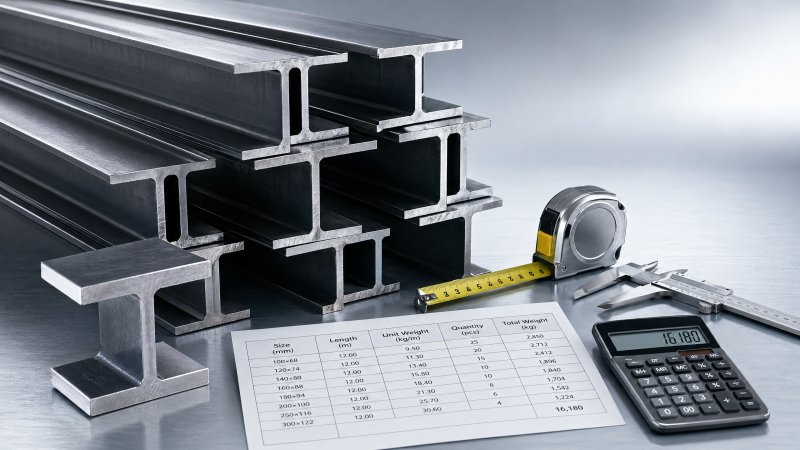
When someone searches for an I beam weight calculator, they are rarely looking for a math lesson. In most business settings, especially for finance approvers, procurement managers, and project controllers, the real goal is to understand how beam weight affects total project cost. Weight is directly tied to steel pricing, transport charges, loading plans, import duties, storage handling, and even installation budgeting.
This is why manual estimates often create problems. A rough number may seem acceptable during early budgeting, but even a small weight deviation multiplied across dozens or hundreds of beams can distort the purchase value significantly. For financial teams, that means inaccurate approvals, weak cost forecasts, and avoidable disputes between procurement, engineering, and suppliers.
An I beam weight calculator is valuable because it turns a technical specification into a commercial control tool. Instead of approving a quotation based on assumptions, decision-makers can verify whether the supplied tonnage, unit price basis, and logistics budget are realistic. In other words, accurate beam weight is not just an engineering detail. It is a budgeting safeguard.
Why Manual I Beam Weight Estimates Often Miss the Mark
Manual estimating usually fails for one of four reasons: incomplete dimensions, confusion between nominal and actual sizes, overlooked standard differences, and oversimplified assumptions. Many buyers use handbook values, old spreadsheets, or memory-based approximations. These methods may work for very simple checks, but they are often too weak for final commercial decisions.
The first issue is dimensional mismatch. Two I beams may look similar on paper but have different flange thickness, web thickness, root radius, or section height depending on the standard used. ASTM, EN, JIS, and GB profiles are not interchangeable just because the beam designation appears close. If a finance team approves a budget based on a “comparable” section instead of the exact one, the downstream variance can be meaningful.
The second issue is that manual estimation often ignores procurement reality. Buyers may estimate by theoretical weight, while the supplier quotes by actual section mass under a specific standard. Freight forwarders may then calculate shipping based on gross packed weight, not just net steel weight. As a result, the final landed cost can exceed internal approval assumptions even when the supplier did nothing wrong.
The third issue is scale. On one beam, a small error looks harmless. On a full order for industrial buildings, warehouse structures, support frames, or export containers, the error compounds quickly. That affects not only steel cost but also transport planning, crane allocation, and container loading efficiency. For finance teams, this means an estimate that looked “close enough” can still be commercially unreliable.
What Financial Approvers Should Check Before Trusting a Weight Figure
Financial decision-makers do not need to calculate every beam manually, but they do need a practical framework for validating numbers. The first question is simple: what standard is the beam based on? If the quotation says I beam, H beam, universal beam, or wide flange beam, the exact profile family and applicable standard must be stated clearly. Without that, the weight figure is only a placeholder.
The second question is whether the weight is theoretical weight per meter or total supplied weight. These are not the same thing in a commercial review. A supplier may provide kilograms per meter, while the buyer internally budgets per piece, per bundle, or per shipment. Unless these units are aligned, a perfectly correct technical figure can still create budgeting confusion.
The third check is quantity logic. Ask whether the total tonnage matches the number of pieces, cut lengths, and project scope. If a quote contains a suspiciously round total weight, it may be based on broad assumptions rather than exact takeoff. A good I beam weight calculator supports line-by-line verification, helping finance teams identify whether a quotation reflects real production data or just an approximate commercial estimate.
The fourth check is whether secondary costs are linked to that weight. Transport, export packing, insurance, and unloading costs may all change when tonnage shifts. An accurate beam calculation is useful only if the related commercial costs are updated at the same time. This is where many approvals fail: the beam weight changes, but the financial model does not.
How Accurate Weight Data Improves Purchasing and Supplier Evaluation
Precise weight information improves purchasing in several ways. First, it creates a fair comparison between suppliers. One supplier may quote a lower unit price but on a heavier section; another may quote a higher price on a lighter but equivalent profile. Without accurate weight normalization, the finance team may approve the cheaper-looking quote that actually costs more per functional requirement.
Second, accurate data improves negotiation strength. When buyers understand section weight clearly, they can challenge vague quotations, verify tonnage assumptions, and ask suppliers to explain standard selection. This reduces the chance of paying for unnecessary material mass or absorbing hidden logistics inefficiencies. Clear numbers also speed up internal approval because commercial reviewers can see the basis for the quote.
Third, reliable weight calculation helps identify sourcing risk. A capable structural steel manufacturer should be able to provide exact section data, standard compliance information, and transparent tonnage calculations. That level of detail is often a sign of production discipline and export readiness. For international buyers, especially those sourcing from multiple regions, this reduces the risk of discrepancies between quote, production, and shipment.
For example, companies sourcing structural steel for industrial or commercial projects often buy across categories, not just beams. In those cases, consistent weight-based costing matters across the full package. Even lightweight cladding materials can influence transport planning and cost structure. Products such as Color Coated Galvalume Steel Sheet PPGL are often selected because they combine lighter weight with high corrosion resistance, good heat resistance, and long service life, which can improve both budget efficiency and lifecycle value in warehouses, factories, public buildings, and agricultural structures.
Where Manual Estimates Create the Biggest Budgeting Risks
The biggest budgeting risk usually appears in freight. Steel is heavy, and freight costs are highly sensitive to tonnage, loading density, and packaging method. A manual estimate may be acceptable for a concept budget, but once a project moves toward purchasing, small miscalculations can change container quantity, truck allocation, or vessel booking requirements. That shift can erase the apparent savings of a low quote.
Another common risk is quotation comparison. Finance teams often receive multiple offers with different terms, standards, and scope assumptions. If one supplier includes exact beam weight and another uses a simplified estimate, the offers are not directly comparable. Approving on headline price alone can lead to later variation claims, revised freight charges, or costly internal rework.
There is also a compliance risk. International projects often require steel that meets ASTM, EN, JIS, or GB standards. If the original estimate uses the wrong profile table, the projected weight may not match the compliant section required by the project. In that case, the budget is not just inaccurate; it is based on the wrong product. For finance approvers, this can lead to underfunded procurement or delayed re-approval cycles.
Finally, manual estimates can distort inventory and cash flow planning. If actual delivered tonnage is higher than approved, the purchasing team may need additional payment authorization. If it is lower due to wrong assumptions, project execution may be delayed while missing material is reordered. Either way, avoidable uncertainty enters the financial plan.
What a Reliable I Beam Weight Calculator Should Help You Do
A useful I beam weight calculator should do more than output a number. It should help the user identify the correct beam standard, convert dimensions into weight per meter accurately, and estimate total tonnage based on quantity and cut length. For finance users, the ideal tool also makes it easier to connect weight with total commercial impact, including freight and handling assumptions.
It should also reduce ambiguity. If a calculator cannot distinguish between beam families or does not clearly state the basis of calculation, it may create false confidence rather than useful control. Reliable tools should support specification clarity, not hide it. The most helpful outputs are those that can be cross-checked directly against supplier quotations, drawings, and bill-of-material lists.
In practice, the best approach is to combine digital calculation with supplier confirmation. A calculator is excellent for verification, benchmarking, and internal approval review. But before final commitment, the weight should still match the manufacturer’s exact section data and production standard. This is particularly important for export orders, where packing configuration and shipment planning also affect final cost.
A Practical Approval Checklist for Finance Teams Reviewing Steel Purchases
First, confirm the exact beam designation and standard. Do not approve based on generic wording such as “I beam” alone. The profile series, dimensions, and standard must be visible. Second, verify the unit of quotation: per ton, per meter, per piece, or per shipment. Approval problems often begin when different departments review the same quote through different units.
Third, compare calculated weight against supplier-stated weight. If the variance is material, ask why. The answer may be valid, but it should be documented before approval. Fourth, check whether freight, packing, and insurance assumptions use the same tonnage basis. A strong procurement file links these numbers consistently instead of treating them as separate line items.
Fifth, evaluate whether the supplier shows enough technical and commercial transparency. Manufacturers with modern production systems and experience in global markets are usually better positioned to provide consistent weight data, standard-compliant products, and dependable lead times. For buyers sourcing structural steel internationally, this matters as much as the quoted price.
Finally, keep a record of approved calculation logic. This reduces future disputes and improves repeat purchasing efficiency. When internal teams can trace how a beam weight figure was validated, they can approve faster, negotiate better, and build more reliable cost models for upcoming projects.
Conclusion: Accurate Beam Weight Is a Financial Control, Not Just a Technical Detail
For financial approvers, the value of an I beam weight calculator lies in risk reduction. It helps prevent underbudgeting, overpaying, and freight surprises. Manual estimates often miss the mark because they overlook exact standards, real dimensions, and the commercial consequences of tonnage differences.
The most important takeaway is simple: accurate weight data improves decision quality. It supports cleaner supplier comparisons, stronger purchasing control, better logistics planning, and more reliable project budgeting. In steel sourcing, especially across international markets, the teams that validate weight carefully are usually the ones that control cost more effectively.
If a quotation depends on beam tonnage, do not treat the weight figure as a minor technical note. Treat it as a core financial variable. That mindset leads to better approvals, fewer surprises, and more confident steel purchasing decisions.
Please give us a message


Please enter what you want to find