Choosing the right steel wire rope supplier is not just about price—it depends on your application, quality requirements, delivery expectations, and long-term sourcing risk. For procurement teams in construction, industrial, and manufacturing sectors, comparing suppliers by use case helps identify the most reliable option, improve project efficiency, and avoid costly supply issues before they affect performance.
What should procurement teams compare first when reviewing a steel wire rope supplier?
The first comparison point is not the quotation sheet but the intended use case. A steel wire rope supplier that performs well for light-duty handrail projects may not be suitable for hoisting, port handling, mining, or heavy construction lifting. Procurement professionals usually reduce risk by matching supplier capability with service environment, load category, safety factor expectations, and replacement cycle. In most industrial buying processes, 4 to 6 core checks are enough to eliminate weak candidates before technical review goes deeper.
Start with application fit, then review material consistency, dimensional control, documentation, and delivery reliability. If the rope will be exposed to outdoor moisture, cyclic loading, or corrosive conditions, coating and surface treatment become critical. If the rope is used in cranes or lifting assemblies, tensile performance, fatigue resistance, and traceable inspection records often matter more than unit price. A procurement team that compares suppliers only on cost may save 3% to 8% upfront but face much higher replacement, downtime, or safety-related costs later.
Supplier type also matters. Some suppliers are traders focused on price aggregation, while others are mills or integrated manufacturers with better process control, shorter feedback loops, and stronger customization support. For global buyers sourcing from China, this difference can affect lead time by 2 to 4 weeks, especially when the order includes non-standard diameter, packaging, or testing requirements.
A practical first-round screening checklist
- Does the steel wire rope supplier serve your exact application category, such as lifting, marine, construction, barrier systems, or industrial manufacturing?
- Can the supplier provide standard compliance documents, mill test data, or dimensional tolerance records for each batch?
- What is the usual production and shipment cycle, such as 10 to 20 days for stock items or 25 to 45 days for custom production?
- Is there support for OEM, labeling, packaging, or destination-specific export documentation?
- How does the supplier handle quality claims, re-inspection requests, and replacement discussions?
This screening stage is where experienced buyers save time. It is usually better to shortlist 3 suppliers with strong use-case alignment than to compare 10 suppliers with mixed capability. In steel sourcing, a narrower, more relevant comparison often leads to better procurement outcomes and fewer surprises after order confirmation.
Quick comparison table for initial supplier evaluation
The table below helps procurement teams compare a steel wire rope supplier based on decision factors that usually affect quality, schedule, and total sourcing cost.
A good steel wire rope supplier should score consistently across all four areas, not just one. The most common problem in international steel procurement is that a supplier looks competitive in price but loses points in response time, documentation quality, or delivery consistency.
How do use cases change the way you compare supplier options?
Use case changes almost everything in supplier evaluation. In procurement, the same rope diameter may be acceptable in two different projects, yet the qualification criteria can still differ because working load, duty cycle, bending frequency, weather exposure, and inspection intervals are not the same. This is why a steel wire rope supplier should be assessed through the lens of where and how the product will perform over time.
For example, construction lifting applications generally prioritize tensile integrity, traceable quality control, and dependable replenishment in case of urgent site demand. Barrier, railing, or architectural support systems may prioritize surface finish, corrosion resistance, dimensional consistency, and visual uniformity across batches. Industrial manufacturing environments may focus more on repeat purchase stability, packaging method, and compatibility with downstream fabrication or assembly workflows.
For procurement teams handling several steel categories, it is useful to source from partners who understand adjacent structural applications, not only standalone wire rope. In many projects, wire rope selection connects with broader steel systems such as support structures, rails, brackets, or fabricated components. That is why some buyers prefer suppliers or export partners with wider structural steel experience and the ability to coordinate multiple product lines under one delivery plan.
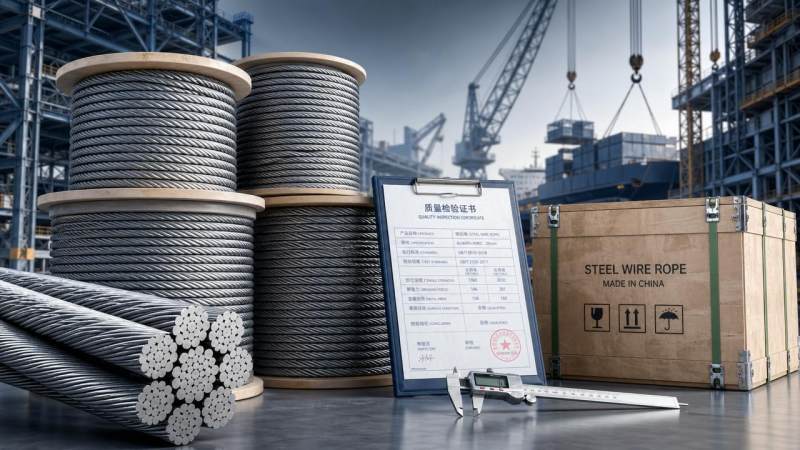
Typical use-case priorities
The following table shows how procurement priorities change by application. It is a practical way to compare each steel wire rope supplier beyond a simple product catalog review.
The main takeaway is simple: there is rarely one universally best steel wire rope supplier. There is only a best-fit supplier for a defined operating scenario. Procurement teams that document use-case priorities at the RFQ stage generally make faster, clearer, and lower-risk decisions.
Where does broader structural steel sourcing fit into this decision?
Many international buyers do not purchase wire rope in isolation. They often source related steel items for transport, support, or installation in the same procurement cycle. For example, infrastructure and industrial buyers may also need track or railing-related sections. In that context, evaluating adjacent product capability can improve supplier coordination and shipment efficiency.
A relevant example is Rail, which is used in railway rail, bridge railings or handrails, and deck railings or handrails. Typical grades include U74, U71Mn, PD2, PD3, Q235, 55Q, 50Q, U71, and 45Mn, with common sizes covering 12m to 30m lengths, 3mm to 24mm thickness, and rail heights from 134mm to 170mm. For buyers managing mixed steel packages, supplier familiarity with such structural and transport-related products can simplify documentation, packing coordination, and container utilization.
This matters because procurement efficiency is often built across the full steel package rather than one item alone. If your supplier network includes structural steel sections, customized components, and related products with ISO9001-2008 or ISO14001:2004 process frameworks, you may reduce communication gaps and shorten coordination time by several working days per order cycle.
Which technical and commercial details reveal whether a steel wire rope supplier is reliable?
Reliability becomes visible in details. A dependable steel wire rope supplier usually responds clearly to technical requests, not just quickly to pricing requests. Procurement staff should check whether the supplier can explain material grade logic, coating options, tolerance range, test scope, packaging format, and replacement handling in a structured way. When answers are vague or inconsistent across sales and technical staff, that is often an early warning sign.
Commercial clarity matters just as much. Ask about MOQ, loading port, standard packaging, lead time assumptions, and how the supplier manages schedule changes. In steel exports, a quoted lead time of 15 days may only apply to stock material, while a made-to-order item could require 30 to 40 days before shipment. Procurement teams should confirm whether the timeline starts from PO issue, deposit receipt, drawing approval, or final technical confirmation.
For buyers serving construction, industrial, and manufacturing sectors, documentation quality is another major indicator. This includes packing lists, heat or batch identification, test certificates where applicable, and destination-specific export files. A supplier that gets paperwork right consistently can reduce customs friction and receiving delays, especially for multi-country shipment programs.
Questions procurement should ask before awarding an order
- What tolerance range can you maintain across repeated orders, and how do you record batch variation?
- What is the normal lead time for stock items versus customized production?
- Can you support ASTM, EN, JIS, GB, or other project-required standards where applicable?
- How do you package material for long-distance sea transport lasting 20 to 45 days?
- What is your process if the receiving inspection identifies non-conforming material?
These questions are useful because they test process maturity, not marketing language. A strong steel wire rope supplier should be able to answer them with measurable detail rather than generic assurance.
Supplier warning signs that buyers should not ignore
- Frequent changes in quoted specifications after RFQ submission
- No clear distinction between stock material and custom production capacity
- Unclear origin of raw materials or missing traceability references
- Inconsistent response times, especially during technical clarification
- Overly aggressive pricing that does not align with material, coating, or packaging scope
In global steel sourcing, reliability is often visible before production starts. Procurement teams that watch for these signals early can avoid high-friction suppliers and reduce claim exposure later in the project cycle.
What are the most common mistakes when comparing a steel wire rope supplier?
The most common mistake is assuming all suppliers are quoting the same scope. In practice, two offers may appear similar while differing in material source, coating level, packaging method, inspection coverage, or production timeline. This can create false price comparisons. A supplier with a quote that is 5% lower may actually be excluding test records, stronger export packaging, or tighter dimensional control that another supplier includes.
A second mistake is failing to define the service environment. If buyers do not specify whether the rope will face salt air, frequent load cycling, abrasion, or visible architectural exposure, suppliers may quote standard options that do not match actual field conditions. That often leads to premature wear, replacement claims, or installation delays after arrival. For steel products, clarity at the inquiry stage usually saves more cost than negotiation at the order stage.
A third mistake is underestimating logistics and replenishment. Some projects need one-time bulk supply, while others need 3 to 6 phased deliveries over several months. A capable steel wire rope supplier should be evaluated on continuity, not just first shipment performance. For procurement managers, the ability to maintain batch consistency across phases can be as important as securing the initial order.
Mistakes and better procurement responses
The table below converts common sourcing mistakes into better actions that support clearer supplier comparison and lower operational risk.
A disciplined RFQ and review process can prevent most of these issues. In many steel procurement operations, the difference between a smooth order and a difficult one is not the supplier list alone but the quality of the questions used to compare them.
How can buyers make a final decision with less risk and better long-term value?
The final decision should combine technical fit, commercial clarity, delivery confidence, and long-term cooperation potential. Instead of selecting only the lowest quote, many experienced procurement teams use a weighted scorecard. A simple version may assign 30% to technical capability, 25% to quality control, 20% to delivery reliability, 15% to price, and 10% to service responsiveness. The exact ratio can change, but the method helps prevent overreliance on headline price.
It is also useful to separate strategic and transactional needs. If your company buys steel wire rope regularly for multiple projects per year, a supplier with stable performance, fast communication, and broader structural steel support may create more value over 12 to 24 months than a lower-cost supplier that performs unevenly. Total sourcing efficiency includes fewer delays, simpler claim handling, and better planning across repeat orders.
For buyers working with Chinese steel exporters, consistency is especially important. Hongteng Fengda serves global construction, industrial, and manufacturing projects with structural steel products, customized solutions, and support for standards such as ASTM, EN, JIS, and GB. That broader manufacturing and export background can help procurement teams reduce sourcing risk, especially when projects involve multiple steel categories, customized specifications, and delivery commitments across regions.
A low-risk decision path for procurement teams
- Define the use case in measurable terms, including load expectations, environment, standards, and delivery stage count.
- Send a uniform RFQ package to 3 qualified suppliers instead of a wide but unfiltered list.
- Review technical scope and documentation first, then compare pricing on a like-for-like basis.
- Check production and replenishment capability for at least one additional order cycle beyond the first shipment.
- Confirm claim handling, packaging details, and export documents before placing the purchase order.
This process is practical, repeatable, and aligned with how professional buyers reduce uncertainty. It also supports better internal reporting, because the supplier decision can be justified through clear criteria rather than personal preference.
Why choose us or contact us for your steel sourcing plan?
If you are comparing a steel wire rope supplier for construction, industrial, or manufacturing use, we can help you review the decision from a broader structural steel sourcing perspective. Hongteng Fengda is a professional structural steel manufacturer and exporter from China, supplying angle steel, channel steel, steel beams, cold formed steel profiles, customized structural steel components, and related project solutions for global buyers.
You can contact us to discuss parameter confirmation, product selection, delivery cycles, custom steel solutions, applicable standards, packaging requirements, sample support, and quotation planning. If your project includes multiple steel items or needs coordinated export delivery, we can also help evaluate how to reduce sourcing complexity, control cost, and improve schedule reliability.
Send us your drawings, specifications, target market standards, expected order quantity, and required delivery window. We will help you compare options more clearly, identify the right supply approach for your use case, and support a more dependable procurement decision.
Please give us a message


Please enter what you want to find