Choosing the right steel i beam supplier is critical for buyers who need stable delivery, consistent quality, and low sourcing risk. For business evaluation teams, a reliable partner should offer proven production capacity, international standards compliance, and dependable lead times. This guide explains how to assess suppliers effectively and avoid delays that could impact project schedules and procurement performance.
The core search intent behind steel i beam supplier is practical supplier evaluation, not general product education. Readers want a clear way to verify whether a supplier can deliver on time, meet specifications, and support long-term procurement stability.
For business evaluation teams, the key concern is not only unit price. The bigger issue is whether a supplier can reduce disruption risk, protect project schedules, and maintain consistent performance across multiple orders and changing market conditions.
The most useful content, therefore, is a structured vetting framework. Buyers need concrete checkpoints covering manufacturing capability, quality systems, delivery performance, export experience, communication reliability, and the warning signs that usually appear before supply problems occur.
In this article, the priority is decision-making value. We will focus on how to judge a steel i beam supplier using evidence, what questions to ask during evaluation, and how to compare suppliers beyond quotations and basic claims.
Start with the real question: can the supplier deliver consistently when your project depends on it?
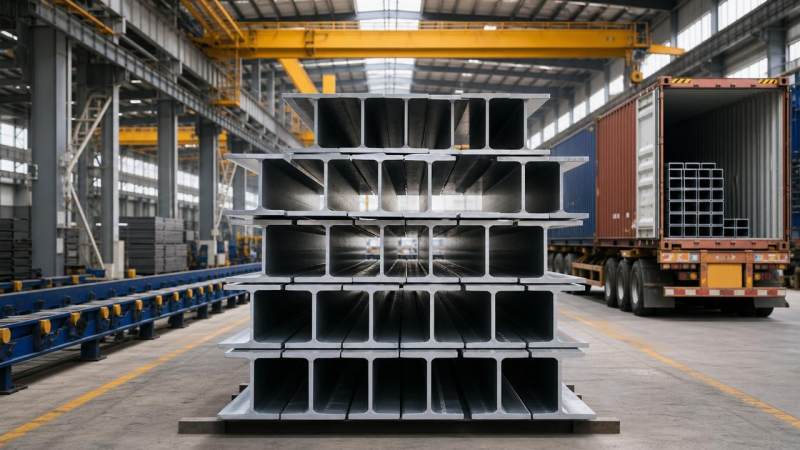
Many buyers begin with pricing, but stable delivery should come first. A low-cost supplier becomes expensive when production delays create site interruptions, contract penalties, emergency reordering, or excess internal workload for procurement and project teams.
A dependable steel i beam supplier should show evidence of repeatable output, not just promise flexibility. Consistency comes from production planning, raw material control, equipment readiness, inspection discipline, and the ability to handle both normal and urgent order cycles.
For evaluation teams, the central test is simple: can this supplier still perform when volume increases, specifications change, or logistics become difficult? Stable delivery is a systems issue, not a sales commitment.
That is why supplier assessment should move quickly from brochure claims to operational proof. Ask for recent shipment records, average lead times, on-time delivery rates, and examples of how the company handled schedule pressure or specification adjustments.
Check whether the supplier is a real manufacturer or mainly a trading organizer
This is one of the most important distinctions in supplier vetting. A true manufacturer usually has stronger control over schedules, quality, customization, and corrective action. A trader may still be useful, but it often introduces another layer of uncertainty.
Ask directly whether steel beams are produced in-house. Request photos or videos of workshops, cutting lines, welding areas, forming equipment, packaging zones, and loading operations. Documentation should match the products and capacities being promoted.
You should also verify factory basics: annual output, main export markets, equipment list, production workflow, and whether the supplier handles standard sections only or also offers custom structural fabrication. These details reveal operational maturity.
For projects with recurring demand, manufacturers with stable facilities often offer better long-term value. They can coordinate specifications, testing, packaging, and shipment planning more effectively than suppliers that rely entirely on outside mills.
Evaluate production capacity in relation to your purchasing pattern, not in isolation
Capacity figures alone can be misleading. A supplier may quote large annual tonnage but still struggle with your required beam sizes, tight schedule, or mixed-order structure. Capacity must be matched to your actual procurement profile.
Ask whether the supplier regularly produces your target dimensions, grades, tolerances, and surface requirements. It is safer to choose a partner already familiar with your order type than one treating your order as a special case.
Business evaluation teams should also examine scheduling flexibility. Can the supplier reserve production windows for repeat customers? Can they split shipments by project phase? Can they maintain lead times during seasonal demand peaks?
If your projects involve multiple steel categories, it is useful to understand cross-product coordination. Some buyers source beams together with channels, angles, or other components from one supplier to reduce interface risk and simplify logistics.
In some procurement models, companies also review suppliers with broader metal processing capability. For example, buyers managing mixed industrial demand may compare structural products with adjacent sourcing items such as 316 Stainless Steel Coil for separate applications requiring corrosion resistance and certified processing control.
Look for proof of standards compliance and inspection discipline
Stable delivery is not only about arrival time. A shipment that arrives on time but fails inspection still delays the project. That is why quality compliance should be assessed together with delivery capability.
For a steel i beam supplier, ask which standards they produce to, such as ASTM, EN, JIS, or GB. More importantly, ask for mill test certificates, dimensional inspection records, chemical composition data, and mechanical property reports from recent orders.
Suppliers serving international markets should be able to explain how they control tolerance, straightness, section dimensions, and material traceability. Strong quality systems are visible in process control, not just in certificates shown during sales discussions.
It is also worth asking how nonconforming products are handled. A reliable supplier should have a clear procedure for segregation, root-cause analysis, corrective action, and customer communication. Weak answers here often predict future claims issues.
Assess export experience and logistics coordination, because factory output alone is not enough
Even a strong manufacturer can become a risky supplier if export execution is weak. Stable delivery depends on packing quality, document accuracy, container loading, port coordination, and responsiveness when shipping conditions change.
Ask which regions the supplier already serves and how often they ship there. Experience in North America, Europe, the Middle East, or Southeast Asia often indicates familiarity with different documentation, standards expectations, and logistics practices.
Evaluation teams should review packaging methods for steel beams, rust prevention measures, loading plans, and labeling systems. Damage, missing identification, or poor bundling can create receiving delays even when the vessel arrives on schedule.
You should also ask who manages booking, customs documents, and shipment updates. Reliable suppliers usually provide a defined contact process and regular milestone reporting from production release through final dispatch.
Study communication quality as a predictor of future supply performance
Communication is often underestimated during supplier selection. In practice, delayed responses, vague answers, and incomplete confirmations are early signals of operational disorder. These issues become more damaging once live orders are running.
During evaluation, note how quickly the supplier answers technical questions, whether specifications are confirmed clearly, and whether they identify risks before you ask. Good suppliers reduce uncertainty instead of creating more follow-up work.
A business evaluation team should test scenario-based communication. Ask what happens if a dimension changes, if raw material prices move sharply, or if shipment must be brought forward. The quality of the response reveals preparedness.
Suppliers that communicate with precision usually manage production with similar discipline. This matters especially for buyers who need dependable lead times, transparent updates, and less internal escalation across procurement, engineering, and project teams.
Use sample orders, audits, and reference checks to replace assumptions with evidence
When possible, avoid making a full decision from quotations and presentations alone. The safest path is to build evidence through a sample order, third-party inspection, remote or onsite audit, and customer reference verification.
A sample order can test documentation accuracy, tolerance control, packaging, and shipment timing on a manageable scale. It also shows whether the supplier treats smaller orders professionally or only prioritizes high-volume opportunities.
Reference checks are especially valuable if they come from buyers with similar order complexity. Ask about lead time consistency, claim handling, responsiveness, and whether the supplier maintained performance after the first successful shipment.
If an audit is possible, review raw material storage, production flow, quality checkpoints, loading areas, and traceability records. For remote evaluation, detailed live video verification and shared operational records can still provide useful confidence.
Watch for common red flags before approving a steel i beam supplier
Some warning signs appear repeatedly in high-risk supplier cases. One is pricing that is far below market without a clear explanation. Another is broad capability claims unsupported by production evidence or technical detail.
Be cautious if lead times sound unusually short but no scheduling explanation is provided. The same applies when certificates are outdated, product photos are generic, or export records are unclear. These gaps often indicate weak operational control.
Another red flag is inconsistency between sales promises and technical responses. If commercial staff confirm everything immediately, but engineering details remain vague, the supplier may be prioritizing order capture over execution reliability.
Finally, pay attention to how problems are discussed. Mature suppliers do not claim perfection. They explain risks honestly, describe control methods, and show how they respond when something does not go as planned.
Build a supplier scorecard that reflects business risk, not just cost
For structured decision-making, many companies use a weighted scorecard. This is especially helpful when comparing several shortlisted suppliers that all appear acceptable at first glance.
Your scorecard should include manufacturing capability, standards compliance, on-time delivery history, export experience, communication responsiveness, pricing transparency, corrective action process, and fit for your order profile.
Assign greater weight to factors that affect project continuity. In many cases, delivery reliability and quality consistency should outrank minor unit-price differences. A slightly higher quote can create lower total procurement cost if risks are better controlled.
It can also be useful to score strategic fit. Suppliers with broader structural steel capabilities and disciplined quality culture may support future sourcing plans more effectively than companies optimized only for one transactional order.
What a strong long-term partner usually looks like
A trustworthy supplier typically combines real production capability, international standards awareness, consistent export execution, and clear communication. They understand that procurement teams are evaluating business risk, not only material availability.
For global buyers, manufacturers with modern facilities, stable capacity, and experience serving multiple markets are often better positioned to support repeat demand. They can align product quality with practical delivery commitments more reliably.
This is especially relevant in structural steel sourcing, where delays affect not only purchasing performance but also installation sequencing, contractor coordination, and overall project profitability. Supplier reliability becomes a competitive advantage.
Companies such as Hongteng Fengda operate in this space by combining structural steel manufacturing, export service, and standards-based quality control for international buyers seeking lower sourcing risk and dependable lead times.
Conclusion: choose the supplier you can verify, not the one that sounds the best
To vet a steel i beam supplier for stable delivery, focus on evidence. Confirm manufacturing control, evaluate capacity against your real demand, verify standards compliance, review export execution, and test communication quality before approval.
The best supplier decision is rarely based on price alone. It is based on the ability to deliver the right product, at the right quality level, within the promised timeframe, with fewer surprises across the full order cycle.
For business evaluation teams, that means turning supplier selection into a risk assessment process. When you use a structured framework, you improve procurement confidence and reduce the chances of costly delivery disruption later.
In short, a reliable partner is one that can prove consistency. If a supplier can show operational discipline, transparent communication, and repeatable delivery performance, they are far more likely to support stable project execution over time.
Please give us a message


Please enter what you want to find