Before placing a large order, distributors and sourcing agents need a clear way to evaluate stainless l channel quality and supplier reliability. From material grade and dimensional accuracy to surface finish and compliance with ASTM, EN, JIS, or GB standards, every detail affects resale value and project performance. This guide explains the key checkpoints that help bulk buyers reduce risk, control costs, and choose a dependable structural steel partner.
Why Quality Judgement Is Becoming More Important in Today’s Stainless L Channel Market
The way buyers assess stainless l channel is changing. In the past, many distributors focused mainly on price, standard size availability, and delivery speed. Today, the market is more demanding. End users in construction, fabrication, industrial support systems, and equipment manufacturing expect better consistency, cleaner surfaces, tighter tolerances, and traceable material documentation. For bulk buyers, that means poor quality no longer creates only a technical issue; it creates a commercial risk that can affect returns, project delays, brand reputation, and after-sales claims.
Several market signals explain this shift. First, more projects now require compliance with multiple standards, especially when products move across regions. Second, downstream customers are comparing suppliers more closely and asking for mill test certificates, inspection reports, and stable repeatability from batch to batch. Third, global sourcing has expanded options, but it has also increased quality variation. As a result, distributors and agents need a more disciplined way to judge stainless l channel before confirming bulk supply contracts.
The Main Trends Reshaping Bulk Buying Decisions
A clear trend in the steel industry is the movement from simple product comparison to full supply-chain evaluation. Buyers are no longer asking only whether a supplier can produce stainless l channel. They are asking whether the supplier can maintain consistent chemistry, dimensional stability, surface quality, lead time discipline, and documentation support over repeated orders. This is especially important for distributors serving customers who reorder standard profiles and expect no change in performance.
Another change is the rise of customized processing. Many buyers want cut lengths, punching, welding support, protective packaging, or OEM labeling. These requests increase the importance of manufacturing capability and quality control systems. A supplier with weak process management may produce acceptable base material but still create problems during secondary processing. In this environment, judging stainless l channel quality means evaluating both the product and the production system behind it.
The First Judgement Point: Material Grade Must Match the Real Application
When evaluating stainless l channel, the first question is not the unit price. It is whether the material grade is truly suitable for the intended application. Different projects may require different corrosion resistance, strength, or fabrication performance. Some buyers assume all stainless profiles offer similar value, but that assumption often causes trouble. A lower-cost grade may be acceptable for indoor structural supports yet fail in humid, chemical, marine, or food-processing environments.
Distributors should confirm the exact grade requested by downstream customers and compare it with the supplier’s actual production capability. The supplier should be able to provide clear chemical composition records and explain the applicable standard. If grade substitution is proposed, buyers should request a technical reason, not just a price benefit. Reliable stainless l channel sourcing depends on matching grade, environment, and service life expectations.
Dimensional Accuracy Has Become a Resale and Processing Issue, Not Only a Factory Issue
The second key trend is tighter dimensional expectations across the supply chain. Buyers once accepted minor size deviation if the material looked acceptable. Now, more customers use stainless l channel in systems where fit-up, alignment, welding, bolting, and modular installation all depend on stable dimensions. Leg length, thickness, angle accuracy, straightness, and length tolerance directly influence installation efficiency and secondary processing cost.
For bulk orders, request actual tolerance data rather than broad verbal promises. Ask how the supplier measures angle deviation, thickness consistency, and bar straightness. Also check whether the inspection method is applied per bundle, per heat, or per production batch. Consistency is often more valuable than a single perfect sample. A distributor needs confidence that the tenth container will match the first one.
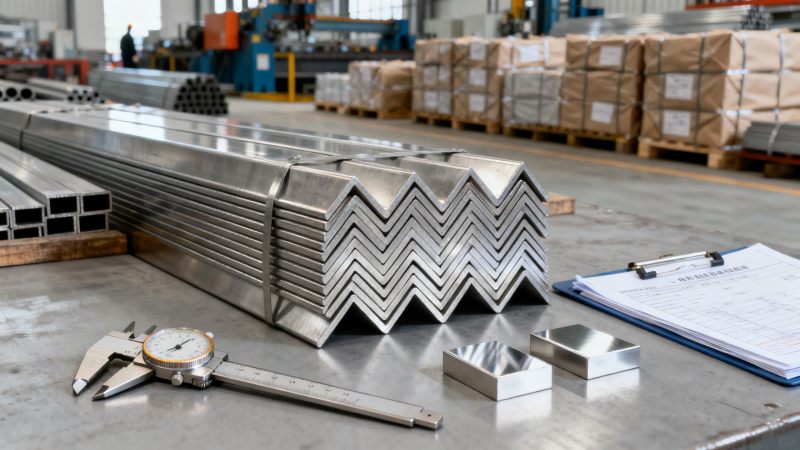
Surface Quality Is Now Closely Linked to Customer Perception and Inventory Value
Surface finish is another area where market expectations have risen. Scratches, pitting, rolling marks, edge burrs, oxidation stains, and inconsistent finishing can reduce resale value even when the stainless l channel still meets basic mechanical requirements. This matters especially for distributors supplying fabricators, visible installations, food-related facilities, or clean industrial environments where appearance and corrosion behavior both matter.
A practical approach is to define acceptable surface conditions before ordering. Buyers should ask whether the material is hot rolled, pickled, polished, or otherwise finished, and whether protective film or export packaging is available. Surface quality should be judged together with handling and packing methods, because damage can occur after production if bundling, palletizing, or container loading is not properly controlled.
Compliance Signals Matter More as Standards Converge Across Global Projects
A major industry change is that more buyers are serving international or mixed-standard projects. This means compliance is no longer a simple box to tick. A supplier should be able to explain how its stainless l channel aligns with ASTM, EN, JIS, or GB requirements depending on the order destination and application. Documentation quality often reveals real factory discipline. If certificates are vague, inconsistent, or slow to provide, buyers should treat that as an early warning sign.
This is also where supplier experience becomes visible. An exporter with strong international project exposure usually understands labeling, traceability, test records, and customer-specific compliance requests more clearly. For distributors and agents, this reduces the administrative burden and helps avoid customs disputes, project rejection, or internal quality complaints.
Why Factory Capability Now Tells You More Than a Sample Ever Can
One polished sample is not enough to judge a bulk stainless l channel supplier. In the current market, production stability is often the true difference between low-risk and high-risk sourcing. Buyers should understand the factory’s equipment, inspection flow, and quality control checkpoints. Can the supplier keep tolerance within target over long production runs? Can it identify defects before packing? Can it separate different heats clearly? Can it respond quickly if a corrective action is required?
This broader capability check is especially relevant when distributors handle multiple structural steel categories. For example, many experienced buyers prefer suppliers that can support not only stainless profiles but also related structural products for industrial projects. A manufacturer with wider steel processing experience may offer more stable coordination across orders. In some sourcing plans, buyers also compare supporting products such as Structural I Beam for industrial structure needs, especially when they need hot rolled molding, common grades such as Q195-Q235, Q345, SS400, A36, or St52, tolerance around ±1%, and processing services like bending, welding, punching, and cutting under JIS, ASTM, DIN, GB, or EN-oriented supply programs.
This matters because a supplier that successfully manages products with controlled flange thickness, web dimensions, and heavy-section processing often has stronger operational discipline overall. While stainless l channel should still be judged on its own merits, broader structural steel competence can be a useful supporting signal for buyers building long-term procurement partnerships.
How Different Market Participants Are Affected by Quality Variation
Not every quality issue affects every buyer in the same way. Understanding where the impact appears helps distributors prioritize the right checks before bulk supply.
What Smart Bulk Buyers Should Check Before Confirming Supply
In a market shaped by higher expectations and stronger competition, the best judgement process is structured and repeatable. Before approving a stainless l channel supplier for volume orders, buyers should confirm several points in sequence. First, verify grade, standard, and application match. Second, review dimensional tolerance data and sampling method. Third, inspect surface quality standards and packaging details. Fourth, confirm documentation capacity, including MTC and traceability. Fifth, assess production stability, lead time reliability, and export handling experience.
It is also wise to test responsiveness. Ask technical questions, request a sample inspection report, and compare how clearly the supplier answers. Strong suppliers usually communicate specifications, quality limits, and corrective actions with confidence. Weak suppliers often rely on generic promises. In today’s environment, communication quality is often an early indicator of supply reliability.
The Next Direction: Buyers Will Judge Partners, Not Just Products
Looking ahead, the stainless l channel market is likely to reward suppliers that combine product consistency, standard compliance, processing support, and dependable export service. For distributors, agents, and wholesalers, this means procurement decisions will increasingly depend on total partner performance rather than low quotation alone. As end-user requirements continue to tighten, the ability to supply stable quality over time will become a stronger competitive advantage than short-term price gaps.
For companies sourcing from China, this creates an important opportunity. A professional structural steel manufacturer and exporter with modern production facilities, strict quality control, international standard familiarity, and experience serving North America, Europe, the Middle East, and Southeast Asia can help reduce sourcing uncertainty. Buyers who build relationships with such suppliers are better positioned to control claims, improve delivery confidence, and support long-term account growth.
Final Judgement Questions Before You Place a Bulk Order
If you want to judge stainless l channel quality more accurately before bulk supply, focus on a few decision questions. Does the grade truly fit the final environment? Are dimensions consistent across batches, not just in one sample? Is the surface good enough for your resale market? Can the supplier provide credible standard compliance and traceable documents? Does the factory show process discipline, not just sales confidence? And if your business expands into broader industrial structure sourcing, can the same supplier support related products and coordinated delivery without losing quality control?
These questions help convert market trends into practical buying decisions. For distributors and sourcing agents, the goal is not simply to buy stainless l channel at a workable price. The goal is to secure a reliable supply base that protects margins, supports customer trust, and keeps future orders easier to manage.
Please give us a message


Please enter what you want to find