Finding a reliable Galvanized Steel Wire Rope supplier requires more than comparing a steel wire rope price list. Buyers should evaluate product quality, compliance standards, delivery reliability, and supplier capabilities across related steel products such as custom steel profiles, ASTM standard steel pipe, and hot dip galvanized angle steel. This guide explains how to identify qualified suppliers and reduce sourcing risk for industrial and construction projects.
For procurement teams, engineers, quality managers, project leaders, and distributors, supplier selection directly affects safety, installation efficiency, lifecycle cost, and schedule control. A poor supplier may offer an attractive unit price, but inconsistency in zinc coating, unclear testing records, or unstable lead times can create delays that cost far more than the initial savings.
In steel-related projects, wire rope is rarely sourced in isolation. Buyers often need a partner that understands broader material coordination, including structural steel sections, galvanized products, fabricated components, and export documentation. That is why evaluating manufacturing depth, standards compliance, and communication capability is essential before placing a first order.
Define What Your Project Really Needs Before Contacting Suppliers
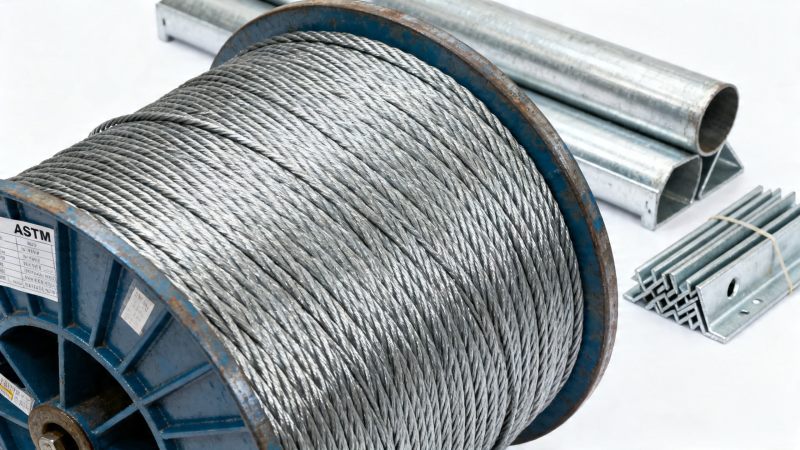
The first step in finding a steel wire rope supplier is to clarify technical and commercial requirements. Many sourcing problems begin when buyers request only diameter and quantity. In practice, at least 6 factors should be confirmed in advance: rope construction, diameter tolerance, tensile grade, zinc coating requirement, end fitting type, and intended application environment.
For example, a rope used in lifting, marine exposure, scaffolding, or bridge-related work may require very different corrosion resistance, flexibility, and fatigue performance. A 6x19 construction may be selected for one use case, while a more flexible configuration is needed for repeated bending cycles. If the project environment includes salt spray, humidity above typical indoor levels, or outdoor exposure for 12 months or more, coating and inspection requirements become more critical.
Commercial terms also matter. Buyers should define order volume, forecast frequency, acceptable lead time, target incoterm, destination port, and documentation needs. A supplier able to ship 20 tons in 15 days may not be the same supplier able to support rolling orders every 30 days with stable packaging and batch traceability.
Core requirement checklist
- Application type: lifting, securing, structural support, marine, industrial handling, or general construction use.
- Technical scope: diameter range, construction type, wire grade, coating mass, lubrication status, and minimum breaking load expectations.
- Commercial scope: MOQ, shipment schedule, payment term, packaging format, and destination compliance requirements.
- Quality scope: mill test reports, batch identification, dimensional inspection, and third-party inspection if required.
The following table helps teams align internal requirements before requesting quotations. This reduces comparison errors and makes supplier responses more meaningful.
When these details are prepared early, technical evaluators and procurement managers can compare suppliers on equal terms instead of reacting only to headline pricing. This improves sourcing speed and reduces the risk of re-quotation or production change after order confirmation.
Check Manufacturing Capability, Standards, and Product Range
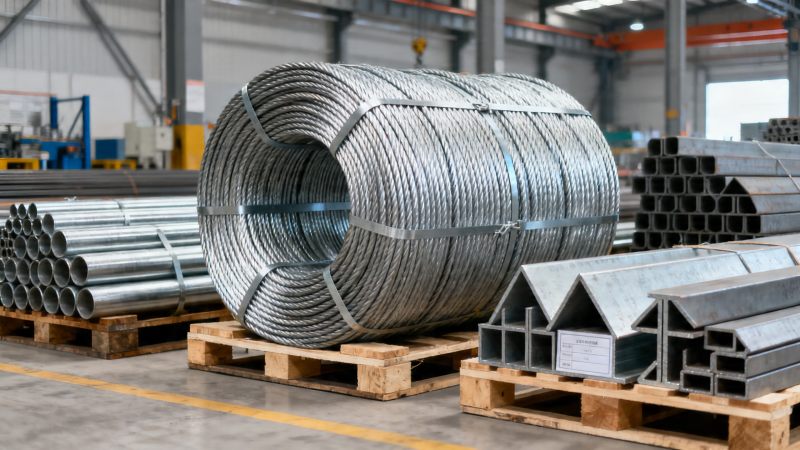
A dependable supplier should demonstrate more than trading ability. Buyers should verify whether the company has actual manufacturing coordination, stable raw material channels, and inspection procedures suitable for export projects. In the steel industry, this is especially important when one project includes multiple categories such as wire rope, steel beams, channel steel, angle steel, pipes, and custom formed sections.
A supplier with broader steel processing knowledge can often reduce purchasing complexity. For example, Hongteng Fengda serves global construction and industrial buyers with structural steel products including angle steel, channel steel, steel beams, cold formed steel profiles, and custom components. For buyers managing 3 to 5 material categories on one project, this type of supply coordination can lower communication cost and simplify schedule planning.
Standards compliance is another key checkpoint. International buyers commonly request materials aligned with ASTM, EN, JIS, or GB requirements. Even if the steel wire rope order itself is not large, supporting materials must still match project documents. A supplier that routinely handles export-oriented standards is usually better equipped to provide traceable paperwork, packaging control, and consistent specification interpretation.
Questions to ask during supplier qualification
- Which international standards can you supply against, and can you provide matching inspection records?
- What is your normal production lead time for standard orders and customized orders?
- Do you support OEM processing, cut-to-length, packaging customization, or mixed container loading?
- How do you control dimensional tolerance, coating consistency, and batch traceability?
- Can you support projects across multiple steel categories instead of only a single item?
Beyond wire rope, many buyers also source corrosion-resistant sheet materials for enclosures, roofing, fabrication, and auxiliary construction parts. In such cases, it is useful to review related products like Galvanized Steel Coil Sheet, which is available in grades such as DX51D+Z, SGCC, and S350GD+Z, with thickness from 0.12mm to 3.5mm, width from 600mm to 1500mm, and zinc coating options from Z80 to Z275. For projects that require both rope-related accessories and galvanized sheet fabrication, this kind of compatibility can streamline procurement planning.
The table below shows what buyers should compare when evaluating a supplier’s operational depth rather than just quotation speed.
A supplier with real steel-sector capability is usually easier to work with during technical review, design revision, and shipping coordination. This is particularly valuable when projects run on compressed schedules of 4–8 weeks and material substitution is not acceptable.
Evaluate Quality Control, Testing, and Delivery Reliability
Quality risk in steel wire rope sourcing often appears in small but important details: uneven galvanizing, diameter deviation, inadequate packaging, missing test documents, or mixed batches. These issues may not be obvious on the quotation sheet, but they affect performance in the field. Procurement teams should ask for a clear inspection flow covering raw material review, in-process checks, final inspection, and shipment verification.
At minimum, a supplier should be able to explain how they verify dimensions, coating condition, identification marks, and supporting certificates before dispatch. For project-critical materials, buyers may also request sample approval or third-party inspection. Even one pre-shipment review can prevent weeks of rework if cargo arrives with incorrect labeling or unsuitable packaging for sea transport.
Delivery reliability is equally important. Many buyers accept a lead time difference of 5 to 10 days if the supplier communicates honestly and ships complete, compliant goods. In contrast, an unrealistically fast offer that slips after deposit can disrupt crane booking, installation windows, and downstream subcontractor schedules. For this reason, historical delivery discipline matters more than marketing claims.
Practical quality and logistics checkpoints
- Ask whether each batch can be traced by heat number, coil number, or production lot.
- Confirm whether packaging includes anti-moisture protection for sea shipment lasting 20–45 days.
- Check if the supplier can provide pre-shipment photos, marking details, and packing dimensions.
- Clarify response time for nonconformity claims, ideally within 24–72 hours after receiving evidence.
Common warning signs
Be cautious if a supplier avoids technical questions, cannot explain coating or standard differences, changes lead time repeatedly, or provides documents only after repeated follow-up. Another warning sign is when the price is far below the market range but no clear reason is given for the discount, such as alternate grade, lighter zinc layer, or reduced inspection scope.
For quality-sensitive buyers, the best approach is to combine document review with process transparency. A consistent supplier should be able to support not only sales communication but also engineering verification and quality assurance decision-making.
Compare Suppliers by Total Procurement Value, Not Price Alone
A low steel wire rope price list can be attractive during the first screening stage, but experienced buyers compare total procurement value. This includes unit price, coating level, usable service life, packaging quality, inspection support, freight efficiency, and the likelihood of delivery disruption. In many projects, a 3% to 8% difference in purchase price is less important than avoiding a site delay or replacement shipment.
Total value analysis is particularly useful for finance approvers and business evaluators. It translates technical quality into commercial impact. For example, if a cheaper supplier causes only one week of delay on a construction package, the added cost in labor rescheduling, equipment idle time, and urgent freight may exceed the original material savings. That is why sourcing decisions should include risk-adjusted cost, not only ex-works price.
Distributors and project contractors also need to consider repeatability. A supplier who performs well on 1 trial order but cannot maintain the same quality over 6 monthly shipments creates hidden operational cost. Consistency across batches is often more valuable than a short-term discount on the first container.
A simple supplier scorecard
The following matrix can be used during internal review meetings. It helps procurement, technical, and finance teams assign weight to the factors that most affect project success.
Using a scorecard helps teams avoid subjective decisions. It also creates a stronger basis for supplier approval, especially when multiple departments must sign off on orders above a set budget threshold.
Build a Lower-Risk Sourcing Process for Long-Term Cooperation
The best way to find a steel wire rope supplier is to treat sourcing as a process rather than a one-time quote comparison. A practical model includes 5 stages: requirement definition, supplier screening, sample or document review, pilot order, and ongoing performance evaluation. This structure is suitable for project buyers, distributors, and industrial users who expect repeat orders over 6 to 12 months.
During the first order, keep the scope controlled. Confirm product details, packaging method, marking rules, and shipping documents in writing. After delivery, record actual lead time, quality findings, communication responsiveness, and issue resolution speed. These records become valuable benchmarks when deciding whether to expand order volume or consolidate more steel categories under one supplier.
Suppliers that can support broader steel solutions often create more value over time. Hongteng Fengda, for example, focuses on structural steel manufacturing and export from China, with support for standard specifications and OEM solutions across angle steel, channel steel, steel beams, cold formed profiles, and customized structural steel components. For international buyers in North America, Europe, the Middle East, and Southeast Asia, this kind of coordinated supply model can reduce sourcing fragmentation and improve project execution efficiency.
Recommended implementation process
- Prepare a technical RFQ with specifications, standards, quantity, destination, and documentation requirements.
- Shortlist 2 to 4 suppliers based on manufacturing capability, export experience, and response quality.
- Review samples, test reports, or comparable product records before confirming bulk production.
- Place a pilot order with clear acceptance criteria and delivery milestones.
- Evaluate performance after receipt and establish a repeat-order framework if results are satisfactory.
FAQ: What buyers ask most often
How many suppliers should I compare? In most cases, 3 qualified suppliers are enough to identify a realistic market range and reveal major differences in quality support, lead time, and communication.
Is a sample order always necessary? Not always, but it is strongly recommended for first-time cooperation, customized specifications, or projects with strict approval procedures. Even a small verification batch can reduce risk significantly.
What is a reasonable lead time? For standard steel products, many export orders fall within 2–6 weeks depending on quantity, processing, and port schedule. Customized items may take longer, especially when multiple product categories are combined.
What documents should be requested? Buyers commonly ask for packing list, invoice, mill test report where applicable, standards declaration, and shipping marks confirmation. Project-specific documents may also be needed for inspection or customs use.
Choosing the right steel wire rope supplier means balancing technical suitability, quality control, delivery stability, and broader steel supply capability. Buyers who define requirements clearly, verify standards, compare total value, and use a phased approval process are far more likely to secure reliable supply and avoid expensive project disruption.
If your project also requires structural steel sections, cold formed profiles, galvanized materials, or customized steel components, working with an experienced Chinese manufacturer and exporter can improve procurement efficiency across the full package. Contact us today to discuss your specifications, request a tailored solution, or learn more about integrated steel supply options for your next project.
Please give us a message


Please enter what you want to find