Finding a reliable galvanized steel sheet exporter to Europe is essential for distributors, agents, and wholesalers seeking stable supply, compliant quality, and competitive pricing. With growing demand for certified steel products in European markets, choosing the right exporter can reduce sourcing risks, improve delivery performance, and strengthen your market position. This guide explains the key factors to evaluate before selecting a trusted long-term partner.
For most buyers, the core search intent behind “galvanized steel sheet exporter to Europe” is practical, not academic. They want to identify exporters that can meet European compliance, deliver consistent quality, protect margins, and reduce claims, delays, and communication problems.
Distributors and agents usually care less about generic supplier introductions and more about proof. They need to know whether an exporter understands European standards, offers stable production, supports documentation, and can handle repeat orders without quality fluctuations.
The best way to choose is to evaluate an exporter through four lenses: compliance, manufacturing capability, export execution, and commercial reliability. If a supplier performs well in all four, the sourcing relationship is far more likely to succeed over time.
What European Buyers Really Need From a Galvanized Steel Sheet Exporter
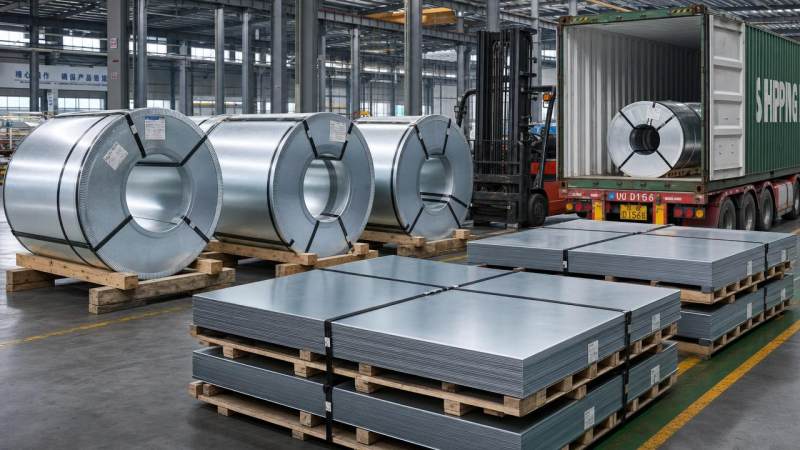
If you supply steel products into Europe, your reputation depends on more than price. Buyers in this market expect traceability, clear specifications, dependable delivery schedules, and documentation that supports customs clearance and downstream customer confidence.
A qualified galvanized steel sheet exporter to Europe should understand how different European customers buy. Some focus on price-sensitive distribution, while others prioritize standard conformity, coating consistency, and packaging quality because resale claims can quickly damage business relationships.
For wholesalers and agents, the real cost of a weak supplier is often hidden. A lower quoted price may lead to nonconforming thickness, poor zinc coating adhesion, incorrect labels, missing certificates, or delivery disruptions that reduce customer trust and create expensive after-sales problems.
That is why the first question should not be “Who is cheapest?” but “Who is dependable under European market expectations?” Reliable exporters make it easier for you to keep stock moving, protect your account base, and plan future sales with confidence.
How to Check Whether the Exporter Can Meet European Compliance Expectations
European buyers often treat compliance as a baseline requirement, not a premium feature. Before discussing volume or discounts, verify whether the supplier can manufacture and document products according to the specifications your target market actually requires.
Start by checking supported standards. A serious exporter should be familiar with major international specifications such as ASTM, EN, JIS, and GB, and should be able to explain how its galvanized steel sheet aligns with your intended application and customer expectations.
You should also request mill test certificates, coating data, dimensional tolerances, and quality inspection procedures. If the exporter struggles to provide technical documents clearly and quickly, that is often an early warning sign for future execution problems.
It is equally important to confirm whether the supplier has experience serving Europe specifically. Exporting globally is useful, but Europe has its own purchasing culture, documentation habits, and compliance sensitivity. Prior market experience usually reduces avoidable friction.
Ask direct questions about certificate availability, third-party inspection support, and packaging standards for long-distance sea transport. An exporter that answers with specifics rather than vague claims is generally better prepared for long-term European cooperation.
How to Assess Product Quality Beyond the Sample Stage
Many exporters can provide a good-looking sample. The harder issue is whether they can maintain the same quality across bulk orders. For distributors, consistency matters more than isolated performance because resale credibility depends on repeatable product results.
When evaluating quality, look beyond appearance. Review thickness tolerance control, coating uniformity, flatness, edge condition, and surface defects. Small deviations may still pass basic visual inspection but can create complaints during fabrication, storage, or installation.
It is smart to ask how quality is controlled from raw material procurement through forming, galvanizing, packing, and loading. A structured quality process shows that the supplier does not rely only on final inspection to catch problems.
You should also ask for recent shipment references, especially for repeat international customers. Repeat orders often say more than marketing materials. They suggest the exporter can deliver stable quality, acceptable lead times, and service good enough to retain demanding buyers.
If possible, use third-party inspection before shipment on early orders. This adds cost, but it can save far more by reducing disputes and giving your team confidence in the supplier’s real manufacturing discipline.
Why Production Capacity and Lead Time Stability Matter More Than Quoted Price
For agents and distributors, missed delivery windows can be more damaging than moderate price differences. If you cannot replenish stock on time, customers may switch suppliers, postpone projects, or negotiate more aggressively against you in future orders.
A reliable exporter should be able to explain production capacity clearly, including monthly output, normal scheduling, peak season limitations, and lead time for customized or nonstandard specifications. These details matter because steel supply chains can change quickly.
Lead time reliability is especially important if you serve project-based buyers. Construction and industrial customers often schedule downstream work around delivery commitments. Delays from your exporter may become financial and reputational losses for your own business.
Ask how the supplier manages raw material planning, manufacturing queues, and shipment booking. A factory with stable internal coordination is usually better positioned to avoid disruptions caused by price volatility, order surges, or port congestion.
In many cases, the best supplier is not the one with the lowest initial quote, but the one that helps you forecast inventory better and reduces emergency sourcing. Over time, that stability often improves overall purchasing economics.
Questions to Ask About Export Experience, Packaging, and Logistics
Export ability is separate from manufacturing ability. Some factories make acceptable steel products but lack the operational discipline needed for smooth international shipments. For Europe-bound cargo, documentation and packing mistakes can create avoidable delays and cost.
Ask whether the exporter handles regular container and bulk shipments, how products are protected against moisture and handling damage, and what labels and packing lists are prepared for customs and warehouse receiving. Clear answers suggest stronger export management.
Packaging quality deserves more attention than many buyers give it. Galvanized steel sheets can be affected by poor bundling, insufficient protection, or improper loading practices. Damage in transit can turn a profitable shipment into a dispute over responsibility.
You should also ask about incoterms flexibility, preferred ports, shipment tracking, and communication during production and dispatch. A dependable exporter will provide structured updates rather than forcing the buyer to chase every milestone manually.
For European importers, consistency in export execution helps reduce internal workload. It allows purchasing teams, warehouse staff, and downstream customers to work with fewer surprises, which is a major commercial advantage in competitive distribution markets.
How to Evaluate Communication and Long-Term Business Reliability
Communication quality is often underestimated during supplier selection. However, many sourcing failures happen not because the product is impossible to make, but because specifications, deadlines, or corrective actions were not handled clearly and quickly.
A good exporter communicates in a way that supports business decisions. That means fast quotation response, clear technical confirmation, transparent lead times, honest discussion of risks, and practical solutions when specifications require adjustment.
Notice whether the supplier asks useful questions about application, target market, standard, coating requirement, and packaging expectation. Strong suppliers do not simply say yes to everything. They clarify details to prevent mistakes before production starts.
Long-term reliability also shows in commercial behavior. Watch for consistency in pricing logic, willingness to support claims investigation, and ability to balance flexibility with process discipline. These traits matter if you intend to build recurring business rather than place one-off spot orders.
A trustworthy partner should help you reduce sourcing risk over time. That includes stable quality, predictable communication, and a service mindset that supports your customer relationships rather than treating each order as an isolated transaction.
What a Strong Product Portfolio Says About the Exporter
When an exporter handles a broader structural steel range, it often indicates stronger production organization and more experience serving industrial and construction buyers. This can be useful for distributors planning to expand purchasing beyond a single steel category.
For example, some manufacturers that export galvanized steel sheet also supply structural profiles for steel construction projects. A relevant case is Z-beam, a Z-shaped steel profile used in purlins, wall beams, lightweight roofing systems, brackets, mechanical columns, light manufacturing beams, and support arms.
Products like this are typically available in materials such as Q235B, Q345B, Q420C, Q460C, SS400, SS540, S235, S275, S355, A36, A572, G50, and G61, with thickness from 6 mm to 25 mm and lengths from 2 to 12 meters or customized.
Additional options such as perforated or non-perforated formats, galvanized coating, roll forming technology, and certifications like CE, SGS, BV, and ISO can be a sign that the supplier is accustomed to specification-driven export business rather than only commodity trade.
For distributors, this broader capability can create cross-selling opportunities and simplify procurement. It also suggests the exporter may be better equipped to support customized solutions for customers involved in structural steel workshops and construction systems.
Red Flags That Suggest the Exporter May Not Be a Good Fit
Some warning signs appear early if you know what to look for. One common issue is vague documentation. If a supplier cannot provide precise technical data, inspection records, or standard references, quality risk is probably higher than the quotation suggests.
Another red flag is pricing that changes dramatically without clear explanation. Steel pricing can move with the market, but inconsistent quoting may indicate weak raw material control, unstable planning, or a low-commitment sales approach that will affect future orders.
Be cautious if communication is fast before payment but slow when questions become technical or operational. This often signals a weak handover between sales and factory teams, which can create errors during production and shipment.
You should also be careful with exporters who promise any specification without discussing feasibility. In steel sourcing, unrealistic flexibility is not a strength. It may mean the supplier is prioritizing order capture over actual production control.
Finally, avoid making decisions based only on sample quality and first-order discounting. Short-term attractiveness is not the same as long-term reliability, especially in European distribution markets where repeat performance matters most.
A Practical Supplier Screening Checklist for Distributors and Agents
To compare suppliers efficiently, use a structured screening process. First, confirm target specifications, standards, thickness range, coating requirements, and documentation needs. Clear internal requirements make supplier evaluation faster and more objective.
Second, review the exporter’s manufacturing profile, quality control system, supported standards, and export markets. Ask for recent order examples, inspection documents, and packaging photos. Evidence is more useful than broad sales language.
Third, test commercial responsiveness. Evaluate quotation speed, communication quality, technical clarity, and problem-solving attitude. The way a supplier manages pre-order communication often predicts how they will manage live production and shipment issues.
Fourth, start with a manageable trial order if the exporter passes initial checks. Use that order to measure actual product consistency, delivery performance, packaging execution, and document accuracy. Practical performance should guide long-term decisions.
Finally, review the supplier not only as a product source, but as a business partner. The right galvanized steel sheet exporter to Europe helps you grow more predictably, serve customers more confidently, and compete on reliability as well as price.
Conclusion
Choosing a galvanized steel sheet exporter to Europe is ultimately a risk management decision as much as a purchasing decision. For distributors, agents, and wholesalers, the best partner is one that combines compliant quality, stable production, dependable export execution, and clear communication.
Instead of focusing only on the lowest offer, evaluate how well the exporter supports your real business goals: protecting margins, reducing claims, improving delivery performance, and building customer trust in the European market. That is what creates sustainable sourcing value.
If a supplier can demonstrate standard awareness, consistent quality control, practical export experience, and long-term service reliability, they are far more likely to become a partner worth keeping. In Europe-focused steel trade, dependability is a competitive advantage.
Please give us a message


Please enter what you want to find