For finance decision-makers, steel sheet size is not just a technical detail—it directly affects cutting loss, freight efficiency, and total procurement cost. Choosing the right dimensions can reduce material waste, improve container loading, and prevent avoidable budget overruns. This article explains how size selection influences both production economics and delivery expenses, helping buyers make more cost-effective structural steel purchasing decisions.
Why does steel sheet size matter so much in cost approval?
When finance teams review a steel order, unit price per ton often gets the most attention. However, the real landed cost is shaped by how well the selected steel sheet size matches the production plan. A low quoted price can still lead to higher total spending if sheet dimensions create 5% to 15% cutting loss, extra rework, or inefficient packaging. For structural steel buyers, size is therefore a budget variable, not only a technical specification.
In practical procurement, the same project may require panels, brackets, stiffeners, covers, or formed parts with different nesting patterns. If the ordered sheet is too narrow, too short, or poorly aligned with the component layout, more offcuts are generated. Those offcuts are not always reusable, especially when thickness, grade, or surface condition must remain consistent across the job. This is why steel sheet size directly influences material yield and purchasing efficiency.
For exporters and international buyers, there is another layer: transportation. A sheet size that looks economical in the mill can become more expensive when it creates poor container utilization, difficult handling, or non-standard packing. In many shipments, a 20-foot or 40-foot container can be underused not because of weight limits, but because sheet dimensions prevent efficient stacking. That means more freight cost per usable ton.
What should finance teams examine beyond the steel price?
- Expected cutting loss percentage based on actual part layout, not only nominal sheet area.
- Container loading efficiency by width, length, thickness, and pallet arrangement.
- Handling cost impact, including crane time, forklift movement, and repacking needs.
- Lead time differences between standard sizes and custom cut dimensions, often ranging from 7 to 30 days.
- Whether offcuts can be reused in future production or will become scrap with discounted recovery value.
A disciplined approval process should compare cost per usable square meter or cost per finished part, not just cost per ton. This shift helps procurement and finance evaluate the real effect of steel sheet size on total project economics.
How does steel sheet size affect cutting loss in real production?
Cutting loss occurs when purchased sheet dimensions do not match the geometry of the final parts. The gap between ordered size and required layout may seem minor, but over a batch of 50 tons, even a 3% yield difference can materially change budget performance. In steel service and fabrication environments, sheet width is often the first variable that determines whether parts can be nested efficiently side by side.
Length also matters. If buyers choose a standard length simply because it is easy to source, they may pay for unused edge zones, trimming allowances, and process-related safety margins. For example, a part set requiring repeated lengths of 2.3 m may generate less waste from a 4.6 m or 6.9 m planning logic than from a generic 6 m sheet, depending on the cut map. That is why engineering and finance should review nesting assumptions together before confirming purchase dimensions.
Thickness adds a hidden cost dimension. Thick plates with poor dimensional planning create more expensive scrap because each offcut contains more steel value per square meter. In addition, thicker material may have fewer reuse opportunities if the next project uses lighter gauges. A 10 mm offcut is not equivalent in recovery flexibility to a 1.0 mm offcut.
What does a finance-oriented cutting loss comparison look like?
The table below shows a simplified comparison of how different steel sheet size choices can affect yield. Actual results depend on part geometry, edge allowance, and cutting method, but the pattern is common across fabrication projects.
This comparison shows why the lowest nominal sheet cost may not deliver the lowest production cost. A change in steel sheet size that improves yield by only 4 percentage points can offset a higher purchase price and still lower the total cost per finished component.
Which cutting loss mistakes are most common?
- Approving standard sheets without checking actual nesting software output.
- Ignoring grain direction, bend allowance, or surface-sensitive orientation.
- Using one sheet size for multiple part families that should be separated.
- Assuming all offcuts are reusable at full value, when many are not.
For approval workflows, asking for a nesting summary before purchase is often more useful than requesting another small discount on the ton price.
How does steel sheet size change delivery cost and container efficiency?
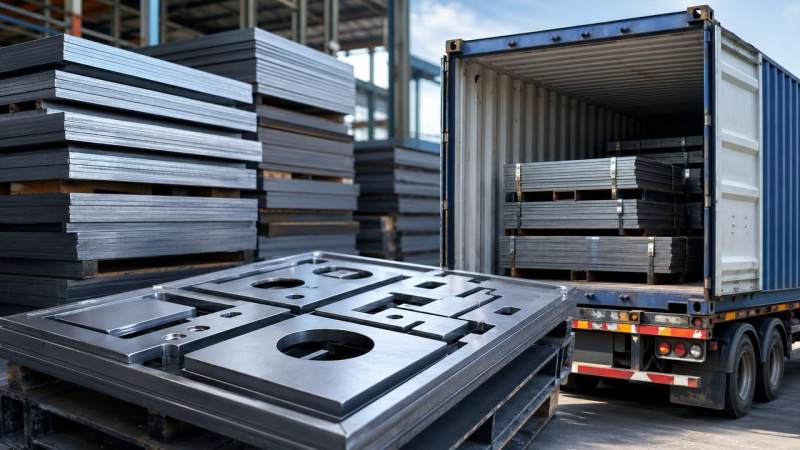
Delivery cost is influenced by both weight and dimensions. In steel exports from China to North America, Europe, the Middle East, or Southeast Asia, freight planning usually works within container length, stacking safety, weight distribution, and loading convenience. If the selected steel sheet size leaves large voids in a container or requires special pallets, the buyer may pay more freight per net usable ton.
Long or oversized sheets can create practical loading constraints. A sheet length close to the internal limit of a container may reduce the ability to add protective packaging or mixed bundles. Wide sheets may also reduce stack flexibility and increase the chance of handling damage during loading and unloading. In some cases, buyers shift from standard container shipping to break bulk or special arrangements, which can significantly increase logistics complexity.
For finance decision-makers, the key issue is not only freight rate per container, but freight cost per delivered usable part. If one steel sheet size improves container fill from 78% to 90%, that difference can spread fixed logistics costs over more productive material. On repeat procurement, the savings become measurable over 6-month or 12-month buying cycles.
What delivery factors should be checked before approval?
The following table helps finance and procurement teams evaluate how steel sheet size affects transport cost, packaging, and handling risk in a typical export scenario.
This is why logistics should be included in sheet selection discussions early. A size that is efficient in production but inefficient in shipping may still weaken the total cost result. The best purchasing decision usually balances cutting yield, stackability, protection requirements, and destination handling capability.
How can buyers lower delivery cost without oversimplifying the order?
- Group part families and match them to 2 or 3 practical sheet dimensions instead of ordering too many random sizes.
- Confirm container loading plans before production starts, especially for sheets above common handling ranges.
- Ask suppliers to compare standard mill sizes versus custom cut sizes with freight implications included.
- Review whether local unloading equipment can safely receive longer or heavier bundles.
For many structural steel importers, one coordinated review between purchasing, fabrication, and logistics can prevent avoidable overspending later.
Which steel sheet size strategy usually works best for budget control?
There is no single ideal steel sheet size for every buyer. The right approach depends on part geometry, annual volume, production equipment, shipment mode, and whether the buyer values standard stock flexibility or custom cut efficiency. For finance teams, the most effective strategy is to compare scenarios using total cost logic rather than relying on sheet price alone.
A practical method is to classify demand into three groups: standard repetitive parts, project-based parts, and custom formed components. Standard repetitive parts often benefit from a limited range of optimized sizes used continuously across 3 to 12 months. Project-based parts may justify custom dimensions if the batch is large enough to offset added planning or lead time. Custom formed components need closer review because bend lines, surface finish, and forming behavior can all influence the ideal blank size.
In the middle of this evaluation, buyers often compare cold rolled and structural applications that require stable quality and processing consistency. For such projects, Carbon Steel Plate can be considered where dimensional range, grade selection, and downstream forming requirements must be aligned. Available models include SPCC, SPCCT, SPCD, SPCE, SPCF, and SPCG, with width from 100 mm to 3000 mm, length from 1 m to 12 m or customized size, and thickness from 0.1 mm to 400 mm.
What product details matter when size planning meets application planning?
For buyers evaluating material for refrigerators, rails, switchboards, iron baskets, automobile chassis, roofs, fenders, rear side panels, interior boards, or visible surfaces, size planning should not be separated from formability and finish requirements. In addition to smooth surface options such as ordinary, wire drawing, or laminated film finishes, grades in the SPCC family are commonly selected according to forming depth and hardness condition.
Mechanical and chemical performance also influences the cost outcome of steel sheet size decisions. For example, harder tempers may change cutting behavior and forming scrap rates, while deeper drawing grades can reduce process loss on more complex shapes. International buyers also frequently request compliance references such as AISI, ASTM, ASME, DIN, BS, EN, ISO, JIS, GOST, and SAE, especially when procurement needs to align with project specifications across multiple markets.
When used in a controlled sourcing plan, this type of material can support high tensile strength, good formability, uniform appearance, and corrosion-prevention considerations in downstream manufacturing. Those factors matter because the wrong size paired with the wrong grade can increase both material waste and rejection risk.
How should finance teams compare sheet size options?
The table below gives a simple approval framework that can be used when reviewing quotations and technical proposals.
This framework helps keep the conversation focused on measurable outcomes. In many cases, the best steel sheet size is the one that delivers the lowest combined cost across purchase, processing, freight, and scheduling.
What are the most common misconceptions about steel sheet size?
One common misconception is that larger sheets always reduce cost because they lower the number of pieces handled. In reality, larger dimensions can improve yield for some parts but hurt loading efficiency, increase damage risk, or exceed equipment convenience at the destination. The decision must be tested against the full process, not assumed from scale alone.
Another misconception is that standard sizes are always safer financially. Standard stock can shorten sourcing time and reduce supply complexity, but it may also create recurring waste if the production mix remains stable and poorly matched. Over quarterly or annual purchasing cycles, repeated mismatch can cost more than a moderate premium for optimized dimensions.
A third misconception is that scrap value fully offsets cutting loss. Scrap usually returns only a fraction of the original processed material value, and it does not recover handling time, storage space, freight allocation, or production delay. From a finance perspective, scrap recovery is damage control, not a true substitute for yield optimization.
Which warning signs suggest your current size choice is costing too much?
- Material consumption regularly exceeds quotation assumptions by more than 3% to 5%.
- Containers ship below expected fill efficiency despite steady order volume.
- Offcuts accumulate but are rarely reused within 60 to 90 days.
- Production teams repeatedly trim edges or split bundles for easier handling.
- Custom projects are priced using standard sheets without a nesting review.
If several of these signs appear together, the issue is often not steel price volatility alone. It may be that the selected steel sheet size is creating structural inefficiency across procurement and operations.
What should buyers confirm before placing the next order?
Before confirming a new purchase, finance decision-makers should ask for a short but disciplined review covering material yield, logistics fit, lead time, and specification compliance. This does not require a complicated internal process. In many cases, a 4-point confirmation sheet is enough to prevent expensive assumptions from entering the order.
First, verify whether the proposed steel sheet size is based on real part drawings or only a general sales quotation. Second, confirm whether the dimensions fit standard export packing and container loading plans. Third, check whether custom sizes affect mill schedule or minimum order quantity. Fourth, ensure the selected grade, thickness, and finish are appropriate for the application rather than chosen only for availability.
For global structural steel sourcing, suppliers with stable production, international standard familiarity, and practical export experience can help reduce this decision burden. A manufacturer that understands ASTM, EN, JIS, and GB requirements, and that can support both standard specifications and OEM solutions, is often better positioned to recommend commercially sensible dimensions rather than just available stock.
FAQ summary for faster approval
The summary below can be used as a quick screening tool during internal review.
A clear answer to these three questions can improve purchasing discipline and reduce budget surprises across fabrication and delivery stages.
Why choose us for structural steel sourcing support?
Hongteng Fengda is a structural steel manufacturer and exporter from China serving customers across North America, Europe, the Middle East, and Southeast Asia. We support buyers with stable production capacity, quality control, and practical export coordination for angle steel, channel steel, steel beams, cold formed steel profiles, and customized structural steel components.
If you need to evaluate steel sheet size for cost approval, we can help you review specification ranges, product selection, delivery cycle expectations, custom dimension feasibility, and standard compliance requirements. We can also discuss sample support, quotation structure, and whether a standard or customized size plan is more suitable for your project and budget.
Contact us to confirm parameters before ordering: required width and length, thickness range, grade options, expected cutting pattern, destination port, packaging preference, and lead time target. A brief early discussion can often prevent unnecessary cutting loss, improve freight efficiency, and create a more reliable total procurement plan.
Please give us a message


Please enter what you want to find