Choosing the right galvanized sheet for roofing is not just a matter of buying the thickest sheet or the lowest-priced option. Climate has a direct effect on corrosion speed, coating life, maintenance frequency, and overall project cost. For project managers and engineering decision-makers, the practical question is simple: which roofing sheet will still perform after years of rain, heat, salt air, snow, or industrial exposure without creating avoidable repair risk?
The short answer is that different climates change the required zinc coating, substrate grade, profile design, drainage approach, and sometimes even whether standard galvanized roofing is enough at all. A roof that performs well in a dry inland area may fail early in a coastal zone or under acidic industrial pollution. Likewise, a sheet suitable for moderate weather may deform, leak, or corrode faster under heavy snow loads or extreme thermal cycling.
This article focuses on how climate should guide roofing sheet selection, what project leaders should check before procurement, and how to balance upfront cost with long-term performance. Instead of discussing galvanized roofing in general terms, it will highlight the decisions that matter most when your goal is reliable service life, lower lifecycle cost, and fewer site problems.
Why climate matters more than many buyers expect
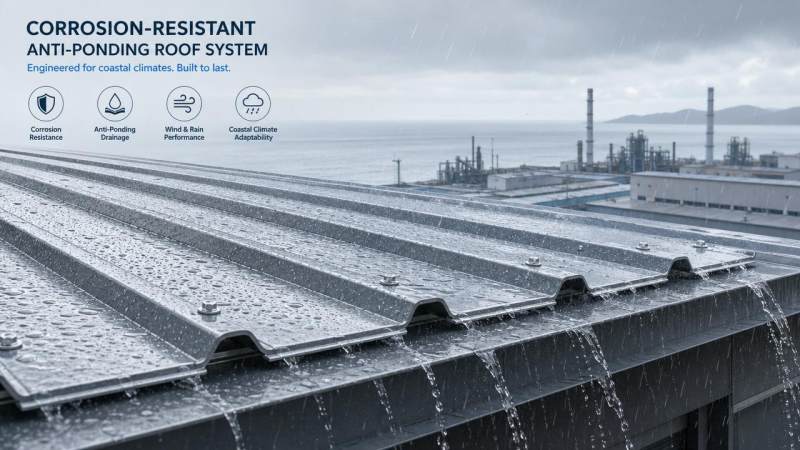
Galvanized roofing sheets rely on a zinc coating to protect the base steel. That protection works very effectively in many environments, but not equally in all of them. The rate at which zinc is consumed depends on moisture, airborne salt, pollutants, condensation patterns, temperature swings, and how long the roof stays wet after rain or dew. This means climate is not a secondary consideration; it is one of the main factors that determines whether a roof reaches its intended service life.
For project managers, the main risk is not always immediate failure. More often, the issue is accelerated deterioration that looks minor at first but creates higher operating cost later: premature rusting at cut edges, coating breakdown around fasteners, staining, drainage-related corrosion, and more frequent maintenance interventions. These issues may not appear in early project handover inspections, but they directly affect asset performance over time.
Climate also influences structural and installation behavior. High heat can increase thermal expansion and contraction. Heavy snow changes load requirements. Wind-driven rain can test overlap design and fastening layout. In humid conditions, poorly ventilated roof systems may corrode from the underside, even when the top surface still looks acceptable. A sound roofing specification therefore needs to connect environmental exposure with both corrosion resistance and structural design.
What project managers should evaluate before choosing a galvanized sheet for roofing
When evaluating a galvanized sheet for roofing, decision-makers usually focus first on thickness and price. Those are important, but they should not be the starting point. The first step is to define the exposure category of the project site. Is the building located inland, in a coastal area, in a heavy rainfall region, in a snow zone, in a desert-like hot climate, or near industrial emissions? This environmental profile affects every later decision.
The second key issue is service life expectation. A temporary warehouse, an agricultural shed, and a long-life industrial plant do not require the same roofing strategy. If the roof is difficult to access, if business interruption from repair would be costly, or if replacement would affect production schedules, then a stronger coating specification is usually justified even if the initial purchase cost is higher.
Third, project teams should review the complete roof system rather than the sheet in isolation. Sheet profile, purlin spacing, slope, fastening method, overlap detail, drainage design, insulation, and ventilation all influence real performance. Many corrosion and leakage problems are not caused by the sheet alone but by a mismatch between material choice and roof design conditions.
How different climates change material selection
Coastal and marine climates are among the most demanding for galvanized roofing. Salt-laden air accelerates corrosion, especially when surfaces remain damp. In these areas, standard zinc coating levels may be insufficient for long service life. Project leaders should typically look for heavier galvanized coatings, better edge protection practices, and strict attention to fixing details. If the project is very close to the sea, it may be necessary to assess whether an upgraded metallic or painted system is more appropriate than basic galvanized sheet alone.
High rainfall and tropical humidity create a different risk pattern. The concern here is not only direct rain but also long periods of wetness, condensation, and limited drying time. Roofs with poor drainage, shallow slopes, or debris accumulation can develop localized corrosion much faster than expected. In this climate, selection should prioritize adequate coating weight, good profile geometry for water runoff, and careful control of lap joints and fastener sealing.
Hot and high-UV climates place more stress on thermal movement and surface aging than on moisture-driven corrosion alone. While zinc coating remains important, project teams should also consider reflectivity, heat absorption, expansion behavior, and compatibility with any additional painted finish. Thermal cycling can loosen fasteners over time or increase stress at joints if detailing is poor. A roofing sheet that is acceptable in mild weather may perform inconsistently in regions with intense sun and large daytime temperature swings.
Cold, snowy, or freeze-thaw climates require attention to both corrosion and structural loading. Snow accumulation increases demand on sheet profile strength, support spacing, and fastening layout. Ice dams, standing meltwater, and repeated freezing can affect seams and drainage points. In these areas, selecting the right thickness without reviewing load path and roof geometry is a common mistake. The material must resist environmental attack while also maintaining mechanical integrity under seasonal loading.
Industrial and polluted environments can be as aggressive as marine exposure, especially where sulfur compounds, chemical fumes, or particulate deposits are present. In such settings, corrosion often progresses faster than buyers expect because pollutants remain on the surface and react with moisture. If the building is part of a manufacturing, logistics, or processing site, it is essential to evaluate both external exposure and emissions generated by nearby operations.
Which specifications matter most in practice
The most critical specification is often the zinc coating mass, because it directly affects corrosion resistance. A heavier coating generally provides longer protection, especially in humid, coastal, or industrial environments. However, coating weight should be selected in relation to the actual exposure level and expected service life rather than by habit. Under-specifying can lead to early maintenance, while over-specifying for a low-risk site may increase cost without proportional benefit.
Base steel thickness is another important factor, but it should be understood correctly. Thicker sheet can improve stiffness, dent resistance, and structural capability, yet thickness alone does not solve corrosion problems. A thicker sheet with inadequate coating may still deteriorate too quickly in harsh environments. For project owners, the right decision is usually the combination of proper thickness and coating, not a trade-off between them.
Profile shape and roof slope also influence long-term behavior. Some profiles shed water more effectively, resist ponding better, and perform more reliably under wind-driven rain. On low-slope roofs, poor drainage can shorten service life regardless of coating quality. This is why technical review should include not only product data sheets but also the actual building geometry and water management design.
Fasteners, washers, cut-edge treatment, and installation quality are often underestimated. Corrosion frequently begins at penetrations and edges. Even a well-specified galvanized sheet can underperform if dissimilar metals are used, fasteners are poorly sealed, or field cutting damages the protective layer. For project managers, quality control during installation is part of material performance, not a separate issue.
How supporting steel members affect roofing performance
Roofing sheet selection should also be coordinated with the supporting steel framework. Purlins, wall beams, and light structural members influence load transfer, sheet stability, and installation tolerance. If the support system is not matched to the roofing design, the result can be excessive deflection, misalignment, water retention, and reduced service life. In real projects, roofing durability depends on the entire assembly.
For lightweight steel roof systems, properly selected secondary framing can improve both performance and construction efficiency. One practical option used in steel structure workshops, wall beams, brackets, and lightweight roofs is the Z-beam. This Z-shaped steel profile is available in materials such as Q235B, Q345B, SS400, S235, S275, S355, A36, and A572 grades, with thicknesses from 6-25mm and lengths from 2 to 12 meters or customized, helping project teams align support design with structural and environmental requirements.
For managers handling industrial buildings or export projects, supporting members with galvanized coated options, controlled tolerances of ±1%, and certification such as CE, SGS, BV, and ISO can simplify compliance and quality planning. In climate-sensitive roofing applications, reliable secondary steel helps maintain proper drainage lines, fastening accuracy, and load performance, all of which support the service life of the roof sheet itself.
Common mistakes that increase roofing risk
One common mistake is choosing by price alone. Lower-cost roofing sheets may look similar on paper, but differences in coating mass, steel chemistry, dimensional control, and manufacturing consistency can significantly affect durability. For a project manager, the real comparison is not purchase price per ton or per square meter, but total cost over the roof’s expected operating life.
Another mistake is relying on a generic specification for all regions. Companies managing multiple projects across countries or climate zones sometimes use one standard roofing sheet regardless of location. This approach may simplify procurement, but it often creates avoidable failures. A specification suitable for dry inland warehousing may not be appropriate for a humid port facility or a snow-loaded workshop.
A third issue is separating procurement from technical review. If sourcing teams evaluate only quotations and delivery times without input from engineering or operations, the selected sheet may meet budget targets but miss climate-related performance needs. Cross-functional review is especially important for export or international projects where local weather exposure differs greatly from the buyer’s domestic experience.
How to make a better procurement decision
The most effective approach is to create a climate-based specification checklist before requesting quotations. This should include site location, distance from the coast, humidity level, rainfall intensity, snow load, pollution exposure, desired service life, roof slope, support spacing, and maintenance access conditions. With this information, suppliers can recommend a more suitable galvanized sheet rather than offering a generic product.
It is also useful to ask for clear technical confirmation on coating level, steel grade, dimensional tolerance, applicable standards, and recommended application limits. Because Hongteng Fengda supplies structural steel products according to major international standards such as ASTM, EN, JIS, and GB, buyers working on global construction and industrial projects can better align roofing-related structural requirements with broader project compliance needs.
Finally, decision-makers should evaluate supplier reliability as part of technical risk control. Stable production capacity, consistent quality, and dependable lead times matter when roofing materials must coordinate with fabrication, shipment, and site schedules. Delayed or inconsistent supply can force substitution, rushed installation, or specification compromise, all of which increase project risk more than a modest difference in initial material price.
Conclusion: match the roof to the environment, not just the budget
The best galvanized sheet for roofing is not universal. It depends on climate, exposure severity, roof design, support system, and service life expectation. Coastal salt, tropical humidity, strong sun, snow loading, and industrial pollutants each change what “good enough” means. That is why smart roofing selection starts with environmental assessment, not with unit cost alone.
For project managers and engineering leaders, the practical goal is clear: choose a roofing system that protects the structure, limits maintenance, and supports predictable lifecycle cost. In many cases, that means specifying the right zinc coating, confirming structural adequacy, coordinating with secondary framing, and enforcing sound installation practice. These decisions reduce sourcing risk and help avoid the expensive pattern of early repair and unplanned replacement.
When climate is treated as a primary design input, galvanized roofing becomes a more reliable and controllable investment. And when the sheet, support members, and supplier capability are aligned from the start, the result is not only better roof performance but also smoother project execution and stronger long-term asset value.
Please give us a message


Please enter what you want to find