Galvanized steel often costs more upfront, but in many projects it delivers longer service life, lower maintenance, and better corrosion resistance. For buyers comparing Steel Beam, Steel Sheet Pile, or other structural products, understanding when Galvanized is worth the extra cost is essential. This guide helps engineers, procurement teams, and project decision-makers evaluate performance, budget impact, and sourcing value with confidence.
In the steel industry, the real question is rarely whether galvanized steel is better in absolute terms. The better question is whether the additional coating cost creates measurable value in a specific environment, over a specific service period, and under a specific maintenance strategy. For structural projects, industrial fabrication, logistics systems, and export procurement, this distinction directly affects lifecycle cost, installation planning, and supplier selection.
For global buyers working with Chinese structural steel manufacturers such as Hongteng Fengda, the decision often extends beyond material price per ton. It includes coating method, compliance with ASTM, EN, JIS, or GB standards, lead time stability, dimensional consistency, corrosion category, and the cost of future repainting or replacement. A lower initial quote can become the more expensive option within 3 to 7 years if corrosion exposure is underestimated.
This article explains when galvanized steel is worth the extra cost, when alternative steel solutions may be more economical, and how technical teams, buyers, finance reviewers, and project managers can evaluate the decision with practical criteria.
How Galvanized Steel Creates Value Beyond the Initial Purchase Price
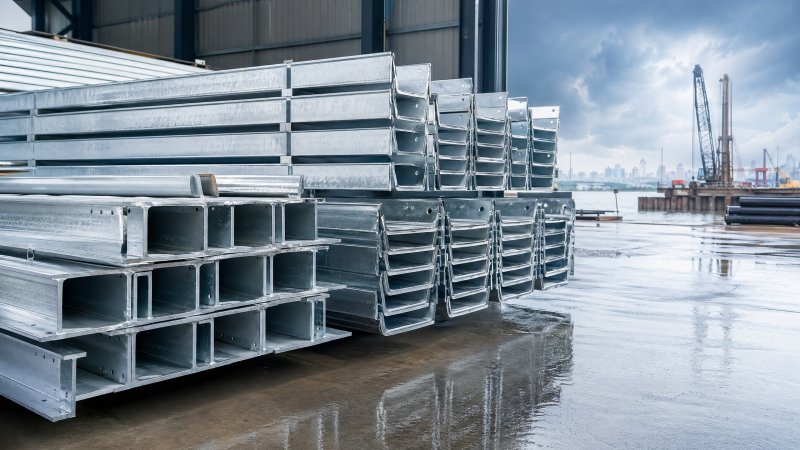
Galvanized steel is carbon steel protected by a zinc coating, most commonly applied through hot-dip galvanizing. In many structural and industrial applications, the zinc layer acts as both a barrier and a sacrificial coating. That means even if the surface is scratched, the zinc can continue protecting the base steel for a period of time. This is one reason galvanized products are widely selected for outdoor service, humid facilities, exposed framing, utility supports, and transport-related fabrication.
The extra cost typically varies by section size, coating thickness, and order volume. In practical B2B sourcing, buyers may see galvanized steel priced roughly 8% to 25% higher than comparable black steel, although actual differences depend on zinc market conditions, fabrication complexity, and regional shipping costs. For thin-gauge profiles and sheet-based products, the percentage impact may feel larger because coating cost makes up a bigger share of total material value.
However, the financial logic changes when the service environment includes rain, coastal air, condensation, chemical splash, or inconsistent maintenance access. In those cases, repainting intervals, shutdown costs, labor hours, and corrosion-related safety risk may exceed the coating premium within 2 to 5 years. This is especially relevant for warehouses, infrastructure support frames, outdoor platforms, fencing systems, cable brackets, and steel components installed in hard-to-reach areas.
For project decision-makers, galvanized steel should be evaluated as a lifecycle decision rather than a unit-price decision. A component with a 15- to 30-year protection window in a moderate environment may reduce maintenance events from every 3 to 5 years to a far less frequent cycle. That matters not only for owners, but also for EPC contractors, distributors, and OEM buyers responsible for warranty exposure or after-sales service.
Typical Cost Drivers Behind Galvanized Steel
Several variables affect whether the premium feels reasonable or excessive in a quotation review:
- Base steel type and thickness, from light-gauge sections to heavy structural beams
- Coating method, such as hot-dip galvanized versus pre-galvanized sheet
- Zinc coating weight or thickness required by the application standard
- Fabrication sequence, especially if cutting, punching, or welding occurs before galvanizing
- Batch size, because small customized orders usually carry a higher processing burden
If the project team understands these cost drivers early, it becomes easier to compare bids fairly and avoid comparing a high-coating product with a lightly protected one that only appears cheaper on paper.
When the Extra Cost Is Usually Justified
Galvanized steel is usually worth the extra cost when corrosion exposure is predictable and long-term access for maintenance is limited. This applies to outdoor support structures, perimeter systems, building secondary framing, rooftop structures, agricultural equipment, transport hardware, and many municipal or utility installations. In these environments, the main savings do not come from the steel itself, but from avoiding repeated surface treatment, rust-related repairs, and operational downtime.
It is also often justified in export business. Steel shipped across oceans may face 4 to 8 weeks of transit, port-side storage, inland handling, and variable climate before installation. A galvanized surface gives buyers more tolerance during logistics and site staging, especially in projects where immediate coating touch-up is impractical. For distributors and project contractors, that can reduce claims related to storage rust, appearance degradation, or inconsistent field protection practices.
Another common case is public or commercial infrastructure where asset owners prefer a lower total maintenance burden over a 10- to 20-year period. If a structure is located above traffic lanes, inside operational plants, or in remote project zones, every repainting cycle can require scaffolding, shutdown planning, permit coordination, and safety controls. In such conditions, a higher upfront material cost may support better budget control over the asset life.
The table below helps compare situations where galvanized steel usually provides strong economic value versus situations where it may be optional.
The key takeaway is that galvanized steel makes the most sense when corrosion is persistent, maintenance access is costly, or the project owner values low intervention over a longer service period. Where structures are temporary, fully enclosed, or easy to maintain, the premium may be harder to justify.
High-Value Scenarios for Buyers and Engineers
1. Outdoor structural support systems
Items such as channels, angles, beams, and cold formed profiles used outdoors often benefit from galvanizing because exposure is continuous and inspection cycles may only occur every 6 to 12 months.
2. Export and inventory-sensitive supply chains
If materials will remain in storage for 30 to 90 days before installation, galvanized surfaces reduce the risk of visible rust, which is important for distributors and project clients who inspect goods upon arrival.
3. Fabricated parts with limited post-installation access
Ladders, handrails, roof framing, equipment supports, and embedded or elevated components are expensive to maintain later, so early corrosion protection often produces better total economics.
When Other Steel Options May Be More Cost-Effective
Not every steel application requires galvanizing. In controlled indoor environments with low moisture, stable temperatures, and easy maintenance access, painted or untreated carbon steel may be the more rational option. This is common in interior machine guards, indoor storage racks, appliance components, temporary fabrication fixtures, and enclosed industrial housings where surface corrosion develops slowly and can be managed during normal maintenance intervals.
This is also where product selection should be linked to forming requirements, surface finish, and downstream processing. For example, some manufacturing projects need steel primarily for stamping, bending, chassis fabrication, switchboards, rails, or interior panels rather than long-term outdoor exposure. In such cases, the material decision may prioritize formability and dimensional consistency over external zinc coating.
A practical inserted example is Carbon Steel Plate used in applications such as refrigerators, switchboards, automobile chassis, roofing parts, rear side panels, iron baskets, and interior boards. Available grades such as SPCC, SPCD, SPCE, SPCF, and SPCG support different forming levels, with thickness ranges from 0.1 mm to 400 mm, widths from 100 mm to 3000 mm, and lengths from 1 m to 12 m or customized sizes. For buyers focused on smooth surface finish, excellent formability, and controlled mechanical behavior, this type of plate can be a better fit than galvanized structural steel in indoor or protected-use scenarios.
Its technical profile also shows why selection must match end use. For example, SPCC-grade chemistry commonly limits C to 0.15 and Mn to 0.60, while deeper drawing grades like SPCG reduce C to 0.02 and Mn to 0.25. Mechanical condition can range from annealed to full hard, with hardness levels such as 50 to 71 HRBS for 1/8 hard and 74 to 89 HRBS for 1/2 hard. These distinctions matter far more than galvanizing when the critical requirement is shaping, stamping, or visible surface quality rather than long-term outdoor corrosion resistance.
A Practical Comparison of Selection Logic
The table below compares simplified decision factors for galvanized steel and protected-use carbon steel products in common procurement discussions.
This comparison shows that the right answer depends on function, exposure, and service expectations. Purchasing teams should avoid treating all steel products as interchangeable simply because the base material is carbon steel.
How to Evaluate the Real Return on the Extra Cost
The strongest way to decide is to compare total ownership cost across at least 3 dimensions: initial supply price, maintenance cost over time, and failure or replacement risk. For many industrial buyers, a simple 5-year or 10-year ownership model is enough to expose whether galvanized steel creates value. Finance approvers do not always need laboratory corrosion data; they need a decision structure that connects technical conditions to future cash exposure.
A practical internal review can be built around 5 questions. First, what is the expected service environment: indoor dry, outdoor rural, industrial humidity, or marine-influenced? Second, how many maintenance interventions are acceptable over 10 years? Third, what does one intervention cost in labor, access equipment, shutdown, and coatings? Fourth, what is the consequence of corrosion: appearance only, reduced durability, or safety risk? Fifth, how stable is the supplier’s quality and coating control?
For structural steel procurement, many buyers use threshold logic. If the corrosion risk is medium to high, planned service exceeds 8 to 10 years, and maintenance access is difficult, galvanized steel often becomes commercially reasonable even if the upfront premium is in the low double digits. If all 3 factors are low, standard carbon steel with proper paint or controlled use may remain the better choice.
The evaluation matrix below can help engineering teams and commercial reviewers align their recommendation before issuing purchase orders.
When 3 or more metrics fall into the high-score side, galvanized steel is more likely to justify its premium. This approach helps procurement teams move the discussion from “price per ton” to “cost per year of reliable service.”
A Simple 4-Step Internal Review Process
- Define the service environment and required project life, such as 5, 10, or 20 years.
- Estimate maintenance events for non-galvanized steel, including labor, shutdown, and coating materials.
- Compare coating premium against expected maintenance savings and replacement risk.
- Validate supplier capability on standards, inspection, packaging, and delivery schedule.
This review process is especially useful for distributors, project managers, and commercial teams who need a practical decision framework without overcomplicating the specification stage.
Supplier, Quality, and Delivery Factors That Influence the Decision
Even when galvanized steel is technically justified, the sourcing result depends heavily on supplier execution. Coating quality, steel chemistry stability, dimensional tolerance, packing method, and traceability can determine whether the premium actually creates value. A poorly controlled galvanized product can still generate delays, fit-up problems, or rework at the installation stage.
For international buyers, a capable structural steel manufacturer should support standard specifications and custom processing while maintaining consistent quality inspection. Hongteng Fengda’s business model is aligned with this type of demand: structural steel manufacturing and export from China for global construction, industrial, and manufacturing projects, with product coverage including angle steel, channel steel, steel beams, cold formed steel profiles, and customized structural steel components. For many importers, that combination matters because a reliable supplier can reduce sourcing risk as much as the material choice itself.
Quality evaluation should include more than certificates. Buyers should ask whether products comply with the project’s required standards, such as ASTM, EN, JIS, or GB, whether coating inspection records are available when relevant, and whether the supplier can support OEM requirements or non-standard fabrication. Stable production capacity and dependable lead times are especially important when shipments are scheduled into phased construction programs or multi-country distribution networks.
Lead time planning is another hidden cost factor. A buyer may save 3% to 5% on material but lose far more if delayed steel causes site labor rescheduling or vessel storage charges. In many export orders, the more commercially valuable supplier is the one who delivers consistent quality across repeated batches, protects goods for sea transport, and communicates proactively about inspection and shipping milestones.
What Procurement and QC Teams Should Check
- Applicable standards and grades for the target market, including ASTM, EN, JIS, or GB alignment
- Section dimensions, thickness tolerance, straightness, and fabrication accuracy for assembled structures
- Surface condition, packaging suitability, and export protection for 4- to 8-week transit cycles
- Production and delivery capability for both standard and customized steel components
- Inspection communication, document completeness, and responsiveness during order execution
For project managers and safety reviewers, these checkpoints are not administrative details. They directly affect installation speed, corrosion performance, rework rates, and the credibility of the final asset.
Common Questions and Final Decision Guidance
Many buyers know galvanized steel performs well, but they still hesitate because the extra upfront cost competes with budget pressure, especially in bid-sensitive projects. The most effective response is to match material choice to service life, exposure, and maintenance reality rather than trying to apply one rule to all steel products.
In practice, galvanized steel is most often worth the extra cost when the structure is exposed outdoors, expected to last 8 to 20 years or more, and expensive to maintain after installation. It is less compelling for short-life, indoor, easy-access applications where painting or standard carbon steel already meets the requirement.
For engineering teams, the smartest approach is to define exposure class early. For procurement teams, it is to compare lifecycle cost instead of invoice price alone. For distributors and OEM buyers, it is to work with a supplier that can consistently deliver standard-compliant steel, stable quality, and practical support for custom requirements.
Below are several short questions that often come up during internal review and supplier discussions.
Is galvanized steel always better than painted steel?
No. For dry indoor service with easy maintenance access, painted steel may be fully adequate and more economical. The advantage of galvanized steel becomes stronger when moisture, outdoor exposure, or maintenance difficulty increases.
How long should the planned service life be before galvanizing makes sense?
There is no single threshold, but many buyers begin to favor galvanizing when the expected service life is above 8 to 10 years and repainting would be disruptive or costly. In coastal or industrial humidity conditions, the case may become strong even earlier.
What is the most common mistake in steel selection?
The most common mistake is comparing steel only by ton price without accounting for corrosion exposure, maintenance frequency, and replacement risk. A lower initial quote can become the higher-cost option over the operating life of the asset.
What should import buyers ask a structural steel supplier?
Ask about standards compliance, production capacity, dimensional control, packaging for export, inspection process, and realistic lead time. These factors are critical for projects in North America, Europe, the Middle East, and Southeast Asia where schedule and consistency matter as much as price.
If you are evaluating galvanized steel for beams, channels, angles, cold formed profiles, or custom structural components, a clear technical-commercial review will usually reveal whether the premium is justified. When the goal is lower lifecycle cost, dependable corrosion performance, and reduced sourcing risk, the right supplier becomes part of the answer. Contact Hongteng Fengda to discuss your application, compare specification options, and get a customized steel solution for your project or distribution needs.
Please give us a message


Please enter what you want to find