Choosing the right flexible steel wire grade can directly affect strength, fatigue resistance, corrosion performance, and long-term project safety. For technical evaluators, the key is not only comparing specifications, but also verifying material standards, processing quality, application fit, and supplier consistency. This guide outlines the essential checks before selecting a grade for demanding structural and industrial use.
Why Application Context Matters More Than a Simple Grade Comparison
For technical evaluation teams, flexible steel wire is rarely chosen in isolation. It is selected for a real operating environment: lifting, binding, reinforcement, suspension, motion transfer, fencing, industrial handling, or structural support. A grade that performs well in one scenario may fail early in another because the dominant risk changes. In static indoor use, tensile capacity and dimensional consistency may be enough. In marine, cyclic, or abrasive service, corrosion resistance, fatigue behavior, coating integrity, and surface quality become more important than headline strength.
This is why experienced evaluators do not ask only, “Which grade is stronger?” They ask, “Which grade matches the service condition, installation method, expected life, and safety margin?” In the steel industry, that distinction separates low initial cost from low lifecycle cost. It also reduces the chance of over-specifying premium material where standard carbon steel is sufficient, or under-specifying wire that later causes maintenance issues, downtime, or safety exposure.
Common Business Scenarios Where Flexible Steel Wire Is Evaluated
A useful way to assess flexible steel wire is to start from the application scenario. Below are common industrial and construction-related cases where grade selection criteria differ significantly.
This scenario-based view helps technical evaluators align performance criteria with actual use instead of relying on generic material descriptions.
Scenario 1: Construction and Structural Jobs Need Balanced Strength and Workability
In construction projects, flexible steel wire is often used for tying reinforcement, temporary fastening, packaging steel members, mesh preparation, and light support applications. These jobs usually demand a practical balance: enough strength for secure holding, but sufficient flexibility for rapid on-site handling. If the wire is too hard, crews lose productivity and bending performance suffers. If it is too soft, it may loosen under tension or deform excessively.
For these projects, evaluators should focus on ductility, repeatable diameter, surface condition, and coating selection for the site environment. On inland projects with short exposure, untreated or lightly protected carbon steel wire may be acceptable. On humid or long-duration sites, galvanized options often reduce rust-related complaints and waste.
Key checks for construction-driven use
- Confirm whether the wire is for temporary fixing or semi-permanent service.
- Check if repeated manual bending is required during installation.
- Verify coil quality, straightness, and ease of handling on site.
- Match corrosion protection to storage duration and outdoor exposure.
When structural steel packages include multiple carbon steel items, evaluators often benchmark material behavior across related products. For example, buyers comparing wire with bars and fabricated sections may also review Hot rolled Carbon Steel Round Bar options used in construction, handrails, railings, fences, furniture frames, and shipment structures. Products available in grades such as S235JR, S355JR, Q345, 20#, 45#, ST37, ST52, and 30CrMo show how application fit, tensile strength, wear resistance, dimensions, and surface treatments like passivation, oiling, lacquer sealing, phosphating, galvanizing, or anti-rust oil can vary by use case.
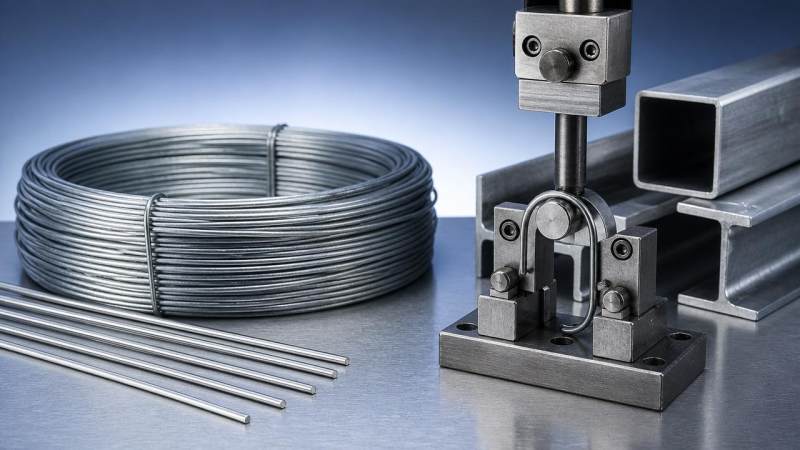
Scenario 2: Dynamic or Cyclic Service Requires More Than High Tensile Strength
One of the most common evaluation mistakes is assuming that a higher tensile number automatically means a better flexible steel wire. In dynamic applications, this is not always true. Wire used in repeated bending, vibration, pulleys, moving assemblies, tension cycling, or machinery support can fail from fatigue long before it reaches nominal tensile capacity.
In these scenarios, technical teams should give extra attention to microcracks, surface scoring, decarburization, drawing quality, and consistency from batch to batch. Even small surface defects can become fatigue initiation points. A supplier that can provide stable process control, mechanical test reports, and heat or lot traceability is usually more valuable than one that only offers an attractive price per ton.
If the wire will pass through guides, rollers, or contact points, surface finish matters even more. Rough coating, uneven diameter, or hidden residual stress can accelerate wear and shorten service life.
What to verify for cyclic loading
- Minimum bend radius in real operation, not only in lab assumptions.
- Expected cycle count and maintenance interval.
- Whether the wire experiences shock load or smooth load transfer.
- Inspection data for surface defects and mechanical consistency.
Scenario 3: Outdoor, Coastal, and Corrosive Environments Change the Grade Decision
For outdoor infrastructure, fencing, barriers, agricultural use, and coastal industrial sites, corrosion performance can dominate the grade decision. A technically adequate flexible steel wire in dry indoor use may become a poor choice in chloride-rich air, heavy rainfall, or chemical exposure. In these environments, buyers should assess not only the base carbon steel but also protective systems such as galvanizing, oil films, passivation, or other surface treatments.
Corrosion assessment should include exposure duration, contact with other metals, drainage conditions, and whether damage to the coating is likely during transport or installation. Technical evaluators should also separate “decorative outdoor use” from “functional outdoor load-bearing use.” The latter demands stricter quality verification and often more conservative material selection.
Questions to ask in corrosive applications
- Is the environment rural, urban, industrial, or marine?
- Will the wire be exposed continuously or intermittently?
- Can coating damage be repaired after installation?
- Are there project specifications tied to ASTM, EN, JIS, or GB standards?
Scenario 4: OEM and Fabrication Projects Must Check Process Compatibility
For OEM buyers and fabrication teams, the right flexible steel wire grade is the one that performs reliably through the full manufacturing route. That includes cutting, forming, welding where applicable, coating, packaging, transport, and final assembly. A wire that looks acceptable at incoming inspection may still cause production loss if it behaves inconsistently during automated or semi-automated processing.
This is especially relevant when the wire is paired with other carbon steel products in fabricated systems. In many supply chains, companies sourcing wire also source round bars, channels, beams, or cold formed profiles from the same manufacturer to simplify quality control. A supplier with integrated structural steel capability, modern production facilities, and compliance with standards such as ASTM, EN, JIS, and GB can often provide better consistency across product categories and reduce sourcing risk for export-oriented projects.
For example, when evaluating fabricated accessories alongside Hot rolled Carbon Steel Round Bar, teams may compare process needs such as excellent strength, wear resistance, length options from 2 m to 12 m, diameter ranges from 5 mm to 2500 mm, and export packaging suitability. This broader review helps ensure the selected wire grade fits the same production logic and delivery expectations.
How Technical Evaluators Should Compare Flexible Steel Wire by Scenario
A structured comparison framework makes evaluation faster and more defensible. Instead of reviewing every grade equally, rank requirements by scenario impact.
This approach helps technical teams justify why one flexible steel wire grade is acceptable for packaging or temporary use but unsuitable for long-term industrial service.
Frequent Misjudgments When Choosing a Grade
Several recurring mistakes lead to poor wire selection:
- Choosing by tensile strength only and ignoring fatigue or bend behavior.
- Assuming all galvanized wire offers the same corrosion life.
- Using indoor test assumptions for outdoor or marine installations.
- Approving one sample without verifying lot-to-lot production consistency.
- Overlooking packaging, storage, and transport conditions that may damage the surface before use.
- Accepting incomplete documentation for export or regulated projects.
For technical evaluators, preventing these mistakes is often more valuable than finding the lowest quoted price. The true cost of a mismatched flexible steel wire grade usually appears later through rejects, downtime, field replacement, or safety risk.
Supplier Checks That Support Better Scenario Matching
A reliable supplier should help translate application requirements into a realistic grade recommendation. This is especially important for global projects where structural steel products must meet multiple standards and delivery schedules. Technical teams should check whether the supplier can provide:
- Material certificates and standard references.
- Mechanical property data linked to actual production lots.
- Surface treatment options suitable for the target environment.
- Stable production capacity and export packaging capability.
- Support for customized dimensions or OEM specifications.
- Clear lead times and quality control procedures.
For buyers working across North America, Europe, the Middle East, and Southeast Asia, supplier stability can be as important as the material itself. A manufacturer with dependable lead times and strong process control helps reduce sourcing risk and keeps project schedules intact.
FAQ for Technical Evaluators
Is higher strength always better for flexible steel wire?
No. In many applications, especially those involving repeated bending or vibration, a stronger wire may be less suitable if ductility and fatigue performance are reduced. Match the grade to the service mode, not only the maximum strength.
When should galvanized wire be preferred?
Use galvanized or otherwise protected flexible steel wire when the application includes outdoor exposure, humidity, storage uncertainty, or corrosive atmospheres. The required coating level depends on environment severity and design life.
What documents should be reviewed before approval?
At minimum, review material grade confirmation, mechanical test reports, dimensional inspection data, coating or surface treatment details, and any relevant standard compliance records. For critical use, request batch traceability and additional testing evidence.
Final Recommendation: Start from the Scenario, Then Confirm the Grade
The most effective way to select flexible steel wire is to begin with the real application scenario: static or dynamic, indoor or outdoor, temporary or long-term, low-risk or safety-critical. Once that context is clear, technical evaluators can verify the right combination of strength, ductility, fatigue resistance, corrosion protection, dimensional stability, and supplier consistency.
For construction, industrial, and OEM buyers, the best result usually comes from working with a structural steel manufacturer that understands both standard specifications and customized project needs. If your team is comparing wire grades for export, fabrication, or long-life service, the next step should be a scenario-based technical review supported by clear standards, test documents, and dependable supply capability.
Please give us a message


Please enter what you want to find