When comparing DX52D coil and DX51D for forming applications, technical buyers need more than a grade label—they need clear data on ductility, surface quality, process stability, and end-use performance. This guide explains the key differences between the two galvanized steel grades, helping evaluation teams choose the most suitable material for bending, stamping, and structural manufacturing with greater confidence.
In practical sourcing, the choice between DX52D coil and DX51D often affects not only forming success, but also scrap rate, tooling wear, coating integrity, and downstream assembly efficiency. For evaluation teams in construction, profile manufacturing, and light structural processing, selecting the wrong grade can increase cracking risk at tight radii, reduce dimensional stability, or create avoidable rework during stamping and welding.
For buyers working with galvanized steel, the decision should be based on 4 key factors: required formability, target strength range, zinc coating condition after deformation, and consistency from batch to batch. This is especially important when parts move from simple roll forming into more demanding operations such as deep bending, moderate drawing, or repetitive press forming.
Understanding DX52D Coil and DX51D in Forming Applications
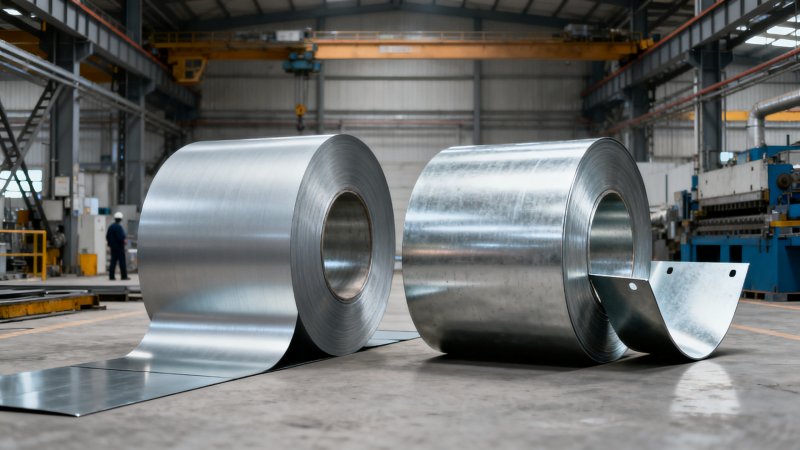
DX51D and DX52D both belong to galvanized flat steel grades widely used under EN-related supply practice for cold forming and general fabrication. However, they are not interchangeable in every process. DX51D is commonly selected for standard forming and general sheet metal applications, while DX52D coil is typically preferred when the part geometry demands higher ductility and more stable elongation behavior.
In simple terms, DX51D is suitable for routine bending, light profiling, and standard panel work. DX52D coil moves one step further in formability. It is generally better suited to tighter bend radii, more complex press operations, and shaped components where surface cracking or loss of coating adhesion becomes a concern after deformation.
Why the grade difference matters
The practical difference is often seen in elongation and forming safety margin. A technical team may process both grades at similar thicknesses such as 0.5 mm, 1.0 mm, or 2.0 mm, but the acceptable bend radius, springback control, and die performance can vary. In many production lines, this difference becomes visible after the first 500 to 1,000 pieces, when minor cracking or coating stress starts appearing on more demanding shapes.
Typical decision triggers for technical buyers
- Parts with multiple bends or narrow flange sections
- Stamped components requiring stable elongation above standard forming levels
- Projects where zinc layer continuity must remain visually acceptable after forming
- OEM production with repeatable tolerances across several coil lots
The table below outlines the most relevant forming-oriented comparison points for evaluation teams reviewing DX51D versus DX52D coil.
For straightforward construction sheet work, DX51D often remains cost-effective and technically sufficient. However, when forming complexity increases even by 1 to 2 process steps, DX52D coil can reduce risk, especially where cracking at edges, unstable springback, or zinc stress marks would affect acceptance.
Mechanical Performance and Process Stability
Technical evaluation should focus on the relationship between yield strength, tensile strength, and elongation. For galvanized forming grades, lower and more controlled yield behavior usually supports smoother deformation. Based on common supply ranges for galvanized steel products, a forming-oriented coil may fall within about 140-300 MPa yield strength and 270-420 MPa tensile strength, with elongation around 26% depending on grade, thickness, and mill route.
That does not mean every DX52D coil will behave identically, but it does explain why it is often chosen when the process requires more deformation reserve. In technical review, the key is not only absolute strength values, but how stable the coil performs over several operations such as decoiling, leveling, punching, bending, and spot welding.
What evaluation teams should test
- Minimum bend radius at actual thickness, such as 0.8 mm, 1.2 mm, or 2.0 mm
- Elongation consistency across head, middle, and tail of one coil
- Coating condition after 90° and 180° bending
- Springback variation in repeated tool cycles
- Surface performance after welding, grinding, or light re-forming
A note on production risk
In many factories, the cost difference between DX51D and DX52D is less significant than the cost of interruption. If a line produces 3,000 to 10,000 formed pieces per batch, even a 2% scrap increase can create a noticeable loss in material, labor, and machine time. For this reason, technical buyers should compare total processing stability rather than base material price alone.
Another common issue is coating damage during aggressive forming. Galvanized steel protects the substrate from corrosion, but if the deformation is too severe for the selected grade, micro-cracking or localized flaking may appear at corners or drawn areas. That can be especially relevant in visible construction components, brackets, ducts, light framing parts, and fabricated supports used in humid or outdoor conditions.
How Product Specifications Affect the DX52D vs DX51D Choice
Beyond the grade name, technical selection depends on dimensions, coating mass, and processing route. In many galvanized steel projects, thickness ranges from 0.12 mm to 3.5 mm, while width can run from 600 mm to 1500 mm. These dimensions influence flatness, roll forming behavior, die loading, and how much forming reserve is realistically needed.
For buyers comparing material options for building processing and construction, Gi Sheet Coil can be supplied in grades including DX52D and SGCD1, with galvanized steel substrate, hot galvanizing from 60-275 g/m², and pre-galvanized coating from 80-275 g/m². Typical dimensions include thickness 0.12 mm-3.5 mm and width 600 mm-1500 mm, with coil ID options such as 508 mm or 610 mm and customization support for different manufacturing lines.
These parameters matter because coating mass and thickness together affect forming behavior. A thin sheet with a heavy zinc layer may require different die control than a thicker sheet with a moderate coating. Likewise, if the end use includes welding operations, the balance between coating thickness, weldability, and post-form surface condition should be checked during sample approval.
Specification factors that influence forming performance
The following table shows how major specification variables can shift the decision between DX51D and DX52D coil in technical procurement.
The key takeaway is that DX52D coil becomes more valuable as forming severity rises. If the application is limited to standard building trims, basic channels, or lightly bent galvanized parts, DX51D may remain adequate. If the part includes tighter geometry, aesthetic requirements, or strict coating continuity, DX52D usually offers a safer process window.
Application-Based Selection for Construction and Structural Processing
In the steel industry, material choice is often decided by actual fabrication steps rather than standard names alone. For structural steel manufacturers and exporters serving buyers in North America, Europe, the Middle East, and Southeast Asia, it is common to support mixed demand: some customers need standard galvanized sheet for simple fabrication, while others require better-forming material for customized profiles, brackets, or cold-formed components.
A solution-oriented supplier should therefore review 3 practical checkpoints before confirming grade selection: forming method, final part geometry, and acceptance standard. This approach reduces sourcing risk and helps avoid mismatch between laboratory values and shop-floor performance.
Where DX51D is usually sufficient
- Standard roofing and cladding accessories with simple bending lines
- Ventilation or covering components with low drawing depth
- General construction sheet parts where visual perfection is not the top criterion
- Projects prioritizing broad availability and cost control
Where DX52D coil is often the better fit
- Cold formed structural accessories with multiple bends
- Stamped galvanized components with tighter dimensional tolerance
- Parts requiring cleaner surface retention after forming and welding
- OEM projects where repeatability across several lots is critical
Selection advice for technical review teams
If your forming route includes only 1 or 2 mild bends, start with DX51D sample validation. If the process includes 3 or more deformation stages, tight corner radii, or visible surface requirements, request DX52D coil trials under production conditions. Sample testing should cover not just tensile data, but actual tooling behavior, coating response, and post-form inspection.
For projects requiring stable quality and international standard alignment, it also helps to work with manufacturers that can supply galvanized products under ASTM, EN, JIS, and GB related requirements, while maintaining consistent processing control. This is particularly relevant for global construction and industrial buyers who need predictable lead times and reduced sourcing uncertainty.
Common Buying Mistakes and How to Avoid Them
One common mistake is treating all galvanized forming grades as equal because the zinc finish looks similar. In reality, two coils with similar appearance may behave differently during bending or stamping. Another mistake is selecting only by nominal price per ton without accounting for scrap, downtime, die adjustment, and requalification time, which may cost more than the initial material difference.
A third issue is skipping process-based communication with the supplier. Technical buyers should share at least 6 data points: thickness, width, coating requirement, minimum bend radius, part use, and whether welding follows forming. With these details, the supplier can recommend whether DX51D is enough or whether DX52D coil is the safer commercial and technical choice.
Practical checklist before placing an order
- Confirm forming type: roll forming, press bending, stamping, or multi-step shaping
- Define thickness range, such as 0.6-1.2 mm or 1.5-2.5 mm
- Specify zinc coating target and service environment
- Review required standards and inspection points
- Test at least 1 sample coil or representative sheets before mass order
- Compare total processing cost, not just raw material price
For technical buyers evaluating galvanized steel for construction and manufacturing, the difference between DX51D and DX52D is not theoretical. It directly affects forming reliability, part quality, and production efficiency. DX51D remains a practical solution for many general applications, while DX52D coil is usually the stronger choice when ductility, bend performance, and process stability carry more weight in the decision.
Hongteng Fengda supports global buyers with structural steel products, galvanized steel options, custom processing understanding, and dependable export supply for construction and industrial projects. If you need help comparing grades, reviewing specifications, or matching a galvanized coil to your forming process, contact us now to get product details, technical guidance, or a customized sourcing solution.
Please give us a message


Please enter what you want to find