Choosing the right carbon plate steel for structural use directly affects project safety, fabrication efficiency, and long-term cost control. For global structural work, carbon plate steel must match design loads, welding methods, corrosion exposure, and code requirements. A clear understanding of common grades helps improve specification accuracy, reduce sourcing risk, and support reliable project execution.
What is carbon plate steel and why is it widely used in structures?
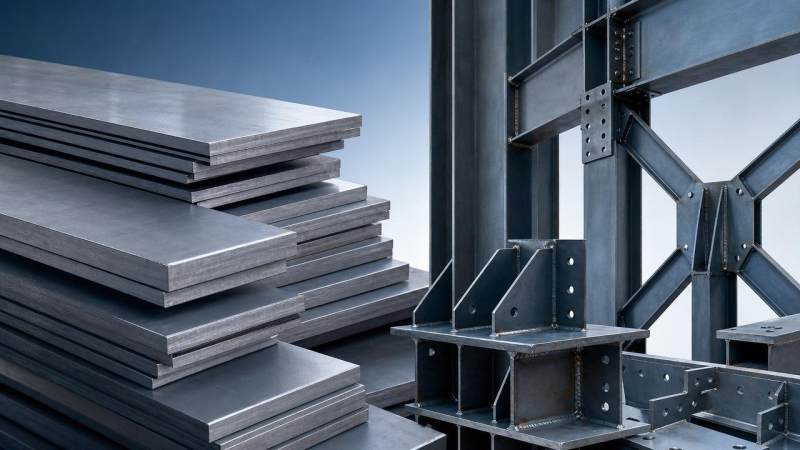
Carbon plate steel is flat rolled steel with carbon as the main alloying element. It is used in frames, base plates, brackets, columns, bridges, equipment supports, and fabricated steel components.
Its popularity comes from balanced strength, good machinability, broad availability, and lower cost than many alloy steels. It also supports cutting, drilling, bending, and welding in standard fabrication environments.
For structural use, carbon content matters. Low-carbon grades usually provide better weldability and forming performance. Medium-carbon grades may offer higher strength, but often require tighter fabrication control.
When people search for carbon plate steel, they often need more than a material name. They need to know the grade system, mechanical properties, available thickness, and whether the steel fits local standards.
Which carbon plate steel grades are commonly used for structural applications?
Several grade systems appear in international projects. The most common include ASTM, EN, JIS, and GB. Each system defines chemical composition, yield strength, tensile strength, and testing rules.
ASTM structural plate grades
ASTM A36 is one of the best known carbon plate steel grades. It is widely used for general structural fabrication, base plates, frames, and welded assemblies.
ASTM A572, especially Grade 50, is selected when higher strength is needed without excessive weight increase. It is common in buildings, bridges, and industrial steelwork.
ASTM A283 may be used for general structural and moderate strength requirements. It is often considered where formability and economy are important.
EN, JIS, and GB equivalents
In Europe, S235, S275, and S355 are common reference grades. These are frequently compared with ASTM options during international bidding and technical review.
In Japan, SS400 is widely recognized for structural use. In China, Q235 and Q355 are common choices for welded structures and steel fabrication projects.
Equivalent grades are not always identical. Matching strength alone is not enough. Impact performance, composition limits, and thickness-specific rules must also be checked carefully.
How do you choose the right carbon plate steel grade for a project?
Grade selection should begin with structural design requirements. Yield strength, tensile strength, plate thickness, and service temperature all influence the final choice.
Weldability is another key factor. Some carbon plate steel grades perform well under routine welding procedures. Others may need preheating, tighter heat input control, or post-weld treatment.
Environmental exposure also matters. Standard carbon plate steel can corrode in marine, chemical, or humid conditions. In those cases, coating systems or galvanized accessories become necessary.
For lifting, anchoring, or outdoor support systems, related steel products must follow the same durability logic. In corrosion-sensitive operations, Galvanized Steel Wire Rope may be selected for mining, marine industries, cranes, elevators, and drilling support applications.
That product is available in steel and stainless steel options, with normal tensile strength from 1470Mpa to 1960Mpa. Common constructions include 6X7+FC, 6X19+IWR, and 8x19S+FC.
It can also be supplied in plain, electro galvanized, or hot dipped galvanized finishes. Certification options include GB/T 20116-2008, DIN, EIPS, ISO 9001, and ABS.
A practical selection checklist
- Confirm required yield strength and load path.
- Review welding process and heat treatment limits.
- Check plate thickness range and mill capability.
- Verify compliance with ASTM, EN, JIS, or GB standards.
- Assess corrosion risk and coating needs.
- Request mill test certificates and traceability records.
What are the main differences between low-strength and high-strength carbon plate steel?
Lower-strength grades like A36 or Q235 are often easier to form and weld. They are suitable for general steel structures where design loads remain moderate.
Higher-strength grades like A572 Grade 50 or Q355 help reduce section size and dead load. This can support transport efficiency and lower total steel consumption.
However, stronger carbon plate steel may increase fabrication sensitivity. Hole making, flame cutting, and welding control may require stricter procedures to protect performance.
The best choice depends on the full system. Material price alone should not drive the decision. Processing cost, welding time, inspection needs, and availability affect the real project budget.
What mistakes should be avoided when specifying carbon plate steel?
A common mistake is using “equivalent grade” too loosely. Similar names do not guarantee identical chemistry, notch toughness, or certification acceptance in regulated projects.
Another issue is ignoring thickness effects. Mechanical properties can vary by thickness range. A grade that works in thin plate may not meet expectations in heavy sections.
Many failures begin with incomplete documentation. Material certificates, heat numbers, dimensional tolerances, and testing scope should be defined before production starts.
Surface protection is also underestimated. Carbon plate steel exposed to aggressive environments needs painting, galvanizing, or another protective system matched to service life targets.
Quick risk reminder
- Do not compare grades by strength only.
- Do not skip weld procedure compatibility checks.
- Do not ignore corrosion class and coating design.
- Do not assume all mills supply the same tolerance level.
How can supply quality and project consistency be improved?
Reliable sourcing starts with a manufacturer that understands structural steel standards, fabrication requirements, and export documentation. Stable production capacity reduces schedule pressure and replacement risk.
Consistency also depends on process control. Material selection, rolling quality, cutting accuracy, packaging, and inspection should align with the end-use structural application.
For international orders, it helps to confirm standard compliance early. ASTM, EN, JIS, and GB requirements should be matched to drawings, calculations, and approval procedures.
Working with an experienced structural steel supplier supports better coordination on angle steel, channel steel, steel beams, cold formed profiles, and custom structural steel components.
Final answer: which carbon plate steel grade is best?
There is no single best carbon plate steel grade for every structure. The right option depends on strength target, fabrication method, environment, code compliance, and delivery reliability.
For general structural use, grades like A36, Q235, or SS400 often provide practical value. For higher load efficiency, A572 Grade 50, S355, or Q355 may be more suitable.
A good specification combines grade selection, corrosion protection, inspection documents, and supplier capability. That approach helps control cost while protecting long-term structural performance.
If your project needs structural steel products built to international standards, a dependable Chinese supplier with export experience can support both standard and customized solutions efficiently.
Please give us a message


Please enter what you want to find