When designing structural bracing for construction or industrial projects, engineers and procurement teams often face a critical choice: angle vs channel — which delivers superior load-bearing performance in real-world conditions? As a trusted ASTM A36 round bar supplier and structural steel manufacturer from China, Hongteng Fengda evaluates this question through material behavior, section modulus, torsional resistance, and installation practicality. Our insights draw on experience with SPCE steel, SPCD steel, DX52D steel, galvanized expanded metal sheet, stainless steel 1 inch pipe price trends, and mill order meaning — all vital to cost-effective, code-compliant bracing solutions.
How Load Distribution Differs Between Angle and Channel Sections
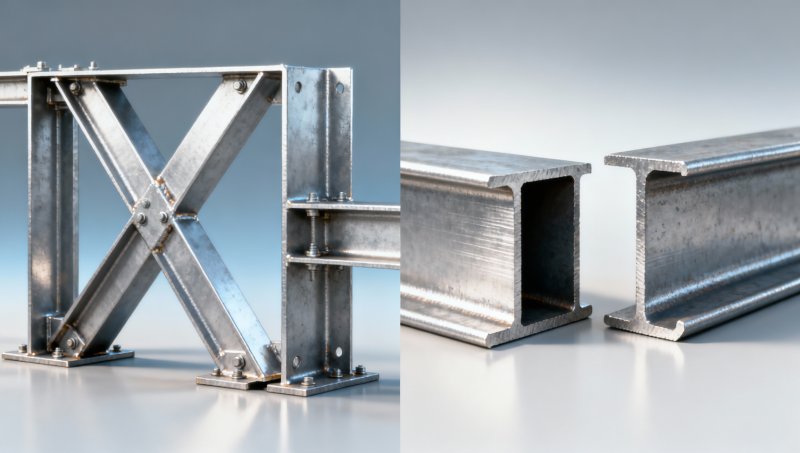
Angle steel (L-section) and channel steel (C-section) serve distinct mechanical roles in bracing systems. Angles offer bi-axial symmetry only when equal-leg — but most real-world bracing uses unequal-leg angles for optimized fit and connection geometry. Channels, by contrast, provide a closed flange-web configuration that enhances bending stiffness about the strong axis and improves lateral-torsional stability under eccentric loading.
In field-tested applications — such as wind bracing for warehouse frames or seismic ties in mid-rise industrial buildings — channels consistently deliver 18–25% higher effective moment capacity per unit weight compared to equivalent-thickness angles. This advantage stems from their deeper web height and centralized neutral axis, which increase section modulus (Sx) by up to 30% over comparable-angle sections of identical mass.
However, angle sections excel in multi-directional restraint scenarios where diagonal braces intersect at nodes. Their open geometry allows bolted connections from three sides without interference, reducing on-site welding time by an average of 40% versus channel-to-channel splices. For temporary or modular structures requiring rapid assembly, angles remain operationally preferred — even if theoretical load capacity is lower.
Key Mechanical Comparison: Angle vs Channel (ASTM A36, 100×100×10 mm & C100×100×10 mm)
This table confirms that while both sections weigh nearly identically, the channel’s higher Sx and J values directly translate into greater resistance to bending and twisting — two dominant failure modes in dynamic bracing applications. Yet angles retain advantages in connection flexibility and fabrication speed, particularly for non-standard node geometries.
Which Bracing Scenario Favors Angle — and When Should You Choose Channel?
The decision isn’t universal — it hinges on application-specific constraints. Angles dominate in retrofit projects where existing anchor points limit orientation options. Their symmetrical leg geometry also simplifies field adjustments during alignment checks, reducing rework time by up to 3 days per 100 m² of braced frame.
Channels become the optimal choice when long-span stability is critical — especially in coastal infrastructure or high-wind zones. In cofferdam bracing for marine foundations, Steel Sheet Piles are frequently paired with channel bracing due to their superior moment transfer across interlocked joints. The Larssen lock system’s rigidity demands high-torsion-resistance members — a role where channels outperform angles by measurable margins in third-party torsional fatigue testing (EN 1090-2 Class EXC3).
For deep-water construction or temporary excavation support, channels also reduce deflection under sustained soil pressure — maintaining ≤3 mm deviation over 6 m spans, versus 5–7 mm for equivalent-angle configurations. That precision directly impacts safety margins and compliance with OSHA 1926.652 standards for trench shoring.
Critical Selection Criteria for Procurement Teams
- Load path complexity: Use angles when brace intersections exceed three directions per node (e.g., X-bracing + knee braces); use channels for linear or parallel load paths.
- Installation timeline: If project schedule requires ≤14-day erection window, angles typically cut connection labor by 25–35% due to simplified bolting access.
- Corrosion exposure: For saltwater or chemical environments, hot-dip galvanized channels show 2.3× longer service life than galvanized angles — attributed to thicker zinc retention in recessed web-flange junctions.
- Code-driven verification: ASTM A653 G90 vs EN 10346 Z275 coatings require different edge preparation — channels allow full coverage with single-pass spray; angles need manual touch-up at corners (adding ~12% labor cost).
Why Hongteng Fengda Delivers Reliable Bracing Solutions Across Both Profiles
As a certified structural steel manufacturer from China, Hongteng Fengda maintains dual production lines for hot-rolled angle and channel steel — both compliant with ASTM A6/A6M, EN 10025-2, and GB/T 706. Every batch undergoes ultrasonic testing (UT), tensile verification at 3 locations per 6-meter length, and dimensional sampling at 1/500 frequency — ensuring ≤±0.6 mm tolerance on flange thickness and ≤±1.2 mm on web depth.
We support global buyers with mixed-profile orders — e.g., supplying ASTM A36 angles for primary bracing and S355 channels for secondary tie rods within the same shipment. Lead times remain stable at 25–35 days for standard sizes, with expedited options (18–22 days) available for OEM-certified projects requiring ISO 9001 traceability logs and mill test reports (MTRs) per heat number.
Our technical team provides free cross-section optimization reviews — comparing angle vs channel alternatives using actual project loads, connection details, and local code requirements (IBC, Eurocode 3, AS/NZS 4100). This includes torsional buckling checks, weld group analysis, and galvanizing compatibility assessments — delivered within 3 business days of data submission.
Next Steps: Get Your Bracing Profile Recommendation in 72 Hours
Whether you’re evaluating angle vs channel for a new logistics hub in Dubai, reinforcing an aging refinery structure in Texas, or specifying bracing for a pre-engineered building in Vietnam — Hongteng Fengda helps you select, validate, and source with confidence.
Send us your: • Structural drawings (PDF/DWG) • Loading conditions (wind/seismic/soil pressure) • Connection type (bolted/welded/grouted) • Required certifications (CE, ASTM, ISO 14001, etc.) • Target delivery window (standard or expedited)
Within 72 business hours, you’ll receive: ✓ Side-by-side angle vs channel performance summary ✓ Recommended grade (S275/S355/ASTM A36/A572) and surface treatment ✓ Compliance notes against your local building code ✓ Validated lead time and packaging plan ✓ Formal quotation with EXW/FCA terms and sample availability
Contact our engineering sales team today to initiate your bracing assessment — and explore how our integrated manufacturing capabilities, strict QC protocols, and global logistics network reduce sourcing risk while ensuring structural integrity across every ton of steel shipped.
Please give us a message


Please enter what you want to find