Choosing the right structural profile can directly affect warehouse frame strength, installation efficiency, and total project cost. For project managers comparing angle vs channel steel for warehouse construction, the decision is not only about load capacity, but also connection design, fabrication flexibility, availability, and long-term reliability. This guide explains the key differences between angle steel and channel steel in warehouse framing applications, helping you evaluate which option better supports your project schedule, budget control, and structural performance requirements.
Quick Decision: When Angle Steel or Channel Steel Makes More Sense
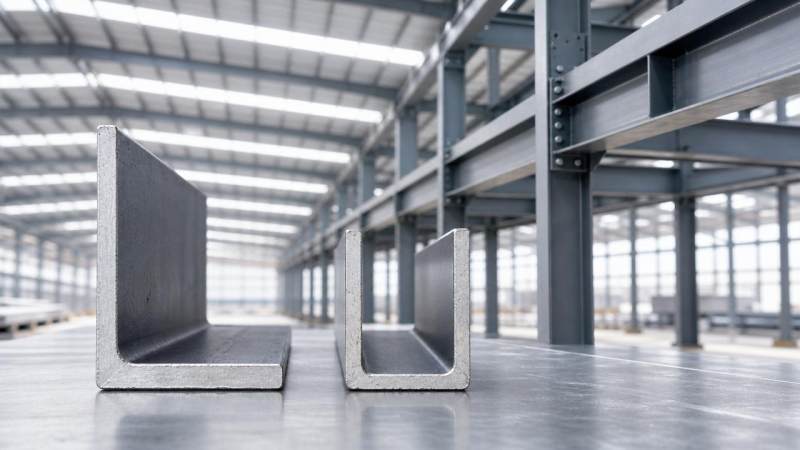
For most warehouse frames, channel steel is better for members requiring higher bending resistance, cleaner alignment, and stronger single-direction support.
Angle steel is often better for bracing, secondary supports, connection components, light framing, and locations where simple fabrication reduces labor time.
The right choice depends on the member function, not only the steel grade or section weight listed on the drawing.
Project managers should first separate primary load-bearing members from secondary support members before comparing price per ton or delivery availability.
If the profile carries roof loads, crane loads, wall pressure, or significant bending, channel steel usually deserves closer engineering review.
If the profile mainly stabilizes, connects, reinforces, or supports lighter fixtures, angle steel may provide a practical cost-performance advantage.
Why This Choice Matters in Warehouse Construction
Warehouse projects are highly sensitive to schedule delays, erection efficiency, and coordination between design, fabrication, logistics, and site installation.
A profile that looks cheaper during procurement can become expensive if it causes difficult welding, extra plates, or slower alignment on site.
For project managers, the practical question is not which section is universally stronger, but which section reduces total execution risk.
Angle and channel steel both serve warehouse construction well, but they behave differently under load and during installation.
Understanding these differences helps avoid overdesign, underdesign, procurement confusion, and repeated coordination between engineers and fabricators.
It also supports clearer communication with suppliers when confirming standards, tolerances, surface treatment, packing method, and delivery schedule.
Structural Behavior: Strength Is About Direction and Application
Channel steel has a U-shaped section, giving it stronger resistance to bending in a predictable primary direction.
This makes it suitable for purlins, girts, secondary beams, platform supports, equipment frames, and edge members in warehouse structures.
Because the web and flanges work together, channel steel often performs better when loads act mainly in one direction.
Angle steel has an L-shaped section, with two legs arranged at ninety degrees and an unequal distribution of stiffness.
It is very useful for bracing, truss components, cleats, lintels, support brackets, and reinforcement details within warehouse frames.
However, angle steel can twist more easily under eccentric loading if the connection and orientation are not properly designed.
This does not mean angle steel is weak; it means the engineer must control how the member receives and transfers load.
For warehouse frames exposed to wind, roof loads, and lateral forces, section orientation and connection detailing are especially important.
Connection Design: The Hidden Cost Factor
Connection design is one of the biggest differences between angle steel and channel steel in real warehouse projects.
Angle steel is easy to bolt, weld, cut, and use as a connector between other structural members.
Its two-leg shape allows simple connection layouts, especially for bracing systems, frames, support clips, and diagonal members.
Channel steel may require more careful access for welding or bolting, depending on whether the open side faces inward or outward.
However, channel sections can provide stronger bearing surfaces and cleaner alignment for repeated modular warehouse components.
If a project uses many standardized connections, channel steel can support faster installation once fabrication details are optimized.
If the project has many small supports or field-adjusted connections, angle steel may reduce fabrication complexity and site modification time.
Before purchasing, project managers should ask whether connection plates, stiffeners, holes, and welding details are included in the cost review.
Cost Comparison: Look Beyond Price per Ton
Steel buyers often compare angle and channel steel by unit price, but warehouse construction cost is broader than material price.
Total cost includes cutting, drilling, welding, surface treatment, inspection, packing, transport, unloading, and erection labor.
Angle steel is commonly available, simple to process, and efficient for light-duty or secondary structural applications.
This can reduce fabrication cost when the design uses many short members, brackets, or bracing elements.
Channel steel may have a higher unit cost in some markets, but it can reduce member quantity or improve frame stability.
In some warehouse designs, a stronger channel section can replace more complex built-up details, reducing welding and inspection work.
The best procurement decision comes from comparing installed cost, not only supplier quotation per metric ton.
Project managers should request section drawings, processing requirements, tolerance expectations, and packing details before confirming the final comparison.
Fabrication and Installation Efficiency on Site
Warehouse frames are usually built under tight deadlines, so fabrication and erection efficiency directly affect project performance.
Angle steel is highly flexible during fabrication because it can be easily cut, punched, welded, and positioned.
This flexibility is valuable when project details change, or when secondary supports must adapt to site conditions.
Channel steel provides better shape consistency for repeated members, which helps modular warehouse systems and standardized assemblies.
Its geometry also supports straightforward alignment when used as purlins, support rails, or load-carrying secondary beams.
On site, angle steel may be easier for workers to handle, especially in smaller sections and lighter assemblies.
Channel steel may require more careful lifting orientation, but it can improve straightness and reduce adjustment during final positioning.
The practical choice should match the crew’s installation method, lifting plan, bolt access, and inspection requirements.
Common Warehouse Applications for Angle Steel
Angle steel is commonly used in warehouse bracing systems where members work mainly in tension or compression.
It is also used for roof truss components, wall supports, equipment brackets, edge protection, and connection cleats.
In mezzanine or maintenance areas, angle steel can support light platforms, handrail bases, stair supports, and auxiliary framing.
Its simple L shape makes it convenient when engineers need compact support members in limited spaces.
For temporary supports or non-critical framing accessories, angle steel often offers good value and fast availability.
However, angle steel should not be selected only because it is easy to buy or simple to weld.
When bending, torsion, or eccentric load is significant, engineering verification is necessary to prevent deformation and long-term performance issues.
Common Warehouse Applications for Channel Steel
Channel steel is widely used for purlins, girts, side rails, secondary beams, equipment supports, and platform edge members.
Its U-shaped section provides a clear load path and better bending resistance than many comparable angle sections.
In warehouse walls and roofs, channel steel can help maintain alignment across repeated spans and connection points.
It is also practical for supporting conveyors, pipe racks, service platforms, and industrial equipment inside warehouse buildings.
Where the structure needs clean linear support and predictable stiffness, channel steel is often easier to justify technically.
The open profile also allows integration with plates, bolts, and other fabricated components when detailing is carefully planned.
For larger warehouse frames, channel steel is frequently combined with beams, columns, bracing, and cold formed profiles.
How Steel Grade and Standards Affect the Final Decision
The comparison between angle and channel steel is incomplete without considering grade, standard, and mechanical requirements.
A poorly specified high-shape profile can underperform, while a correctly specified lighter profile may meet the project requirement efficiently.
International buyers should confirm whether the project requires ASTM, EN, JIS, GB, or another recognized structural standard.
Yield strength, tensile strength, elongation, chemical composition, and dimensional tolerance should be aligned with engineering drawings.
Surface treatment also matters, especially for warehouses exposed to humidity, coastal air, chemical storage, or outdoor loading zones.
Common options may include black finish, galvanized finish, painting, anti-rust oil, or other project-specific protective treatments.
For export projects, documentation such as mill test certificates and inspection records can reduce acceptance risk after arrival.
Procurement Planning: Availability, Packing, and Related Components
Project managers should evaluate whether the supplier can provide stable batches across the full construction schedule.
Warehouse projects often require angle steel, channel steel, beams, plates, bolts, and customized components to arrive in coordinated shipments.
When sourcing from overseas, packaging quality and seaworthy protection become important for avoiding corrosion and handling damage.
Suppliers should clarify bundle weight, marking method, loading plan, moisture protection, and container utilization before shipment.
Some warehouse projects also need complementary carbon steel products for bracing details, rails, frames, or fabricated accessories.
For example, Q235 Carbon Steel Round Bar can support construction-related fabrication where round sections are specified.
Available grades and standards may include Q235, S235JR, S355JR, ASTM, DIN, JIS, GB, and EN specifications.
For global procurement, consolidating compatible steel items with one qualified supplier can reduce coordination cost and delivery uncertainty.
Risk Control Checklist for Project Managers
Before choosing angle vs channel steel for warehouse construction, confirm each member’s structural role with the responsible engineer.
Do not replace channel steel with angle steel, or the reverse, only because material is available faster.
Check whether the member is under bending, compression, tension, torsion, or combined loading in the warehouse frame.
Review connection drawings carefully, especially bolt spacing, weld length, hole tolerance, plate thickness, and installation access.
Confirm whether the selected profile can be fabricated repeatedly within tolerance and delivered according to the site schedule.
Ask suppliers to provide grade confirmation, dimensional specifications, surface treatment options, packing details, and expected lead time.
For export orders, verify documents, inspection process, port schedule, and communication procedures before production begins.
This checklist helps prevent costly redesign, site rework, delayed installation, and disputes between contractors and suppliers.
Practical Selection Guide by Warehouse Scenario
For lightweight storage warehouses without heavy equipment loads, angle steel may be suitable for bracing and secondary supports.
For logistics warehouses with long spans, frequent roof loads, and strict alignment requirements, channel steel often performs better.
For industrial warehouses with cranes, conveyors, or mechanical systems, channel steel is usually preferred for load-carrying supports.
For connection plates, corner supports, diagonal braces, and adjustable details, angle steel remains highly practical and economical.
For maintenance platforms or service frames, the best choice depends on span, load, vibration, and connection access.
For projects requiring fast procurement, review local availability and supplier inventory, but never ignore engineering suitability.
In many warehouse structures, the most efficient solution is not one profile, but a coordinated combination of both.
How Hongteng Fengda Supports Warehouse Steel Projects
Hongteng Fengda manufactures and exports structural steel products for construction, industrial, and manufacturing projects worldwide.
Our product scope includes angle steel, channel steel, steel beams, cold formed profiles, and customized structural components.
We support buyers with standard specifications and OEM solutions according to project drawings, target standards, and delivery requirements.
Quality control is organized around material consistency, dimensional accuracy, fabrication requirements, packing safety, and export documentation.
For warehouse projects, our team helps customers compare structural profiles, optimize sourcing plans, and reduce supply uncertainty.
We serve customers across North America, Europe, the Middle East, and Southeast Asia with dependable production capacity.
Working with an experienced structural steel supplier helps project managers control risk from quotation through shipment and installation.
Conclusion: Choose by Function, Not by Habit
Angle steel and channel steel both have important roles in warehouse frame construction, but they should not be treated as interchangeable.
Channel steel is generally stronger for predictable bending and linear support, while angle steel is excellent for bracing and connections.
The best decision considers load path, connection design, fabrication effort, site installation, standards, availability, and total installed cost.
For project managers, the practical goal is to reduce structural risk while keeping procurement and construction schedules under control.
When drawings, specifications, and supplier capabilities are aligned early, angle and channel steel can both deliver strong project value.
A reliable manufacturer can help verify specifications, coordinate production, and provide the consistency needed for successful warehouse construction.
Please give us a message


Please enter what you want to find