When working with an angle stainless steel supplier, size tolerance questions can directly affect fit-up, welding quality, and project cost. For buyers comparing steel angle for construction or sourcing from a stainless steel pipe exporter and stainless steel square bar supplier, understanding tolerance standards helps reduce risk, avoid rework, and ensure dependable performance across structural applications.
Why do size tolerance questions matter so much in steel angle procurement?
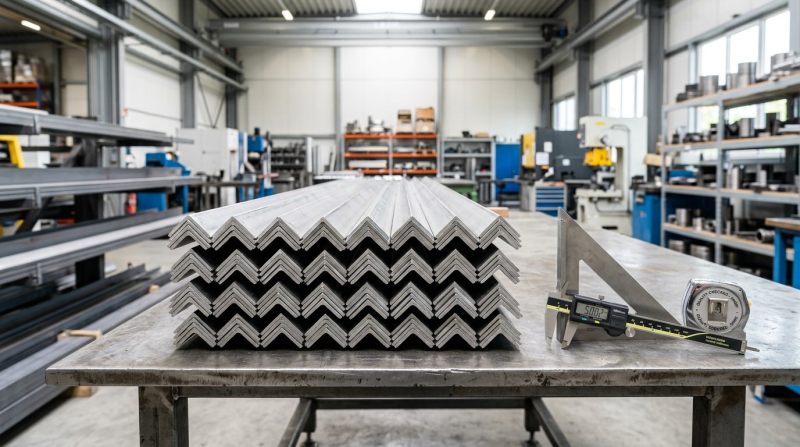
In steel projects, a small dimensional deviation can create a much larger installation problem. If leg length, thickness, straightness, or angle accuracy falls outside the agreed range, operators may need extra grinding, shimming, or corrective welding. On a single trial piece, that may seem manageable. Across 200, 500, or 2,000 pieces, however, rework can quickly affect labor hours, coating quality, and schedule control.
This is why technical evaluators and procurement teams should not ask only for material grade and price. They should also verify which tolerance standard applies, how the supplier measures it, and whether inspection data can be provided before shipment. For angle stainless steel supplier selection, these questions are not administrative details; they are part of real cost control and quality assurance.
In structural steel, dimensional consistency influences connection accuracy, hole alignment, base frame assembly, and visual finish. Typical checks often include 4 core items: leg length tolerance, thickness tolerance, length tolerance, and straightness or twist. If the project involves repeated modules, such as racks, support frames, brackets, or fabrication lines, even a ±1 mm to ±2 mm variation may become significant over multiple connection points.
For global buyers, the risk is even higher when sourcing from different mills or combining stainless angle with carbon steel members, channels, beams, or cold formed profiles. Hongteng Fengda supports this type of mixed procurement by helping buyers confirm drawings, standards, and tolerance expectations in advance, which is especially useful for project managers trying to avoid disputes after cargo arrival.
Common project impacts caused by unclear tolerances
- Poor fit-up during welding, leading to larger root gaps, inconsistent weld beads, and added correction work.
- Mismatch between fabricated angle pieces and mating parts such as plates, channels, square bars, or anchor assemblies.
- Unexpected site modification, especially when installation teams must cut or re-drill parts within a 3–7 day site window.
- Disagreement between procurement, QC, and finance teams when rejected pieces create replacement freight and schedule cost.
Which tolerance questions should you ask an angle stainless steel supplier before placing an order?
The most effective buyers use a question-based checklist before quotation approval. Instead of assuming “standard tolerance” means the same thing everywhere, ask the supplier to define the exact reference. ASTM, EN, JIS, and GB may all be acceptable in different markets, but the acceptable deviation range and measurement method can differ by product form, size range, and processing condition.
You should also ask whether the quoted angle is hot rolled, cold formed, or processed after rolling. Manufacturing route affects edge condition, corner profile, and dimensional repeatability. In many B2B projects, 5 key checks are enough to identify most commercial risks before the PO is issued.
For technical buyers, a useful approach is to separate “mill tolerance” from “fabrication tolerance.” Mill tolerance covers the steel angle itself. Fabrication tolerance covers cutting, punching, slotting, drilling, or welding after the raw section is produced. If these two layers are not separated, one party may believe the material is compliant while the fabricator still finds the parts difficult to assemble.
Hongteng Fengda works with international buyers on standard and customized structural steel, so this kind of clarification is particularly valuable when angle steel is ordered together with channels, beams, or cold formed members for one shipment. It also helps distributors and project owners compare quotations on more than price alone.
5 questions that should be asked in every RFQ
- Which dimensional standard applies to leg length, thickness, length, straightness, and angle degree?
- Are the tolerances based on nominal size, theoretical weight, or finished measured size after processing?
- What inspection tools are used: caliper, tape, angle gauge, straight edge, or custom fixture?
- How many pieces per lot are checked, and can the supplier share pre-shipment inspection records?
- If the order includes punching, cutting, or galvanizing, what additional processing tolerance should be expected?
The table below helps procurement teams organize these questions in a practical review format before supplier approval.
By using a checklist like this, buyers can compare suppliers on measurable criteria. That reduces ambiguity during quotation review and gives QC, engineering, and finance teams a common basis for approval.
How should buyers compare tolerance, processing, and cost together?
A low unit price does not always mean a lower total procurement cost. If the steel angle arrives at the lower edge of acceptable thickness, or if length variation creates higher scrap during fabrication, the final project cost may increase. This is especially relevant in projects with repeated assemblies, where dimensional inconsistency affects every unit in the batch.
Procurement teams often compare 3 layers at the same time: base material price, processing cost, and risk cost. Risk cost includes inspection delays, field rework, replacement freight, and schedule impact. For a shipment with a 2–4 week production cycle and international sea transport after that, even one avoidable rejection can disrupt downstream planning.
This evaluation method also applies when buyers are choosing complementary structural members. For example, in lightweight roof, wall beam, bracket, and purlin systems, some projects may combine angle sections with cold formed profiles or Z-beam solutions. In those cases, tolerance matching between components is often more important than evaluating each section separately.
A practical comparison should therefore connect dimensional control with manufacturing route, certification needs, and end-use complexity. Hongteng Fengda supports this by supplying standard structural steel and OEM solutions under ASTM, EN, JIS, and GB-oriented requirements, allowing buyers to align technical needs with commercial feasibility.
Comparison factors that affect total landed value
The following table is useful when technical evaluators and purchasing managers need to compare more than one supplier or more than one section option.
This kind of side-by-side review helps business evaluators and finance approvers see that tolerance control is not a technical detail alone. It directly influences cost predictability, especially in export projects with strict schedule and documentation requirements.
When alternative profiles may be considered
In some structures, angle steel is not the only answer. Depending on load path, connection layout, and roof or wall design, buyers may review channels, beams, or cold formed Z-shaped profiles. A typical example is the Z-beam, commonly used in purlins, wall beams, lightweight roof systems, brackets, and mechanical support members.
For buyers comparing alternatives, it is useful to know that this profile is often available in Q235B, Q345B, Q420C, Q460C, SS400, SS540, S235, S275, S355, A36, A572, G50, and G61, with thickness typically in the 6–25 mm range, length from 2–12 m or customized, and general tolerance at ±1%. Options such as perforated or galvanized coated finishes may further support project-specific needs.
That does not replace the need to review angle stainless steel supplier tolerance for stainless applications, but it shows how total design efficiency can improve when the right structural section is matched to the right use case instead of forcing one profile into all situations.
What should QC teams, engineers, and project managers check before shipment?
Pre-shipment control is where many sourcing risks can still be reduced. Once cargo is loaded and export documents are issued, replacement becomes slower and more expensive. A disciplined review process usually contains 4 stages: drawing confirmation, production control, dimensional inspection, and packing verification. Even when the order is routine, skipping one stage can create preventable claims later.
For angle stainless steel supplier management, QC teams should confirm whether measurements are taken piece by piece, by sampling lot, or by mixed method. They should also check if the order includes special requirements such as tighter cut length, hole position tolerance, deburring, passivation, or protective packing for marine transport. These details matter for both performance and claim handling.
Project managers should align inspection timing with the delivery plan. For example, if production takes 10–20 days and inland transport plus booking adds another 5–10 days, the inspection window should be fixed early. Waiting until the last 48 hours before loading may leave too little time for correction if nonconformance is found.
Hongteng Fengda’s experience in structural steel exports helps international buyers coordinate these checkpoints across standard and customized orders. This is valuable for distributors, EPC teams, and end users who need one supply partner for angle steel, channels, beams, and cold formed profiles while still keeping documentation and lead time under control.
A practical pre-shipment checklist
- Confirm material grade, standard, and order quantity against PO and drawings before final packing.
- Measure key dimensions on a defined sample quantity, such as first articles plus random pieces from each bundle.
- Review surface condition, edge quality, marking, and bundle identification to reduce receiving confusion at destination.
- Check packing method for moisture protection, lifting safety, and bundle stability during sea or land transport.
- Match shipping documents with inspection records so commercial and technical teams use the same acceptance basis.
Standards and compliance questions worth clarifying
If the project is governed by ASTM, EN, JIS, or GB-related requirements, ask the supplier to state which one applies to material chemistry, mechanical properties, and section dimensions. Some projects also require CE-related documentation, third-party inspection coordination, or mill certificates for audit trails. These are normal B2B needs, especially in infrastructure, manufacturing, and export construction projects.
The key point is consistency. A supplier may provide acceptable steel, but if the dimensional acceptance method is not aligned with the project standard, disputes can still occur. Clear documentation before shipping usually saves more time than arguments after arrival.
FAQ: what buyers most often ask about angle stainless steel supplier tolerance
The questions below reflect common concerns from sourcing teams, fabricators, distributors, and project owners who need reliable structural steel procurement decisions.
How tight should tolerance be for construction and fabrication use?
It depends on the connection design, fabrication process, and number of repeated parts. General structural use may accept normal mill tolerance, while precision assemblies, repeated brackets, or welded frames often require tighter control on leg size, thickness, and cut length. If many parts must align without site correction, confirm the acceptable range in the drawing or PO instead of relying on a generic standard statement.
Is mill tolerance enough if the angle will be cut, punched, or welded later?
Not always. Mill tolerance only covers the raw section. Once the angle is processed, fabrication tolerance becomes equally important. Hole position, notch size, cut squareness, and heat distortion from welding can all affect assembly. Buyers should treat this as a 2-step control issue: raw material compliance first, fabricated part compliance second.
What delivery information should be confirmed with the supplier?
At minimum, confirm production lead time, inspection timing, packing method, and document set. For export orders, many buyers also ask about shipment split options, sample support, and whether standard plus custom components can be combined in one loading plan. Typical planning often includes a 1–2 week quotation and confirmation stage, followed by a 2–4 week production stage depending on order complexity.
What is a common mistake when comparing suppliers?
A frequent mistake is comparing only ex-works price per ton and ignoring inspection scope, dimensional consistency, processing ability, and replacement risk. Another is assuming all suppliers interpret the same standard in the same way. The better approach is to compare at least 5 items together: material grade, tolerance basis, processing scope, compliance documents, and delivery reliability.
Why work with a structural steel manufacturer that understands both tolerance control and project delivery?
For many buyers, the real challenge is not finding a seller. It is finding a supplier that can connect engineering requirements with production reality and export execution. Hongteng Fengda focuses on structural steel manufacturing and export from China, serving construction, industrial, and manufacturing projects with angle steel, channel steel, steel beams, cold formed profiles, and customized structural steel components.
This matters because tolerance control is only one part of a successful order. Buyers also need stable capacity, clear communication, standard compliance, and dependable lead times. Whether the project is for North America, Europe, the Middle East, or Southeast Asia, a supplier should be able to discuss material options, dimensional requirements, OEM details, and shipping coordination in one professional process.
If you are now evaluating an angle stainless steel supplier, the most productive next step is to send your drawing, required standard, quantity range, and any special tolerance or processing request. This makes it easier to confirm whether standard supply is enough or whether a customized structural steel solution would reduce waste and simplify installation.
You can contact Hongteng Fengda to discuss 6 practical topics before ordering: material grade confirmation, dimensional tolerance review, section selection, custom processing scope, expected lead time, and documentation or certification needs. If needed, sample support, quotation communication, and bundled supply planning for multiple steel profiles can also be reviewed to help reduce sourcing risk and improve project efficiency.
Please give us a message


Please enter what you want to find