For buyers balancing lifespan, cost, and project performance, AZ150 Galvalume Steel Coil often raises one key question: does the heavier coating truly deliver better value? For construction and industrial decision-makers, the answer depends on corrosion exposure, service life expectations, and sourcing reliability. Understanding these factors helps companies choose steel solutions that reduce long-term risk while improving project efficiency.
What does AZ150 Galvalume Steel Coil actually mean?
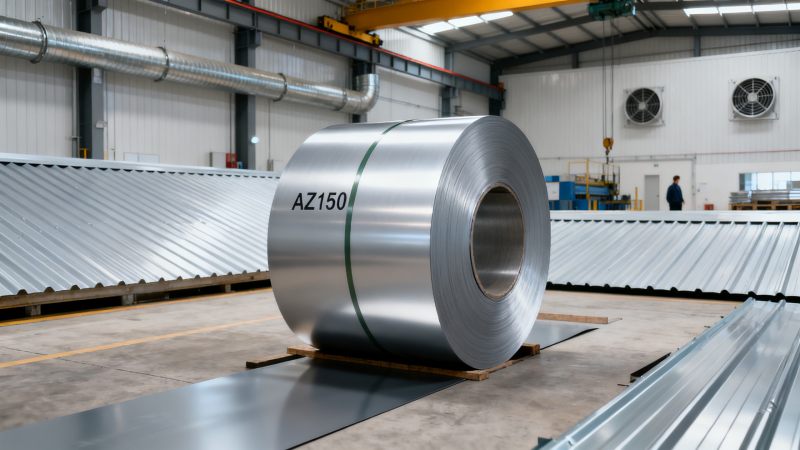
AZ150 Galvalume Steel Coil refers to steel sheet coated with an aluminum-zinc alloy, typically containing about 55% aluminum, 43.4% zinc, and 1.6% silicon. The “AZ150” designation indicates a coating mass of 150 g/m² on both sides combined. In practical terms, this is a heavier protective layer than lower coating classes, and that extra layer is what drives the performance discussion.
Compared with ordinary zinc-coated sheet, AZ150 Galvalume Steel Coil is widely valued for its strong atmospheric corrosion resistance, heat reflectivity, and stable surface performance. Aluminum contributes barrier protection, while zinc supports sacrificial protection at cut edges and scratches. This combination is why Galvalume products are commonly selected for roofing, wall cladding, ducting, industrial panels, and fabricated components exposed to changing weather.
However, the coating code alone does not tell the whole story. Substrate grade, forming requirements, paint system, storage conditions, and installation quality all affect actual service life. A higher coating weight improves resistance potential, but it creates the most value only when matched to the right environment and fabrication process.
Is the extra coating worth it in real service conditions?
In many projects, yes. AZ150 Galvalume Steel Coil is often worth the premium when the steel will face outdoor exposure, intermittent moisture, industrial air, coastal influence, or long maintenance cycles. The heavier coating generally slows red rust formation and helps preserve appearance and structural reliability over a longer period. That matters when replacement is costly or disruptive.
For example, roofing and wall systems on factories, warehouses, agricultural buildings, and logistics centers typically benefit from stronger coating mass because these assets are expected to perform for years with limited intervention. In these settings, a lower-cost coil may reduce initial procurement spending but create higher lifecycle expense through earlier repair, coating breakdown, or premature panel replacement.
That said, AZ150 Galvalume Steel Coil may be more than necessary for dry indoor applications or components with secondary protection such as paint, enclosure, or regular maintenance access. If the steel is installed in a low-corrosion interior environment, the return on the extra coating may be slower. The right decision is not about buying the highest specification by default, but about aligning coating level with actual exposure and expected years of service.
A simple value test
Ask three questions before choosing AZ150 Galvalume Steel Coil: How aggressive is the environment? How expensive is future replacement? How important is appearance retention over time? If at least two of these factors matter strongly, the heavier coating often makes economic sense.
How does AZ150 compare with lower coating options or galvanized steel?
This is where specification review becomes critical. Buyers often compare AZ150 Galvalume Steel Coil with AZ100, AZ70, or conventional hot-dip galvanized products. While exact field performance depends on environment, AZ150 generally provides a more robust corrosion barrier than lighter Galvalume coatings because there is simply more protective alloy on the surface.
Against galvanized steel, Galvalume usually performs better in many atmospheric exposure conditions, especially for roofing and wall cladding. It also offers better heat reflectivity, which can support temperature control in certain building envelopes. Still, galvanized steel may remain a sound choice for structural accessories, embedded uses, or applications where edge protection, forming behavior, or cost priorities differ.
The key point is that AZ150 Galvalume Steel Coil should be judged by total installed value, not just ton price. Even a modest increase in coating cost may be justified if it delays failure, reduces warranty concerns, or helps maintain building performance over a longer period.
Which applications benefit most from AZ150 Galvalume Steel Coil?
Applications with broad exposed surface area and long replacement cycles are the strongest candidates. Roof sheets, wall panels, ceiling systems, ventilation ducts, and enclosure systems often see clear benefits from AZ150 Galvalume Steel Coil because coating durability directly influences maintenance frequency and visual condition.
It is also useful to look beyond coil-based sheet products and think about the broader steel package in a project. Many building systems combine coated sheet with structural framing, purlins, wall beams, and support members. In these cases, corrosion strategy should be coordinated across all components rather than selected in isolation.
For example, roof and wall assemblies often work together with Metal C Beam systems used in purlins and wall beams of steel structure buildings. This product can be supplied in Q195, Q235, Q345, A36, SS400, and S235JR, with galvanized coated surfaces, thickness from 1mm to 12.mm, and standard lengths of 6m, 9m, and 12m, while large quantity customization is also available. Because it supports lightweight roof trusses, brackets, and mechanical light industry components, pairing suitable coated sheet with compatible framing materials helps improve overall durability and installation efficiency.
When sourcing such combinations, it helps to work with a supplier that can coordinate structural steel and related fabricated products under controlled quality systems. Hongteng Fengda, as a structural steel manufacturer and exporter from China, supplies angle steel, channel steel, steel beams, cold formed steel profiles, and customized structural steel components in line with ASTM, EN, JIS, and GB standards. That integrated capability can reduce compatibility issues, support OEM needs, and improve delivery consistency for global projects.
What are the most common buying mistakes?
One frequent mistake is assuming AZ150 Galvalume Steel Coil automatically solves every corrosion problem. It does not. Contact with wet cement, trapped moisture, poor drainage, incompatible chemicals, or aggressive marine conditions can still shorten service life. Coating performance depends heavily on design details such as slope, ventilation, cut edge exposure, and water runoff control.
Another mistake is comparing offers without verifying the full technical package. Similar descriptions can hide differences in base metal thickness, coating certification, surface quality, width tolerance, mechanical properties, or packaging. A low quote may not represent the same product performance. For AZ150 Galvalume Steel Coil, request clear confirmation of coating mass, standard compliance, test records, and intended application suitability.
Storage and handling are also underestimated. Even high-quality coated steel can suffer white rust, staining, or edge damage if coils are stored in humid conditions or handled roughly. Proper packing, dry storage, ventilation, and prompt processing are essential. Reliable suppliers help by providing traceability, inspection, and export-safe packaging that reduces transit risk.
- Do not select by coating code alone; confirm full material specification.
- Match the coating to actual exposure, not just best-case conditions.
- Check fabrication requirements if bending, roll forming, or punching is involved.
- Review packaging and shipping protection for long-distance export orders.
- Consider lifecycle cost rather than initial material price only.
How should you evaluate cost, lead time, and sourcing risk?
The cost question should be framed around total project impact. AZ150 Galvalume Steel Coil may cost more upfront, but the premium can be offset by longer maintenance intervals, fewer replacements, and stronger long-term appearance. This is especially relevant in export construction projects, industrial facilities, and infrastructure-related buildings where downtime or remedial work is expensive.
Lead time matters as much as price. If a supplier offers attractive numbers but cannot maintain stable production, coating consistency, or dependable shipment schedules, the apparent savings may disappear in project delays. That is why many buyers prefer suppliers with modern manufacturing facilities, strict quality control, and experience serving North America, Europe, the Middle East, and Southeast Asia.
A practical approach is to ask for a side-by-side comparison between AZ150 Galvalume Steel Coil and lower specification alternatives based on expected service environment, installation location, and maintenance assumptions. This creates a more accurate value model than relying on unit price alone.
So, is AZ150 Galvalume Steel Coil worth the extra coating?
In many steel building and industrial applications, yes—especially where exposure is real, replacement is costly, and long-term reliability matters. AZ150 Galvalume Steel Coil is not simply a premium label; it is a specification that can improve corrosion resistance, extend service life, and lower long-term risk when properly selected.
The best result comes from viewing the coil as part of a complete steel system. Compare environment, design life, fabrication needs, and supporting structural components. Verify standards, ask for documentation, and choose supply partners with proven production control and export capability. That combination helps ensure the added coating delivers measurable value rather than unnecessary cost.
If the project requires dependable coated steel together with structural sections or customized support components, the next step is to review full specifications, application conditions, and delivery requirements together. A well-matched sourcing plan can improve durability, control budget risk, and keep steel projects moving efficiently from procurement to installation.
Please give us a message


Please enter what you want to find