Choosing the right API 5L pipe grade directly affects strength, weldability, corrosion performance, and project cost. Whether you source API pipe for fluid pipe systems, carbon pipe applications, or large-scale industrial construction, understanding grade differences is essential. This guide explains how to match API 5L pipe specifications with real project needs for engineers, buyers, and decision-makers.
For technical evaluators, the main concern is usually pressure, toughness, and compliance. For buyers and project managers, the focus shifts to delivery stability, processing compatibility, and total installed cost. For business and financial decision-makers, the real question is whether a higher grade creates measurable value or simply increases procurement expense without improving service life.
In practice, grade selection is rarely based on yield strength alone. Temperature range, sour service risk, welding method, wall thickness, coating plan, and fabrication schedule all influence the correct choice. A pipeline for water transfer, for example, may need a very different specification from a line carrying oil, gas, or industrial fluids under cyclic pressure.
As a structural steel manufacturer and exporter from China, Hongteng Fengda supports global industrial and construction buyers with standard and customized steel products built to ASTM, EN, JIS, and GB requirements. That cross-market experience is useful when comparing pipe grades because many projects involve both line pipe systems and structural steel components in the same procurement package.
Understanding API 5L Grades and What They Mean in Real Projects
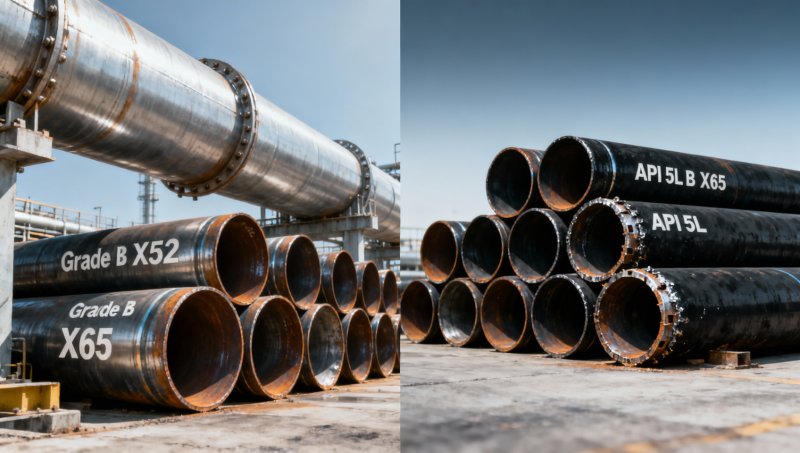
API 5L is the widely used specification for line pipe in oil, gas, water, and industrial fluid transport. Within this standard, common grades include Grade A, Grade B, X42, X46, X52, X56, X60, X65, and X70. The number in X grades generally reflects the minimum yield strength in ksi, so X52 indicates about 52 ksi minimum yield strength, while X65 indicates about 65 ksi.
That strength progression matters because a higher grade can reduce wall thickness for the same pressure design in some cases. However, higher strength does not automatically mean a better buying decision. As grade increases, fabrication controls, weld procedures, heat input management, and low-temperature toughness requirements often become more important, especially on long-distance or outdoor installations.
API 5L also divides products into PSL1 and PSL2. PSL1 is the standard level used for many conventional applications. PSL2 includes tighter requirements for chemical composition, impact testing, and non-destructive examination. For critical service, pressure-sensitive systems, or cross-border projects, PSL2 is often preferred because it supports more consistent quality verification during inspection and acceptance.
Another practical distinction is manufacturing route. Seamless and welded API 5L pipe can both be used depending on diameter, pressure, and service conditions. ERW, LSAW, and SSAW options are common in the market. Diameter ranges can extend from small process lines below 6 inches to transmission lines above 24 inches, while delivery schedules often vary from 2–6 weeks for standard sizes to 6–10 weeks for special wall thickness or coating combinations.
Typical grade positioning
In many industrial projects, Grade B is selected for moderate-duty service where cost control is important and design stress is not extreme. X42 and X52 are often viewed as balanced choices for utility, oilfield, and infrastructure pipelines because they combine adequate strength with manageable weldability. X60 to X70 is more common where pressure, distance, or weight optimization justifies stricter production and inspection control.
The table below gives a practical comparison rather than a design code replacement. It helps procurement teams and engineering reviewers align grade selection with application difficulty, fabrication demands, and inspection expectations.
The key takeaway is simple: the right grade is the one that meets pressure, environment, fabrication, and compliance needs with the lowest total project risk. In many cases, that is not the highest grade on the list.
How to Match Pipe Grade to Pressure, Environment, and Welding Conditions
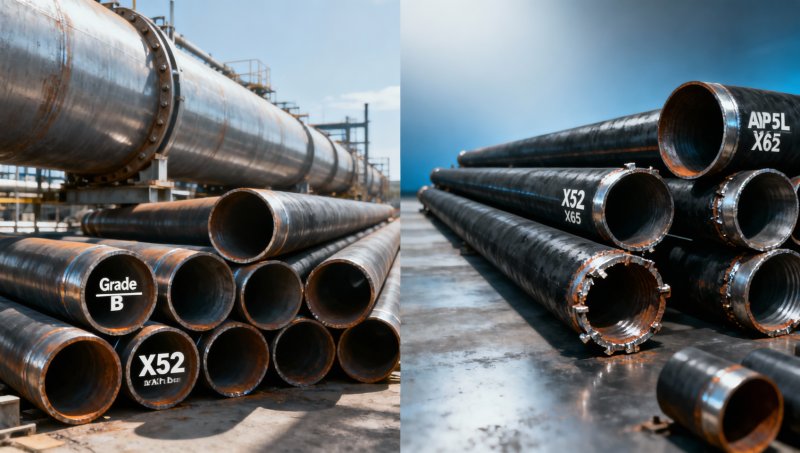
Grade selection should begin with operating conditions. A line working at moderate pressure in a stable indoor industrial environment may perform well with Grade B or X42. A pipeline exposed to outdoor temperature swings from -20°C to 45°C, corrosive soil, or long-distance pumping loads may need X52 or above, plus stricter impact and coating requirements.
Weldability is another major factor. As strength rises, welding procedures often become less forgiving. This affects preheat control, filler metal selection, and repair rates on site. A project with heavy field welding, multiple contractor teams, or a tight installation window of 30–45 days may benefit from a grade that reduces rework risk even if its theoretical design efficiency is slightly lower.
Corrosion planning must also be considered at the same time as base material selection. API 5L pipe is frequently paired with 3LPE, FBE, or galvanized solutions depending on service conditions. In wet, buried, or marine-adjacent environments, corrosion allowance and coating quality can have as much influence on service life as grade strength. A pipe upgraded from X52 to X65 without a suitable coating system may still underperform in aggressive conditions.
For projects that combine pipelines with industrial structures, buyers often want sourcing efficiency from one steel supply partner. In those cases, it is useful to coordinate line pipe procurement with structural sections used for skids, supports, racks, and equipment frames. For example, I Shaped Beams are commonly used in industrial structure support, with carbon steel grades such as Q195-Q235, Q345, SS355JR, SS400, A36, ST37-2, S235J0, S235J2, and St52. Typical dimensions include thickness from 4.5mm to 15.8mm, length from 6m to 12m per piece, flange width from 100mm to 400mm, and tolerance around ±1%, which can simplify steel package planning for plant construction.
Four checkpoints before finalizing the grade
- Confirm operating pressure, temperature range, and design life. A 10-year temporary utility line may not justify the same grade as a 25-year export terminal pipeline.
- Review installation method. Shop welding and controlled fabrication generally support tighter tolerances than remote field welding.
- Check environment and corrosion exposure. Buried, coastal, chemical, and cyclic service conditions require more than a basic strength review.
- Align testing requirements early. PSL2, impact tests, NDT scope, and coating inspection should be specified before purchase order release.
These checkpoints reduce a common procurement mistake: buying by grade label only. Two offers for the same nominal grade can differ significantly in manufacturing route, testing scope, document package, and delivery reliability.
Comparing Cost, Availability, and Procurement Risk Across Grades
From a purchasing perspective, the most expensive pipe is not always the highest-priced tonnage. Delayed shipment, difficult welding, unexpected requalification, and high rejection rates can increase installed cost by 8%–20% depending on project complexity. That is why procurement teams should compare landed value, not just ex-works price per ton.
Availability also changes by grade and size. Standard Grade B and X42 specifications are generally easier to source in regular production cycles. X60 to X70 in special wall thicknesses, large diameters, or PSL2 conditions may require more coordination for mill scheduling, raw material allocation, and third-party inspection. For international buyers, shipping mode and port congestion can add another 1–3 weeks beyond mill completion time.
Buyers should also pay close attention to document control. Mill test certificates, heat traceability, dimensional inspection reports, and coating records are essential for technical approval and final payment. In projects involving EPC contractors or public-sector review, incomplete paperwork can stop site acceptance even when the pipe itself is physically compliant.
The comparison below is useful for balancing engineering requirements with sourcing practicality. It reflects typical B2B concerns in steel projects where schedule, inspection, and installation cost all matter.
For many buyers, X52 is where cost and performance meet effectively. It is strong enough for a wide range of industrial and energy applications, but still practical in fabrication and sourcing. However, each project should validate that choice against code requirements, wall thickness calculations, and environmental conditions.
Common procurement mistakes
- Selecting a higher grade to reduce wall thickness without checking weld procedures and field capability.
- Comparing quotations with different PSL levels, coating scopes, or inspection plans.
- Ignoring tolerance, straightness, bevel condition, and packaging details that affect installation efficiency.
- Treating API 5L pipe as a commodity even when the project requires traceability and approval documents.
A Practical Evaluation Workflow for Engineers, QA Teams, and Decision-Makers
A strong evaluation process usually takes 5 steps. First, define the service conditions: medium, pressure, temperature, environment, and design code. Second, shortlist 2–3 candidate grades based on mechanical properties and fabrication method. Third, compare pipe form, wall thickness, and coating plan. Fourth, review inspection, documentation, and delivery capability. Fifth, calculate total installed cost rather than purchase price alone.
Quality control teams should verify dimensional consistency, weld seam condition where relevant, end preparation, marking, and heat traceability. For high-spec projects, third-party inspection at pre-production, in-process, and pre-shipment stages can reduce acceptance disputes. Even simple checks such as OD tolerance, wall thickness verification, and visual coating review can prevent expensive on-site delays.
Project managers should also connect pipe grade decisions to the broader steel package. Pipe supports, equipment bases, platforms, and skids may use structural sections alongside the line pipe. When the same supplier can coordinate standards, cutting, welding, punching, and shipment planning across multiple steel items, the project often gains better schedule control and fewer communication gaps.
For example, in industrial structure support, buyers may pair line pipe procurement with hot rolled, bent, welded, punched, or cut beam products that comply with JIS, ASTM, DIN, GB, or EN standards. This type of package approach is especially useful when the job includes plant modules, racks, or pipe bridge supports and requires both standard lengths and custom fabrication details.
Suggested approval checklist
Technical review
- Grade, PSL level, and manufacturing process match the design basis.
- Mechanical properties and any impact requirements are clearly stated.
- Dimensions, ends, lengths, and coating or bare finish are specified without ambiguity.
Commercial review
- Delivery time is realistic, including inspection, port handling, and inland transport.
- Quotation clarifies whether testing, coating, and export packing are included.
- Supplier can support recurring demand, not just one-time shipment.
This workflow helps different stakeholders speak the same language. Engineers protect technical fit, QA protects consistency, procurement protects commercial clarity, and management protects schedule and project return.
FAQ: Common Questions When Choosing API 5L Pipe Grades
Many buyers search for a simple answer such as “Which API 5L grade is best?” In reality, the best grade depends on service duty, fabrication conditions, and acceptance criteria. The questions below reflect the most common issues raised by industrial buyers, distributors, and project teams.
Is Grade B still suitable for modern industrial projects?
Yes, in many cases. Grade B remains a practical option for water lines, lower-pressure fluid systems, and general carbon pipe applications where extreme strength is not required. It is especially suitable when standard availability, lower cost, and straightforward fabrication are priorities. The key is to confirm that the design pressure, corrosion environment, and code requirements do not demand a higher grade or PSL2 controls.
When is X52 often the preferred choice?
X52 is often selected when the project needs a practical step up in strength without moving into the more demanding procurement and welding controls associated with X60 and above. It is widely used in energy, industrial transfer, and infrastructure systems because it offers a good balance between mechanical performance, market availability, and fabrication efficiency.
Should buyers always choose PSL2 for safer performance?
Not always. PSL2 adds testing and tighter requirements, which can improve quality assurance for critical systems. But if the service is relatively conventional and the project budget is highly cost-sensitive, PSL1 may still be appropriate. The decision should be based on risk level, customer specification, inspection requirements, and the consequences of failure or non-acceptance.
What documents should be checked before shipment?
At minimum, buyers should review mill test certificates, product marking records, dimensional inspection reports, quantity lists, and any agreed coating or NDT reports. For export projects, packing details and shipping marks should also be confirmed before dispatch. These documents support customs handling, site verification, and final commercial closure.
Choosing the right API 5L pipe grade is a technical and commercial decision at the same time. Strength, weldability, corrosion strategy, compliance level, and supply consistency all need to be evaluated together. When buyers match grade to actual service conditions instead of buying by label alone, they reduce installation risk, control total project cost, and improve long-term performance.
Hongteng Fengda supports global buyers with reliable steel products, strict quality control, and customized supply solutions for construction and industrial projects. If you need help comparing API pipe options, structural steel packages, or integrated procurement plans, contact us to get a tailored solution, discuss technical details, and learn more about the right steel products for your project.
Please give us a message


Please enter what you want to find