Before ordering 90 angle steel, buyers need to look beyond size and price. Material grade, dimensional tolerance, surface condition, and compliance with ASTM, EN, JIS, or GB standards can directly affect project safety, fabrication efficiency, and total procurement cost. This guide outlines the key checks purchasing teams should make to reduce sourcing risks and secure reliable structural steel supply.
What Purchasing Teams Really Need to Confirm Before Buying 90 Angle Steel
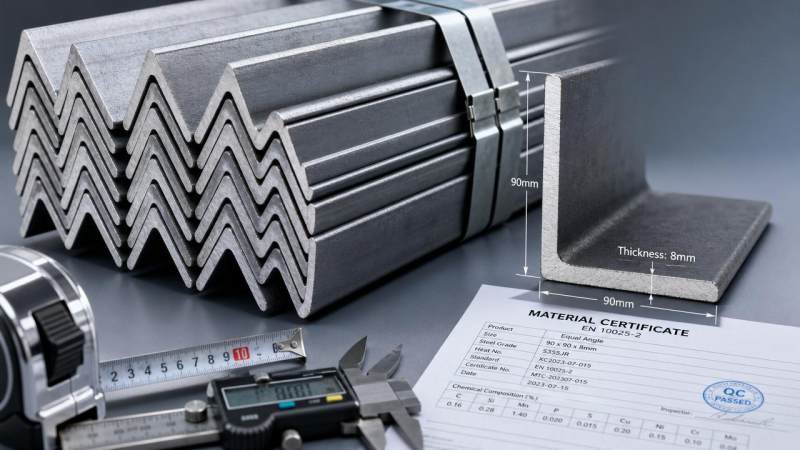
The core search intent behind “90 angle steel” is practical procurement evaluation. Buyers usually want to know what specifications, quality points, and supplier controls must be checked before placing an order.
For procurement teams, the biggest concerns are not theory. They focus on whether the angle steel matches drawings, meets standards, arrives on time, performs well in fabrication, and avoids hidden cost risks.
That means the most useful content is a decision guide. Instead of broad product introductions, buyers need a checklist covering dimensions, grade, tolerance, surface quality, certification, packaging, and supplier capability.
In simple terms, ordering 90 angle steel safely means checking four things first: technical fit, standard compliance, manufacturing consistency, and commercial reliability. If one of these fails, total project cost often increases quickly.
Start with the Exact Definition of 90 Angle Steel
One common sourcing mistake is assuming all suppliers mean the same thing by 90 angle steel. In most cases, the term refers to equal angle steel with a 90-degree bend.
However, buyers still need to confirm whether the request means equal angle or unequal angle, hot rolled or cold formed, and what leg size and thickness are actually required.
For example, a purchasing request may say 90 angle steel, but the workshop drawing may specify 90 x 90 x 8 mm, 90 x 90 x 10 mm, or another section altogether.
That difference matters because section size affects weight, load capacity, welding behavior, galvanizing consumption, transport planning, and the final quoted price. Never approve an order based on name alone.
A good purchase order should clearly state leg dimensions, thickness, length, steel grade, standard, quantity, surface treatment, and any special testing or marking requirements.
Check Whether the Material Grade Matches the Project Requirement
Price comparisons are meaningless if the material grades are different. Buyers should always verify the specified grade before evaluating offers from different mills or exporters.
Depending on the market, 90 angle steel may be supplied under ASTM, EN, JIS, or GB systems. Equivalent-looking products may still differ in yield strength, chemistry, and impact performance.
If the material is for structural frames, equipment bases, supports, or welded fabrications, the grade must align with engineering calculations and project specifications. Substitution without written approval creates serious risk.
Ask the supplier to confirm the exact standard and grade in writing. For example, is the product supplied to ASTM A36, EN S275, JIS SS400, or a GB structural grade?
Procurement teams should also ask whether the mill can provide mill test certificates for each heat or batch. This is one of the simplest ways to reduce material traceability problems later.
Dimensional Tolerance Is Not a Small Issue
Many buyers focus heavily on nominal size but spend too little time checking tolerances. In reality, dimensional variation is often where fabrication inefficiency and site installation problems begin.
For 90 angle steel, key dimensional checks include leg width, thickness, length tolerance, straightness, corner angle accuracy, and twist. These factors directly affect cutting, drilling, welding, and fit-up.
If angle steel is outside tolerance, workshops may need extra grinding, re-alignment, or adjustment. That adds labor cost, slows assembly, and can even lead to rejection on site.
Before ordering, ask the supplier which tolerance standard they follow and whether inspection records are available. If your project has tighter fabrication needs, state special tolerance requirements before production starts.
This is especially important for export orders, because replacing a non-conforming batch after shipment is expensive and disruptive. Prevention is always cheaper than post-delivery correction.
Surface Condition Can Affect More Than Appearance
Procurement teams sometimes treat surface quality as a secondary issue, but it can influence corrosion performance, coating adhesion, fabrication speed, and customer acceptance.
When reviewing 90 angle steel, check for rust scale, lamination, edge defects, pits, rolling marks, cracks, and excessive burrs. These defects may not always stop usage, but they can increase downstream costs.
If the steel will be painted, galvanized, or used in visible structures, surface condition should be written into the procurement requirement. Otherwise, supplier and buyer may have different acceptance expectations.
For galvanized angle steel, ask whether galvanizing is done in-house or outsourced, and whether coating thickness, adhesion, and appearance are inspected before shipment.
A slightly cheaper offer may become more expensive if poor surface condition requires extra blasting, cleaning, or coating rework at the fabrication stage.
Confirm the Applicable Standard and Certification Early
Global structural steel procurement often involves multiple standards. A project may be designed in one system while materials are sourced from another market. That is why standard confirmation must happen early.
When ordering 90 angle steel, procurement personnel should verify the governing standard, test requirements, and document package needed for project approval and customs clearance.
Depending on destination and end use, buyers may need mill test certificates, third-party inspection reports, certificate of origin, packing list details, or coating inspection records.
It is also worth confirming whether the supplier has experience shipping to your target market. Export familiarity often reduces the risk of documentation errors and delayed delivery.
Reliable structural steel suppliers should be comfortable working with ASTM, EN, JIS, and GB requirements, and should explain clearly how they control compliance from production to shipment.
Evaluate Manufacturing Capability, Not Just Trading Ability
For procurement teams, supplier type matters. A company that manufactures structural steel directly can often offer better process control, more stable lead times, and clearer quality accountability.
When sourcing 90 angle steel internationally, ask practical questions: Are you a manufacturer or trader? What is your production range? Can you handle customized lengths, marking, and packaging?
Also ask about production equipment, inspection procedures, and quality checkpoints. These questions help reveal whether the supplier can support repeat orders instead of just one successful shipment.
For projects that use multiple steel products, supply integration can also improve efficiency. Some buyers who source angle steel may also purchase supporting materials such as Wire Rod for broader manufacturing or construction demand.
That kind of consolidated sourcing can simplify vendor management, provided each product line still meets the required technical and certification standards.
Review Packaging, Marking, and Shipping Details Before Production
Packaging may seem like a logistics issue, but for export buyers it is a quality and cost issue as well. Poor packaging can cause bending, corrosion, identification loss, and unloading delays.
For 90 angle steel orders, confirm bundle weight, steel strapping method, tags, heat number marking, moisture protection, and container loading plan before shipment is arranged.
Proper marking is especially important when the project needs traceability by size, batch, or grade. Missing or incorrect tags can create confusion during warehouse receiving and later fabrication.
Procurement teams should also check whether shipment will be containerized or break bulk, because this affects loading efficiency, freight cost, and potential handling damage.
A detailed pre-shipment packing agreement often prevents disputes that cannot be solved easily after the material reaches the destination port.
Lead Time Should Be Evaluated Together with Production Stability
Short lead time is attractive, but buyers should test whether the promise is realistic. Unstable production schedules can hurt project sequencing even if the supplier offers a low initial price.
Ask the supplier to break down the schedule into raw material preparation, rolling or forming, finishing, inspection, packing, and shipment booking. This gives a more realistic delivery picture.
It is also wise to confirm whether the supplier keeps standard sizes in stock or produces only after order confirmation. Stock supply and mill production have very different timing implications.
For recurring procurement, ask about monthly capacity and peak-season performance. A supplier that can deliver one trial order may still struggle with larger repeat volumes.
Dependable lead time is part of total procurement value. A slightly higher unit price may be justified if it reduces site waiting time and project interruption risk.
Know the Cost Drivers Behind the Quotation
Professional buyers should compare more than ex-works ton price. A useful quotation for 90 angle steel should make clear what is included and what may change later.
Typical cost drivers include steel grade, section size, thickness, length, tolerance requirements, galvanizing or painting, testing, packaging, destination, and shipment method.
Ask whether the quote is based on theoretical weight or actual weight. This point can significantly affect final settlement, especially across large tonnage orders.
It is also smart to confirm commercial terms such as MOQ, payment terms, claim period, quantity tolerance, and responsibilities for third-party inspection or re-testing.
Clear commercial terms reduce misunderstanding and help procurement teams compare suppliers on a true like-for-like basis instead of reacting only to the lowest headline number.
A Practical Pre-Order Checklist for 90 Angle Steel
Before approving the purchase, buyers should run through a simple final checklist. This step often catches issues that are easy to miss during rapid RFQ comparison.
Confirm the exact section size, thickness, length, and quantity. Verify the standard and grade. Check tolerance requirements, surface condition expectations, and whether coating is needed.
Request sample documents such as mill test certificates and inspection reports. Confirm packaging, marking, and shipment plan. Review lead time, payment terms, and claims handling procedure.
Finally, assess whether the supplier has proven export experience and stable manufacturing control. These factors often matter more than a small price difference, especially for project-critical steel supply.
If a supplier answers these points clearly and consistently, the chance of a smooth 90 angle steel procurement process becomes much higher.
Conclusion
Ordering 90 angle steel successfully is not about finding the cheapest price first. It is about confirming that the steel will perform correctly, fabricate efficiently, and arrive with reliable documentation and timing.
For procurement professionals, the best approach is structured verification: define the section clearly, confirm grade and standard, review tolerance and surface quality, and evaluate supplier capability in real operational terms.
When these checks are done early, buyers can reduce sourcing risk, improve project control, and achieve better total value from structural steel procurement rather than simply chasing a lower quote.
Please give us a message


Please enter what you want to find