When choosing between 304 stainless steel pipe and 201 stainless steel, many buyers focus on price first—but long-term performance matters more. From corrosion resistance to surface appearance and service life, the right material can save money and reduce replacement risks. This guide explains which option ages better and how to choose the best steel pipe for your actual application.
Why does 304 stainless steel pipe usually age better in real use?
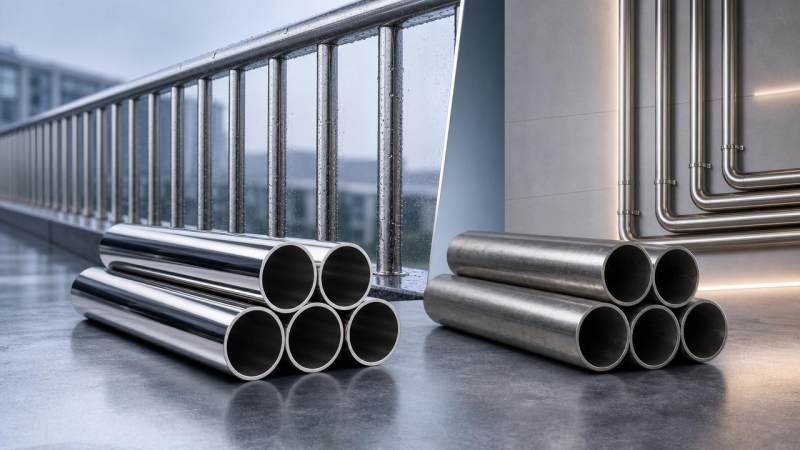
For most end users, aging is not just about whether a pipe stays intact. It also includes how well the material keeps its surface finish, resists rust spots, handles moisture, and maintains strength after years of exposure.
In that comparison, 304 stainless steel pipe usually performs better than 201 because it contains more nickel and has a more stable austenitic structure. That difference improves corrosion resistance, especially in humid, mildly acidic, or outdoor environments.
201 stainless steel can still be useful, but it tends to show staining, tea-colored oxidation, or pitting earlier when the environment becomes demanding. For decorative indoor applications, that may be acceptable. For long service life, it often is not.
- 304 is better for moisture, cleaning chemicals, and temperature variation.
- 201 is often chosen when initial budget matters more than lifecycle performance.
- If appearance retention matters, 304 stainless steel pipe is usually the safer option.
304 vs 201 stainless steel: what actually changes over time?
The table below compares the main aging-related differences buyers should review before selecting 304 stainless steel pipe or 201 for household, commercial, or light industrial use.
This is why many experienced buyers compare total ownership cost instead of only purchase price. A cheaper pipe can become more expensive once surface failure, labor, downtime, or replacement is included.
What causes 201 stainless steel to age faster?
The main issue is not that 201 is unusable. It is that its corrosion resistance margin is smaller. In coastal air, bathrooms, food-related areas, balconies, or lightly polluted cities, that smaller margin can disappear quickly.
If chloride, condensation, fingerprints, cleaning residue, or poor ventilation remain on the surface, 201 is more likely to show visible deterioration earlier than 304 stainless steel pipe.
Which applications justify paying more for 304 stainless steel pipe?
Not every project requires the same material grade. The smart decision depends on environment, cleaning method, appearance standards, and replacement cost. If a pipe is difficult to access later, using 304 from the start often makes more economic sense.
Better scenarios for 304
- Outdoor railings, handrails, exposed pipe runs, and architectural trim.
- Kitchen, food-contact-adjacent, or washdown areas with repeated cleaning.
- Humid indoor spaces such as bathrooms, basements, and enclosed utility areas.
- Projects where surface appearance is part of the final value.
- Installations with high labor cost for future replacement.
Where 201 may still be acceptable
- Dry indoor decorative use with low moisture exposure.
- Temporary projects where short-term cost control is the main target.
- Applications where surface staining will not affect function or customer perception.
For surrounding steel infrastructure, buyers also compare corrosion-protected carbon steel products when stainless is not required. In conduit and support systems, Electrical Conduit Galvanized is often considered for general low-pressure fluid lines, support frames, and construction-related use where galvanizing helps extend service life.
How should end users compare cost, maintenance, and replacement risk?
Price gaps attract attention, but the more useful question is this: how much will the material cost after three, five, or ten years? That depends on environment, labor rates, downtime exposure, and your tolerance for appearance changes.
The following table helps buyers evaluate the decision using a lifecycle mindset instead of a one-time purchase mindset.
If your installation cost is high, the labor to replace failed tubing can exceed the original savings from selecting 201. That is why 304 stainless steel pipe is often the lower-risk choice even when its purchase price is higher.
A practical cost judgment rule
- Choose 304 if the pipe will face water, cleaning agents, outdoor weather, or frequent touch.
- Choose 201 only when the environment is clearly dry, stable, and low-corrosion.
- Recalculate if replacement requires shutdown, dismantling, or finish restoration.
What technical and standards-related checks matter before you buy?
Many purchasing mistakes happen because buyers compare grades by name only. In reality, finish, wall thickness, weld quality, dimensional tolerance, and standard compliance all affect how a stainless pipe performs over time.
Key checks before placing an order
- Confirm the grade clearly on documents and ask whether the pipe is 304 or 201, not just “stainless.”
- Review applicable standards such as ASTM, EN, JIS, or GB based on your market and project requirement.
- Check surface finish if visual consistency matters, especially for decorative or exposed installations.
- Verify thickness tolerance and length tolerance to reduce installation mismatch.
- Ask whether the pipe will be used indoors, outdoors, or near chemicals before finalizing the grade.
For broader steel procurement, buyers often work with manufacturers that can support mixed categories under consistent quality control. Hongteng Fengda supplies structural steel products and customized solutions with production aligned to common international standards such as ASTM, EN, JIS, and GB, helping global buyers reduce sourcing uncertainty.
When galvanized alternatives enter the conversation
In some projects, buyers compare stainless pipe with galvanized steel systems rather than only with another stainless grade. This usually happens in construction supports, conduits, low-pressure fluid lines, general industrial frames, and utility routing.
A product such as Electrical Conduit Galvanized may suit applications in construction, agriculture, light industry, support frame pipe, and pipelines for water, gas, or oil, depending on specification, coating condition, and project standard. Common references can include AISI, ASTM, DIN, JIS, GB, SUS, and EN, while dimensions may be customized by length, width, and thickness range according to project needs.
How can consumers avoid common mistakes when choosing stainless pipe?
Many end users are told that all shiny stainless products perform the same. That is one of the most costly misconceptions in the steel market. Surface appearance at delivery does not guarantee long-term behavior in service.
Frequent buying mistakes
- Choosing 201 for outdoor use simply because the initial quote is lower.
- Ignoring cleaning chemicals, salt exposure, or condensation during material selection.
- Focusing only on grade but not checking thickness, weld quality, or finish.
- Assuming replacement later will be easy, even when access is limited.
If your project combines decorative value with functional duty, 304 stainless steel pipe usually gives a better balance of appearance, durability, and maintenance control.
FAQ: what do buyers ask most about 304 stainless steel pipe?
Is 304 stainless steel pipe always worth the extra cost?
Not always. If the application is fully dry, decorative, and low-risk, 201 may be enough. But once moisture, cleaning agents, outdoor exposure, or long replacement cycles are involved, 304 usually offers better value.
Can 201 stainless steel rust?
Yes. Stainless steel is corrosion resistant, not rust proof in every condition. 201 is more likely than 304 to show staining, oxidation, or corrosion when exposed to chloride, humidity, or poor maintenance conditions.
How do I know whether my project environment is too harsh for 201?
Ask three questions: Will the pipe see outdoor air? Will it be cleaned often? Will water or condensation remain on the surface? If the answer is yes to any of these, 304 stainless steel pipe is usually the safer choice.
What should I request from a supplier before ordering?
Request the material grade, size, wall thickness, finish, applicable standard, tolerance range, and intended use confirmation. If your project has certification or export needs, discuss them before production begins.
Why choose a professional steel supplier when comparing 304 and 201?
The right grade decision is easier when your supplier understands both materials and actual use conditions. That means not just sending a price list, but helping you compare service environment, fabrication needs, compliance standards, and delivery timing.
Hongteng Fengda supports international buyers with structural steel manufacturing and export experience, stable production capacity, and customized solutions for construction, industrial, and manufacturing projects. For buyers balancing budget, quality, and sourcing risk, that kind of support can prevent expensive material mismatches.
- Need help confirming whether 304 stainless steel pipe or 201 suits your environment?
- Want to compare stainless with galvanized options for conduit, support, or low-pressure pipe use?
- Need guidance on specifications, standards, lead time, sample support, or custom processing?
Contact us to discuss material selection, parameter confirmation, delivery schedule, OEM requirements, certification expectations, and quotation planning. A clear technical review before ordering is the simplest way to reduce cost risk and choose the right steel solution for long-term use.
Please give us a message


Please enter what you want to find