When comparing stainless materials for fabrication, choosing between 304 sheet and 304 plate affects forming, welding, strength, cost, and project efficiency. For technical evaluators, understanding how 304 sheet performs in light fabrication versus thicker plate in structural or heavy-duty applications is essential to making the right sourcing and manufacturing decision. In practice, the best option is rarely decided by thickness alone. Fabrication method, end-use environment, flatness tolerance, weld design, finish requirements, and total processing cost all influence whether 304 sheet or plate delivers better value.
This guide explains how to evaluate 304 sheet against 304 plate using a practical checklist. It focuses on real fabrication concerns such as cutting, bending, welding, distortion, structural demand, corrosion performance, and supply considerations, helping you move from material comparison to a confident specification.
Why a structured comparison matters for 304 sheet selection
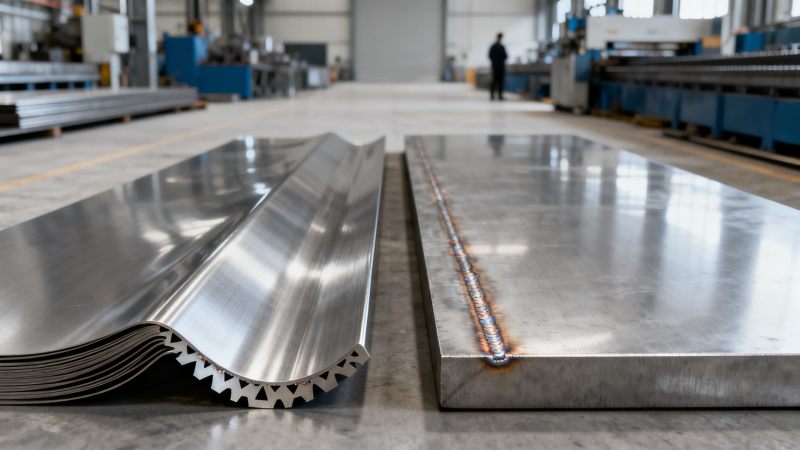
Both 304 sheet and 304 plate are based on the same stainless grade, so buyers often assume they are interchangeable. They are not. Once thickness changes, fabrication behavior changes as well. A thin 304 sheet is generally easier to form, lighter to handle, and often more economical for enclosures, panels, covers, kitchen equipment, and decorative applications. Plate, on the other hand, supports heavier loads, deeper weld prep, and more rigid service conditions.
A structured review prevents over-specifying expensive plate when 304 sheet is sufficient, or under-specifying sheet where impact, load, or welding heat will create performance problems. In steel sourcing, this kind of discipline reduces waste, improves process stability, and shortens production cycles.
Core points to check before choosing 304 sheet or 304 plate
- Confirm the actual thickness requirement first, because thickness determines whether the product is treated as 304 sheet for light fabrication or plate for structural and high-load work.
- Review the forming process in advance, since 304 sheet usually performs better in bending, rolling, and shallow drawing, while thicker plate needs more force and larger radii.
- Check welding volume and joint design carefully, because plate may suit full-penetration welds and load-bearing assemblies, while thin sheet can distort under excessive heat input.
- Evaluate rigidity and service load, especially if the component must resist vibration, impact, or deflection that would exceed the practical limits of 304 sheet.
- Compare surface finish expectations, because 304 sheet is commonly available with finishes better suited to visible parts, clean surfaces, and precision-fabricated assemblies.
- Assess cutting method and edge quality, since laser cutting is often efficient for 304 sheet, while thicker plate may require plasma, waterjet, or more secondary finishing.
- Consider handling, transport, and shop workflow, because 304 sheet reduces weight and can simplify fabrication speed, especially for high-volume parts and repeatable dimensions.
- Calculate total cost instead of unit price alone, including scrap rate, labor time, fixturing complexity, welding hours, and post-processing required for the chosen thickness.
- Verify standard compliance and dimensional tolerance, especially when the stainless parts must integrate with structural steel systems or exported equipment built to ASTM, EN, JIS, or GB.
- Match the stainless choice with surrounding materials, because galvanic effects, fastening design, and assembly methods can influence whether 304 sheet remains the most practical option.
How 304 sheet performs in fabrication
For many fabricated parts, 304 sheet offers the best balance of corrosion resistance, workability, and cost control. It is widely used where the design needs clean appearance, moderate strength, and efficient processing. Common examples include wall panels, machine covers, cabinets, hoppers, ventilation parts, food-related equipment, and architectural trim. In these applications, the ability of 304 sheet to bend and form predictably often outweighs the added rigidity of plate.
Another advantage of 304 sheet is production efficiency. Thinner stainless generally allows faster laser cutting, easier punching, and lower forming loads. Shops can process more parts with less wear on tooling, and finished assemblies are easier to handle. When welding is limited to seams, brackets, or light reinforcement, 304 sheet can support a highly efficient fabrication workflow without unnecessary material mass.
In broader steel project planning, stainless parts are often combined with coated carbon steel components to optimize cost and performance. For example, roofing, walling, appliance panels, or modular structures may use corrosion-resistant coated steel such as DX53D Galvalume Steel Coil for large-area exterior sections, while 304 sheet is reserved for hygienic zones, exposed trim, or parts requiring stronger stainless corrosion performance. This combination can improve budget efficiency without sacrificing durability.
Where coated steel is under consideration, it helps to compare the service environment and fabrication needs directly. DX53D and DX51D+AZ galvalume products, made from low-carbon steel with an aluminium-zinc coating, are used in construction, automobile, home appliance, and agricultural applications. With yield strength around 270–300 MPa, tensile strength of 350–450 MPa, elongation of no less than 24%, thickness from 0.4 mm to 3 mm, and recognized standards such as GB, AISI, ASTM, JIS, and DIN, they offer good corrosion resistance, heat reflectivity, adhesion, and formability. That makes them useful in roofs, walls, garages, sound walls, refrigerator back panels, greenhouse pipes, and similar fabricated uses where stainless is not mandatory.
When 304 plate is the better fit
304 plate becomes the stronger candidate when the fabricated part must carry significant load, withstand repeated impact, or support extensive welding. Tanks, heavy brackets, base frames, support plates, industrial housings, and equipment exposed to mechanical stress often benefit from the extra section thickness. In these cases, choosing plate is less about corrosion resistance and more about structural reliability during service.
Plate is also preferred when edge preparation, beveling, and deeper weld penetration are needed. If the design includes full-strength joints, pressure-related sections, or thick-machined features, 304 plate provides more practical fabrication allowance. While it costs more to cut, handle, and weld, it can reduce the risk of deflection, burn-through, or reinforcement complexity that would arise if thinner 304 sheet were forced into a heavy-duty role.
Application-specific guidance
Light enclosures, covers, and panels
These parts usually favor 304 sheet because they depend on bendability, clean finish, and lower mass. Check flatness, cosmetic surface quality, bend radius, and fastening method before finalizing thickness. If stiffness is marginal, formed ribs or local reinforcements may work better than switching directly to plate.
Food, sanitary, and visible stainless components
304 sheet is commonly preferred where washability and appearance matter. Review finish requirements, weld cleanup expectations, and whether the part will be polished after fabrication. Thicker material should only be added if impact resistance or structural support is truly necessary.
Tanks, supports, and industrial frames
If the part faces pressure, vibration, or sustained loads, plate may be the better option. Check load path, weld type, and service temperature. In some assemblies, 304 sheet can still be used for cladding while plate is reserved only for base or support sections.
Mixed-material construction systems
Projects combining stainless with structural carbon steel or coated coil should compare corrosion exposure zone by zone. Use 304 sheet where hygiene, chemical exposure, or visual finish requires stainless, and use coated structural products where cost-effective weather resistance is sufficient.
Common oversights that affect 304 sheet performance
Ignoring distortion during welding: Thin stainless can move significantly under heat. If weld sequencing, fixturing, or heat input is not controlled, 304 sheet may lose flatness and create rework.
Using thickness to solve every strength concern: Designers sometimes jump from 304 sheet to plate too early. Often, geometry changes such as hems, ribs, folds, or brackets deliver the required stiffness more efficiently.
Overlooking finish damage in fabrication: Stainless surfaces can be scratched by poor handling, unsuitable protective film, or contaminated tooling. This is especially important when 304 sheet is used in visible applications.
Focusing only on raw material price: Plate may appear acceptable on paper, but added cutting time, weld volume, lifting effort, and slower throughput can raise the real fabrication cost.
Not aligning material with global standards: For export projects, confirm required standards, test documents, and dimensional tolerances before ordering. This avoids downstream compatibility and acceptance problems.
Practical steps to make the right choice
- Start with service conditions: load, corrosion exposure, hygiene requirement, and visual finish should define the first boundary of material selection.
- Map the fabrication route from cutting to welding and finishing, then compare how 304 sheet and plate affect cycle time and rework risk.
- Request realistic thickness options and tolerance data from the supplier rather than defaulting to familiar but oversized specifications.
- Prototype critical parts when stiffness, distortion, or appearance is uncertain, especially if the assembly combines formed stainless with structural members.
- Use a total-cost comparison that includes material yield, labor, consumables, finishing, transport, and installation practicality.
Conclusion and next action
The choice between 304 sheet and 304 plate comes down to fabrication intent. If the project prioritizes forming efficiency, lighter weight, attractive finish, and moderate structural demand, 304 sheet is often the better fit. If the design requires high rigidity, deeper welding, impact resistance, or load-bearing reliability, plate usually justifies its added weight and processing cost.
The most effective next step is to review thickness, forming method, weld design, finish requirement, and service load together instead of in isolation. For projects that also involve structural steel, coated steel, or custom fabricated sections, working with a supplier that understands standards, processing behavior, and export consistency can improve both technical accuracy and delivery performance. Hongteng Fengda supports global projects with reliable steel products, customized structural solutions, and stable manufacturing quality across ASTM, EN, JIS, and GB requirements, helping steel buyers reduce sourcing risk and complete fabrication work more efficiently.
Please give us a message


Please enter what you want to find