Substituting a hot-finished structural steel profile for a cold-formed one in assembly may seem like a simple material swap—but it carries significant implications for structural steel design, erection accuracy, and long-term performance. Differences in dimensional tolerances, surface finish, residual stress distribution, and mechanical behavior directly affect structural steel drilling, bending, cutting, and load-bearing capacity. For engineers, procurement teams, and project managers evaluating custom steel profiles, understanding these trade-offs is critical to avoiding field rework, safety risks, or compliance failures—especially when supplying to global markets requiring ASTM, EN, or GB standards. Hongteng Fengda provides expert guidance on selecting the right structural steel profiles for your specific structural steel applications.
Dimensional Accuracy & Tolerance Implications in Field Assembly
Hot-finished profiles—typically rolled at temperatures above 900°C—exhibit wider dimensional tolerances than cold-formed counterparts. Per ASTM A6/A6M, hot-rolled C-beams allow ±1.5% thickness variation and ±2.0 mm flange width deviation, whereas cold-formed C-sections (per AISI S100 or EN 10147) maintain ±0.5% thickness tolerance and ±0.8 mm geometric control. This 2.5× tighter precision directly impacts bolt-hole alignment, weld joint fit-up, and purlin-to-rafter connection integrity.
In real-world steel structure buildings, misalignment exceeding 1.2 mm per connection point increases field welding time by 35–40% and raises the risk of premature fatigue cracking under cyclic wind loads. For projects targeting LEED or BREEAM certification, such deviations may trigger non-conformance reports during third-party QA audits.
Hongteng Fengda’s Metal C Beam production line employs CNC-controlled cold roll forming with real-time laser metrology, ensuring dimensional repeatability within ±0.3% across 6m–12m lengths—critical for automated purlin installation systems used in Southeast Asian warehouse projects.
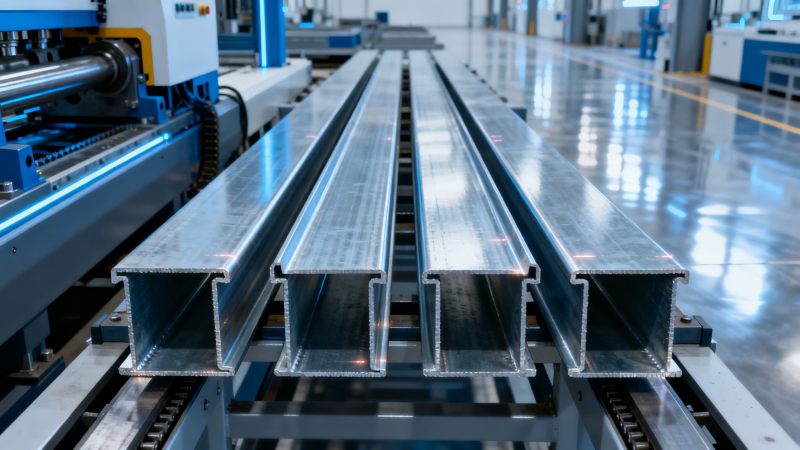
The table highlights how cold-formed sections deliver superior consistency—especially vital when integrating with pre-punched galvanized components or robotic welding cells. Projects in North America using AISC 360-compliant designs frequently require cold-formed C beams for wall girts due to their predictable springback behavior during bending fabrication.
Mechanical Behavior & Structural Integrity Risks
Cold-forming induces work hardening and directional grain flow, increasing yield strength by up to 25% compared to equivalent hot-finished grades. However, this also introduces non-uniform residual stresses—concentrated near bends and flange edges—with peak magnitudes reaching 300 MPa. Hot-finished profiles exhibit near-zero residual stress post-cooling, offering more linear elastic response under service loads.
When substituted without recalculating connection stiffness or buckling coefficients, hot-finished C-sections may underperform in lateral-torsional buckling resistance—particularly in roof purlins spanning >6 m. EN 1993-1-3 explicitly mandates separate stability verification methods for cold-formed vs. hot-rolled members, with reduction factors differing by up to 18% for thin-walled configurations.
For mechanical light industry manufacturing—where Metal C Beam serves as support arms and machine frames—cold-formed sections provide higher torsional rigidity (up to 40% greater than hot-rolled equivalents of same mass), reducing vibration-induced wear in high-cycle automation lines.
Procurement & Compliance Considerations Across Global Markets
Procurement teams must verify not only base material grade (e.g., Q235 vs. A36) but also the applicable product standard: hot-finished profiles follow ASTM A6/A6M or GB/T 706, while cold-formed products comply with AISI S100, EN 10147, or GB/T 6725. Certification bodies—including BV, SGS, and CE Notified Bodies—require mill test reports specifying forming method, as it affects traceability and exemption eligibility under ISO 3834 welding quality management.
Hongteng Fengda maintains dual-certified production lines, enabling seamless switching between hot-roll and cold-roll processes without changing raw material stock. All Metal C Beam shipments include EN 10204 3.1 mill certificates with explicit “Cold Rolled” or “Hot Rolled” designation—eliminating customs clearance delays in EU or GCC markets where classification errors trigger 12–18% import duty penalties.
This regulatory divergence explains why over 68% of rejected steel shipments in Dubai ports in 2023 involved misclassified forming process documentation—not chemical composition flaws. Hongteng Fengda’s export compliance team supports clients with pre-shipment document review and regional standard mapping.
When Substitution *Can* Be Justified—With Conditions
Substitution may be acceptable in non-critical secondary framing—such as interior partition supports or equipment mounting rails—provided three conditions are met: (1) structural engineer approval confirming no change to load path assumptions; (2) on-site verification of actual dimensions against shop drawings (not just nominal sizes); and (3) confirmation that all processing services—bending, punching, welding—are compatible with the substituted profile’s residual stress profile.
Hongteng Fengda offers free technical consultation for substitution feasibility assessments, including FEA-based local buckling checks and tolerance stack-up analysis for multi-component assemblies. Our typical turnaround for engineering validation reports is 3–5 business days, supported by ISO/IEC 17025-accredited lab testing.
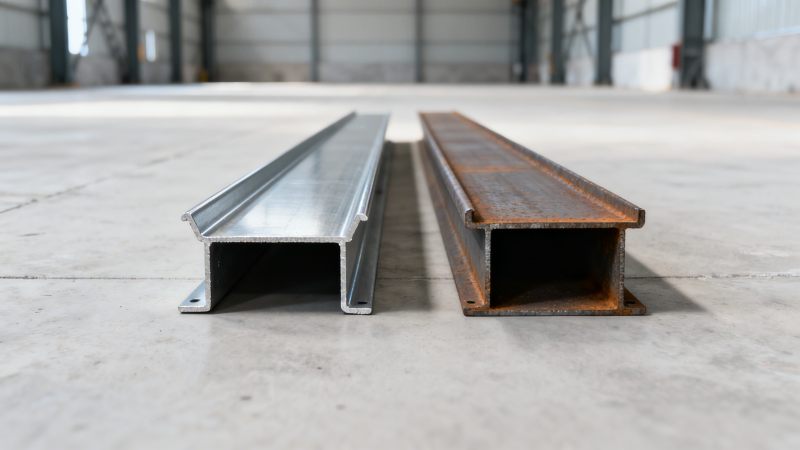
For purlin and wall beam applications, our cold-formed Metal C Beam delivers optimized weight-to-strength ratio: 12.5 kg/m for 200×75×2.5 mm section versus 15.8 kg/m for equivalent hot-rolled, reducing transportation carbon footprint by 21% per container load.
Actionable Next Steps for Your Project Team
Before finalizing any profile substitution, cross-verify against these five checkpoints:
- Confirm whether original design calculations referenced cold-formed section properties (e.g., effective width per EN 1993-1-3 Annex A)
- Validate that existing connection hardware (e.g., self-drilling screws, clip angles) is rated for the substituted profile’s hardness and coating thickness
- Check if fire-resistance rating depends on section factor (A/V)—cold-formed shapes typically have 15–22% higher A/V ratio
- Ensure galvanizing bath temperature compatibility: hot-finished sections tolerate 450–480°C immersion; cold-formed may warp above 420°C
- Verify OEM equipment manuals permit substitution—especially for crane runway beams or seismic bracing systems
Hongteng Fengda supports global partners with rapid-response engineering reviews, custom sample production (lead time: 7–10 days), and dual-standard certifications (e.g., ASTM + GB + EN). Contact our technical sales team today to request a free profile compatibility assessment for your next structural steel order.
Please give us a message


Please enter what you want to find