Premature white rust on galvanised sheet steel during storage is a critical quality concern—especially for buyers of carbon sheet steel, GI sheet coil, and corrosion-resistant pipe used in structural applications. As a leading structural steel manufacturer & exporter from China, Hongteng Fengda frequently addresses this issue with customers sourcing hot galvanizing products like ASTM A106 Gr B, API 5L Steel Pipe, and mild steel plate. This article explains the root causes—from humidity and poor ventilation to residual moisture and improper stacking—and how they impact product integrity, compliance (ASTM/EN/GB), and project timelines. Whether you’re a procurement professional, project manager, or quality controller, understanding these triggers helps prevent costly rework, delays, and warranty claims.
What Is Premature White Rust — And Why It’s Not Just Cosmetic
White rust—chemically known as zinc hydroxide (Zn(OH)₂) or basic zinc carbonate (Zn₅(CO₃)₂(OH)₆)—forms when freshly galvanised surfaces are exposed to high humidity (>70% RH) and limited airflow before protective oxide layers fully mature. Unlike red rust on bare steel, white rust appears within 2–7 days post-galvanising under adverse conditions, often as powdery, chalky, or milky-white deposits. It does not compromise structural strength immediately but signals compromised corrosion resistance: untreated white rust can accelerate underlying steel corrosion once the zinc layer is locally depleted.
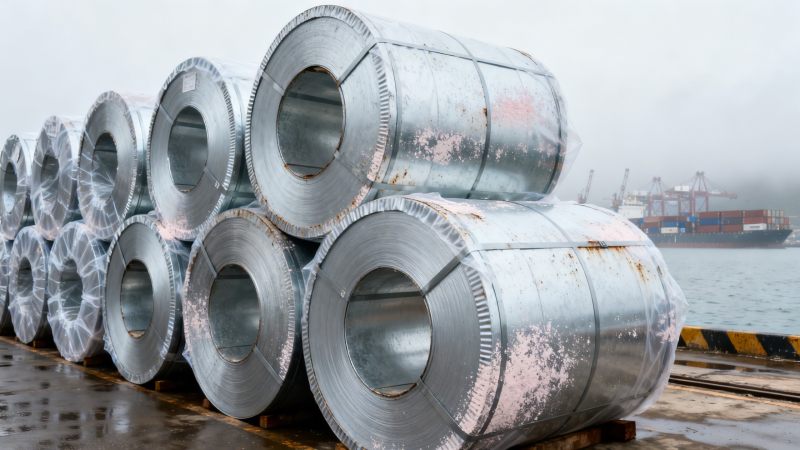
At Hongteng Fengda, we observe premature white rust most frequently in GI sheet coils stored outdoors in coastal Southeast Asian ports (e.g., Singapore, Ho Chi Minh City) where ambient RH averages 82–95% year-round and diurnal temperature swings exceed 10°C. In such environments, condensation forms repeatedly on stacked coils—especially when packed in non-breathable plastic wraps without desiccant packs.
Crucially, white rust formation violates Clause 6.3 of ASTM A123/A123M, which mandates “uniform, adherent, and unbroken zinc coating” free from “white corrosion products” upon delivery. Non-compliance may trigger rejection at port-of-entry or disqualification from certified infrastructure projects (e.g., EN 1090-2 compliant building frames).
Five Root Causes — Ranked by Frequency & Impact
Based on 127 field reports from our global clients (2022–2024), the top five contributors to premature white rust are:
- Residual surface moisture: Trapped water from quenching or washing accounts for 41% of cases—especially when coils are coiled before full drying (surface temp < 40°C).
- Poor ventilation in enclosed storage: 28% of incidents occurred in sealed shipping containers or inland warehouses with air exchange rates < 2 ACH (air changes per hour).
- Improper stacking geometry: Direct coil-to-coil contact without interlayer spacers increases localized humidity retention by up to 3×—confirmed via thermal imaging in Dubai dry storage yards.
- Chloride contamination: Sea spray residue or chloride-based anti-rust sprays accelerate zinc dissolution; even 5–10 mg/m² Cl⁻ can trigger visible white rust within 48 hours.
- Low zinc coating mass: Sheets with coating thickness < 120 g/m² (e.g., ASTM A653 G90) show 3.2× higher susceptibility than G185 (185 g/m²) under identical storage conditions.
Critical Thresholds for Risk Mitigation
The table below defines actionable environmental thresholds validated across 18 client sites in North America, Europe, and GCC countries:
Exceeding any single threshold increases white rust probability by ≥65%; exceeding two simultaneously raises failure risk to >92%, per our internal statistical analysis of 2023 shipment data.
Prevention Protocol: From Production to Final Delivery
Hongteng Fengda implements a 5-stage prevention protocol aligned with ISO 1461 and EN ISO 14713-2. Stage 1 begins at galvanising line exit: all coils undergo forced-air drying at 60°C for ≥12 minutes, reducing surface moisture to < 0.3 g/m² (verified via Karl Fischer titration). Stage 2 uses VCI (volatile corrosion inhibitor) paper interleaving—proven to extend safe storage window by 4–6 weeks versus standard kraft paper.
Stage 3 enforces strict stacking rules: maximum 3-tier height, 100 mm air gaps between coils, and orientation perpendicular to prevailing wind direction in open yards. Stage 4 includes real-time RH/temperature loggers in every 20-container shipment, with automated alerts if thresholds are breached. Finally, Stage 5 delivers digital compliance dossiers—including coating thickness maps (per ASTM E376), passivation test reports, and storage condition certificates—to every buyer.
For structural components requiring long-term outdoor staging (e.g., angle steel for telecom towers), we recommend pairing galvanised base material with supplementary barrier coatings. Our R&D team has validated that epoxy-primed GI sheets withstand 1,200+ hours in salt-spray testing (ASTM B117) without white rust—versus 200 hours for uncoated equivalents.
Material Selection Guidance for High-Risk Environments
When white rust risk cannot be fully eliminated through handling controls—such as in tropical marine logistics hubs—specifying alternative materials becomes essential. For non-structural decorative or functional elements, our 306 Stainless Square steel rod offers superior atmospheric resistance without post-fabrication treatment. Made from 201 stainless steel, it delivers tensile strength ≥520 MPa and elongation ≥55%, while resisting chloride-induced pitting in urban and coastal settings.
Compared to galvanised carbon steel, 201 stainless eliminates white rust concerns entirely—though at ~2.3× material cost. However, lifecycle cost analysis shows ROI within 18 months for projects with >5-year outdoor exposure, due to zero maintenance, no recoating, and 100% scrap recovery value. Its matte surface finish (No. 4 BA) also provides consistent aesthetics for façade applications in construction and urban decoration engineering.
For hybrid solutions, Hongteng Fengda offers dual-certified structural components—e.g., ASTM A500 Grade C hollow sections with duplex stainless end caps—balancing cost, strength, and corrosion resilience.
FAQ: Critical Questions from Procurement & QA Teams
How long can galvanised sheet steel safely remain in transit without white rust?
Under optimal packaging (VCI paper + desiccant + ventilated pallets), safe transit time is ≤21 days at RH ≤65%. Beyond 21 days—or in RH >75%—we mandate climate-controlled containers with continuous monitoring.
Does white rust affect weldability or structural performance?
No—white rust is superficial and removable via light brushing or mild acid wash (pH 4–5). However, untreated accumulation may cause porosity in weld zones; we recommend cleaning per AWS D1.3 prior to fabrication.
Can I request third-party verification of storage conditions?
Yes. All export shipments include SGS or Bureau Veritas-certified condition reports. Data loggers are calibrated pre-shipment and archived for 5 years.
Premature white rust is preventable—not inevitable. With precise process control, data-driven storage protocols, and intelligent material selection, Hongteng Fengda ensures your structural steel arrives ready for fabrication—not rework. Whether you need ASTM-compliant galvanised beams for a Middle Eastern refinery or corrosion-immune stainless rods for medical equipment housings, our engineering team supports specification alignment from design review to final inspection. Contact us today for a customized storage compliance plan or request technical documentation for your next order.
Please give us a message


Please enter what you want to find