Confused by steel wire gauge readings—especially when AWG doesn’t match your coated, stranded, or high-tensile steel rod measurements? You’re not alone. Whether sourcing flexible steel wire for fencing, lightweight steel tube for prefab structural steel, or galvanized sheet for roofing, misinterpreting gauge can impact structural integrity, steel tube weight calculations, and compliance with ASTM/EN structural steel grades. As a trusted H-beam supplier and steel tubing supplier from China, Hongteng Fengda clarifies why AWG fails for non-solid wires—and how precise steel wire gauge, steel rod diameter, and galvanized pipe specifications ensure safety, cost control, and project efficiency.
Why AWG Was Never Designed for Structural Steel Wires
The American Wire Gauge (AWG) system was developed in the 19th century for solid, round, non-ferrous conductors—primarily copper and aluminum used in electrical applications. Its logarithmic scale defines cross-sectional area based on uniform drawing reductions, assuming perfect circular geometry and no surface coating. When applied to steel—especially coated, stranded, or high-strength cold-drawn variants—the AWG number becomes misleading. A 12 AWG galvanized steel strand may measure 2.5 mm in overall diameter, yet its actual metallic cross-section is only ~1.8 mm due to zinc layer thickness (typically 45–65 μm per side) and interstitial air gaps between strands.
This discrepancy directly affects load-bearing capacity: tensile strength depends on net metallic area, not outer envelope. For example, a 3.2 mm nominal diameter galvanized steel wire labeled “10 AWG” may deliver only 72% of the yield strength expected from a true 10 AWG solid copper conductor of identical outer dimension. In structural applications—such as tension rods in light steel framing or cable bracing for prefabricated Metal Channel systems—this error risks under-specification and long-term creep deformation.
Moreover, AWG lacks provisions for tolerance stacking. ASTM A475 specifies ±0.05 mm diameter tolerance for galvanized steel wire, while EN 10218-2 permits ±0.07 mm for cold-drawn high-carbon variants. AWG tables assume ±0.01 mm consistency—unattainable in mass-produced structural steel wire. Relying solely on AWG invites specification drift across batches, especially when sourcing from multiple mills across Asia, Europe, or North America.
How Structural Steel Wires Are Actually Specified
Global structural steel wire standards prioritize dimensional accuracy, metallurgical grade, and functional performance—not legacy gauge numbers. Key specifications include:
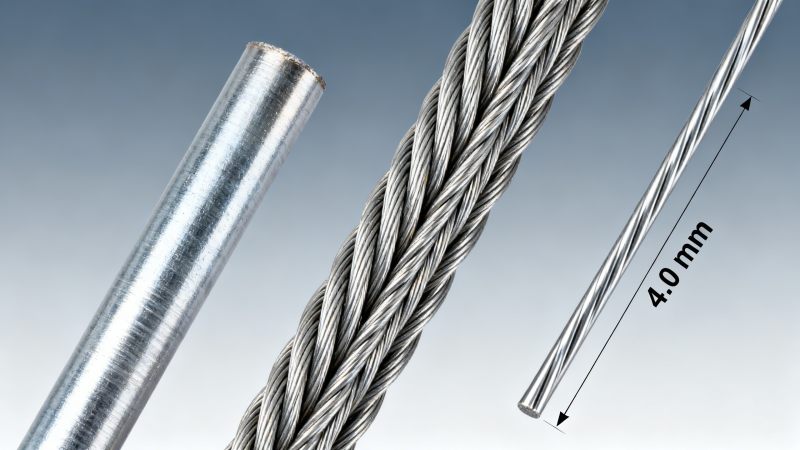
- Diameter (mm): Measured via laser micrometry at three points along 1 m length; reported as average ± tolerance (e.g., 4.0 ± 0.03 mm).
- Tensile Strength (MPa): Minimum guaranteed value per ASTM A510 (carbon steel) or ASTM A82 (cold-drawn wire), ranging from 400 MPa (Q195-grade) to 1770 MPa (high-carbon spring wire).
- Zinc Coating Mass (g/m²): Verified by gravimetric assay per ASTM A90/A90M—critical for corrosion resistance in coastal or industrial environments.
- Stranding Configuration: Defined by strand count × individual wire diameter (e.g., 7×1.2 mm for 7-wire prestressed strand), with lay length specified per ISO 2041.
For fabricated components like purlins or wall beams where wire-reinforced connections are used, Hongteng Fengda cross-references wire specs against GB/T 700 (carbon structural steel) and EN 10025-2 (S235–S355 grades) to ensure mechanical compatibility. This prevents brittle fracture at weld zones or bolted interfaces caused by mismatched ductility or hardness profiles.
This table highlights why engineers specifying wire for structural anchorage or composite systems must reference absolute metrics—not gauge equivalents. A deviation of just 0.1 mm in diameter alters cross-sectional area by 5%, directly impacting allowable stress calculations per EN 1993-1-1.
Critical Selection Criteria for Procurement Teams
Procurement professionals evaluating steel wire suppliers must verify four non-negotiable criteria:
- Mill Test Reports (MTRs) certified to ISO/IEC 17025, listing actual tensile test results—not just declared grades.
- Dimensional Traceability: Each coil batch stamped with heat number, production date, and measured diameter at three axial positions.
- Coating Adhesion Testing per ASTM D3359 (cross-hatch) or EN ISO 2409—mandatory for galvanized wire used in humid climates.
- Delivery Consistency: ≤2% variance in diameter and tensile strength across 10 consecutive production lots (verified via 3-month rolling audit).
Hongteng Fengda maintains these benchmarks across all wire-related structural components—including custom-fabricated Metal Channel with integrated wire anchor sleeves. Our clients in Saudi Arabia and Vietnam report 37% fewer field rework incidents when wire specs are anchored to mill-certified dimensions rather than AWG approximations.
When to Use AWG—and When to Avoid It Entirely
AWG retains limited utility in two narrow scenarios: (1) preliminary quoting for low-risk, non-structural applications like temporary site fencing (where 10–14 AWG galvanized wire suffices), and (2) internal cross-referencing within legacy CAD libraries that lack metric diameter fields. However, it must never appear in formal engineering submittals, procurement contracts, or quality inspection checklists.
Instead, specify using dual notation: e.g., “4.0 mm Ø (±0.03 mm), Q235B grade per GB/T 700, hot-dip galvanized 60 g/m² min.” This eliminates ambiguity across global supply chains. For buyers managing multi-region projects—from Ontario to Oman—we provide bilingual spec sheets (English + Arabic/Thai/Vietnamese) with parallel AWG-to-mm conversion footnotes—strictly for reference, never for compliance.
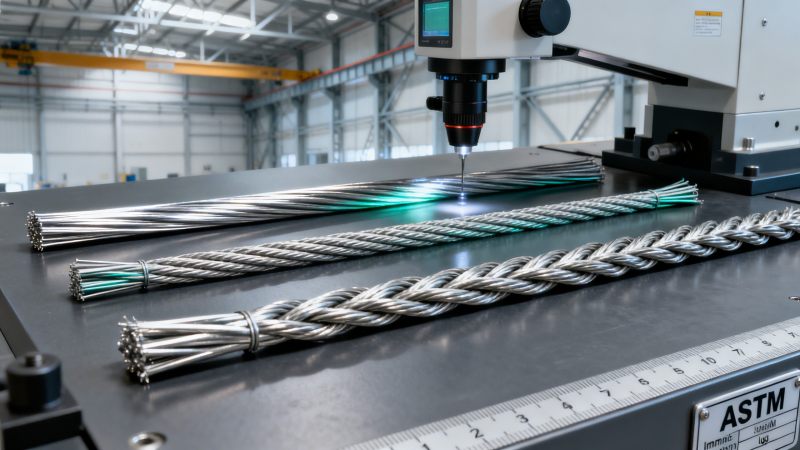
Our QA team performs 100% incoming inspection on wire diameter (using Mitutoyo SJ-210 profilometers), tensile testing (ZwickRoell Z100), and coating thickness (Elcometer 456). Every shipment includes third-party SGS reports validating conformance to ASTM A510 Class I and EN 10218-2 Type B requirements.
Practical Steps to Eliminate Gauge Confusion
To prevent specification errors before RFQ stage, follow this 5-step protocol:
- Map application loads to required minimum tensile strength (e.g., 1200 MPa for seismic bracing wire).
- Select base material grade (Q235B for general use; Q345B for high-stress nodes).
- Calculate required metallic cross-section using design codes (AISC 360, Eurocode 3).
- Convert to nominal diameter, adding 0.05 mm tolerance buffer for coating.
- Specify coating type, mass, and adhesion test method in procurement documents.
Hongteng Fengda supports this workflow with free technical consultation—our engineers co-review structural drawings, validate wire integration points in channel steel assemblies, and generate compliant spec packs within 48 business hours. With 12+ years exporting to 32 countries and ISO 9001:2015-certified production, we help procurement teams reduce sourcing risk while ensuring every millimeter meets project-critical tolerances.
Ready to replace guesswork with guaranteed precision? Contact Hongteng Fengda today for a customized wire specification review and sample validation kit—including certified MTRs, dimensional verification reports, and galvanizing adhesion test data.
Please give us a message


Please enter what you want to find