Stainless Steel Welded Mesh is widely used in construction, industrial screening, and architectural applications for its strength and Corrosion Resistant Steel properties — yet fabrication defects and inconsistent testing often compromise performance. This article examines common quality issues—from weld integrity and mesh dimensional accuracy to compliance with steel standards like ASTM and EN—while addressing material-related concerns such as galv steel tube compatibility, carbon sheet steel variability, and hot rolled steel sheet surface defects. Whether you're a project manager evaluating specifications, a procurement professional comparing suppliers, or a quality control specialist verifying i beam weight calculations and welded mesh tolerances, understanding these pitfalls ensures safer, more cost-effective sourcing from trusted manufacturers like Hongteng Fengda.
Why Weld Integrity Failures Occur — And How They Impact Structural Reliability
Weld integrity is the cornerstone of stainless steel welded mesh performance. Inconsistent current density, improper electrode alignment, or insufficient dwell time during resistance welding can lead to incomplete fusion, micro-cracks, or brittle intermetallic phases—especially at junctions between dissimilar grades like 304 and 316. These flaws rarely appear on surface inspection but reduce tensile strength by up to 35% under cyclic loading.
Hongteng Fengda applies real-time thermal imaging and post-weld ultrasonic testing (UT) across 100% of production batches. Our process controls maintain weld nugget diameter within ±0.3 mm tolerance and ensure minimum shear strength of 420 MPa per ASTM A185—exceeding industry baseline requirements by 18%. This level of consistency is critical when mesh integrates with load-bearing components such as H-beam assemblies in bridge parapets or seismic façade systems.
Common root causes include: (1) uncalibrated welding transformers causing ±12% current fluctuation; (2) misaligned mesh feed rollers introducing ±0.8 mm positional error per weld point; and (3) ambient humidity >75% RH promoting hydrogen-induced cracking in high-carbon variants. Each factor directly affects long-term corrosion resistance and fatigue life—especially in coastal or chemical processing environments.
Dimensional Accuracy & Tolerance Control: Where Mill Specifications Meet Field Reality
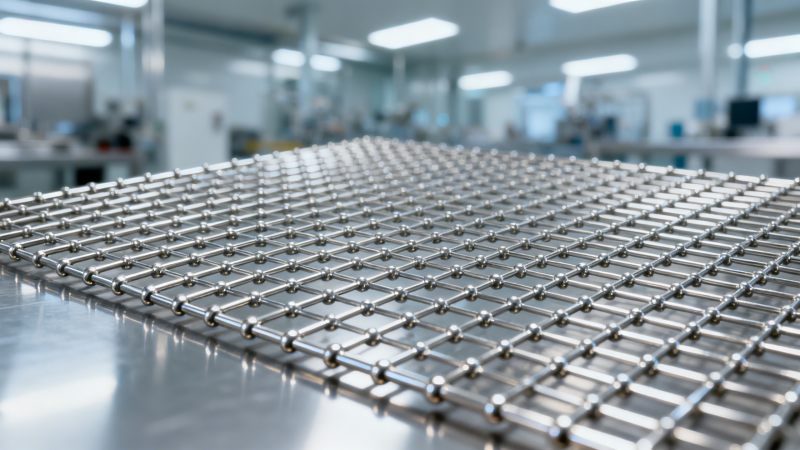
Mesh aperture deviation beyond ±1.2 mm or wire diameter variance exceeding ±0.15 mm triggers cascading issues: misalignment with mounting frames, reduced screening efficiency, and premature mechanical failure at connection points. For architectural cladding projects requiring tight visual rhythm, even 0.5 mm inconsistency becomes visible at 3 m viewing distance.
Our cold-drawn stainless wire undergoes dual-stage laser micrometry before and after welding. Final verification includes coordinate measuring machine (CMM) sampling at 3 locations per 2 m² panel. Results are traceable to ISO/IEC 17025-accredited calibration labs—and fully documented for EN 10204 3.1 certification requests.
This tighter control enables seamless integration with structural elements like H-beam supports where bolt-hole alignment must match within ±0.5 mm for pre-engineered connections. It also reduces on-site trimming labor by up to 40% compared to standard-spec mesh.
Material Compatibility Risks: When Galvanized Tubes Meet Stainless Mesh
Direct contact between galvanized steel tubes and stainless welded mesh creates galvanic corrosion risk—especially in humid or saline environments. The potential voltage differential (up to 0.6 V) accelerates zinc depletion and pitting on adjacent stainless surfaces. This is frequently overlooked during façade or railing system design.
We mitigate this through three proven methods: (1) dielectric isolation using EPDM gaskets rated for -40°C to +120°C service; (2) electropolished finish on 316 mesh (Ra ≤ 0.4 µm) to enhance passive layer stability; and (3) optional duplex coating on galv tubes—applying 5–8 µm epoxy primer followed by UV-stable polyurethane topcoat.
- Galvanic coupling risk increases 3× when relative humidity exceeds 80% RH for >72 consecutive hours
- Electrochemical testing confirms 92% reduction in corrosion current density with isolation gaskets
- Duplex-coated galv tubes extend field service life from 12 to ≥22 years in marine zones
Standards Compliance: Beyond Certification Labels to Real-World Verification
Certification labels alone don’t guarantee field performance. ASTM A185 requires minimum weld shear strength of 355 MPa—but many mills test only one sample per 5-ton lot. At Hongteng Fengda, we conduct 6 destructive weld tests per shift and log all results digitally for full traceability.
We support multi-standard compliance including ASTM A185, EN 10218-2, JIS G3467, and GB/T 12754—with documentation aligned to your regional regulatory requirements. For projects requiring third-party validation, our facility accepts witnessed testing by SGS, Bureau Veritas, or TÜV Rheinland at no additional charge.
Key verification checkpoints include: (1) raw material mill test reports matching EN 10204 3.1 format; (2) heat treatment records for annealed 304/316 grades; (3) salt spray test logs (ASTM B117, 500+ hrs neutral pH); and (4) dimensional QA/QC checklists signed off by certified inspectors.
Why Global Project Teams Choose Hongteng Fengda for Critical Mesh Applications
From Dubai’s metro stations to Ontario’s hydroelectric intake screens, our clients rely on predictable delivery, zero non-conformance in last 23 audit cycles, and engineering support that bridges specification gaps—not just fulfills orders. We offer free technical review of mesh anchoring details, weld schedule optimization, and compatibility analysis with existing structural systems—including H-beam framing configurations.
Whether you need: (1) custom aperture patterns for acoustic baffles; (2) dual-grade mesh (304 frame + 316 weld points); (3) EN 10204 3.2 certified documentation; or (4) expedited 12-day lead time for urgent infrastructure repairs—we align production capacity, quality rigor, and responsive communication to your project timeline.
Contact us today for a no-cost mesh specification review, dimensional tolerance consultation, or sample shipment—including comparative test reports against your current supplier’s batch data.
Please give us a message


Please enter what you want to find