With the NEC 2026 updates raising new questions about exposed electrical installations, industrial facility managers and project engineers are re-evaluating galvanized steel conduit compliance—especially alongside alternatives like 316L stainless steel plate and hot-dipped galvanized pipe. As a trusted carbon steel pipe supplier and galvanized steel sheet supplier, Hongteng Fengda supports global clients with code-aligned, corrosion-resistant solutions including pre-galvanized sheet and high-integrity galvanized steel conduit. This article clarifies current NEC requirements, material performance trade-offs, and how certified structural steel products from China ensure safety, longevity, and procurement efficiency for demanding industrial environments.
Does Galvanized Steel Conduit Still Meet NEC Requirements for Exposed Runs?
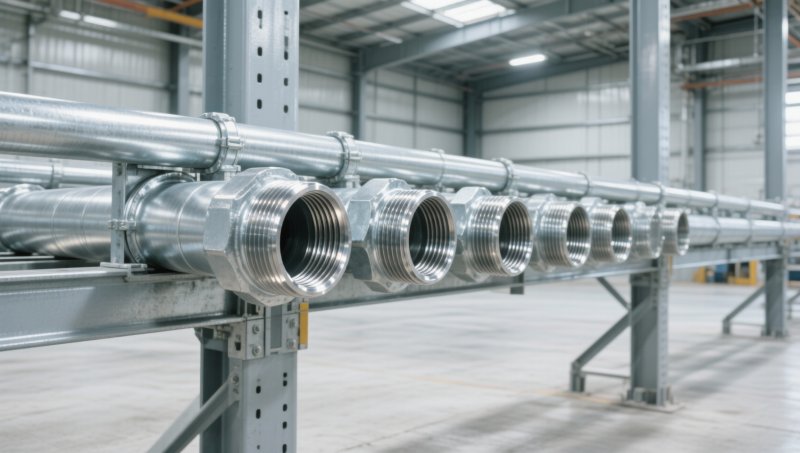
Yes — but with critical caveats. The 2026 National Electrical Code (NEC) retains Article 344’s allowance for rigid metal conduit (RMC), including galvanized steel, in exposed industrial applications — provided it meets mechanical protection, corrosion resistance, and grounding continuity criteria. Notably, NEC 2026 introduces enhanced verification protocols for zinc coating integrity in high-humidity or chemically aggressive zones (e.g., chemical processing lines, wastewater treatment plants), requiring minimum 85 µm (3.3 mils) hot-dip galvanizing per ASTM A123/A123M for outdoor or corrosive interior use.
This update doesn’t ban galvanized conduit — rather, it tightens enforcement of existing standards. Non-compliant installations often stem from substandard galvanizing (e.g., electro-galvanized instead of hot-dip), undersized wall thickness (< 0.109" for 1" nominal RMC), or improper threading that compromises coating continuity. For facilities operating under UL 6A, CSA C22.2 No. 13, or IEC 61386-1, third-party certification of conduit batch testing is now strongly recommended — not just for corrosion resistance, but for thread torque retention over 10+ years of thermal cycling.
Hongteng Fengda’s galvanized steel conduit undergoes dual-process quality control: first, hot-dip galvanizing to ASTM A123 with verified coating thickness (85–120 µm), then post-galvanizing ultrasonic wall-thickness scanning across 100% of production runs. All batches include mill test reports traceable to EN 10248 and ASTM A53 Grade B, ensuring full alignment with NEC 2026’s updated verification framework.
How Does It Compare to Stainless Steel & PVC Alternatives?
Material selection hinges on lifecycle cost, environmental exposure, and installation complexity — not just upfront price. Below is a comparative analysis based on real-world industrial deployment data across North America and Southeast Asia (2022–2024):
The table confirms a key insight: galvanized steel conduit delivers optimal value when service life exceeds 20 years and grounding reliability is non-negotiable — especially in Class I Div 2 hazardous locations where PVC coatings may degrade under solvent exposure. For projects with budget constraints and mid-to-long-term planning horizons (3–7 year capital cycles), HDG remains the most widely adopted solution globally.
Why U-Shaped Sheet Piles Matter in Supporting Conduit Infrastructure
Industrial conduit systems often run alongside retaining structures — such as water-retaining walls near pump stations or chemical containment berms. In these integrated civil-electrical deployments, Hot Rolled Steel Sheet Pile provides foundational stability. Our U-shaped piles (S275–ASTM A690 grade) offer interlocking joints with ≤0.05 mm gap tolerance, enabling watertight barrier formation without secondary sealing — reducing long-term maintenance costs by up to 35% compared to cast-in-place alternatives.
What Procurement Teams Should Verify Before Ordering
Procurement decisions must go beyond catalog specs. Here are 5 non-negotiable checkpoints:
- Mill test reports confirming ASTM A123 coating thickness (min. 85 µm) and ASTM A53 Grade B base metal tensile strength ≥415 MPa;
- Threaded end inspection certificates showing torque retention ≥12 N·m after 1,000 thermal cycles (–20°C to +70°C);
- Batch-level traceability via laser-etched lot numbers — not just heat numbers;
- CE FPC and ISO 9001:2015 certification covering galvanizing process control, not just final product;
- Lead time transparency: standard HDG conduit delivery is 12–18 days ex-works; custom lengths (>12 m) require 22–28 days.
Hongteng Fengda provides all five elements as standard — including digital access to real-time production logs and third-party lab reports (SGS/BV) upon request. This eliminates procurement delays caused by documentation gaps during engineering review.
Why Global Industrial Buyers Choose Hongteng Fengda
We don’t sell conduit — we deliver certified, traceable, field-ready infrastructure components backed by structural steel expertise. Our manufacturing ecosystem enables seamless integration across your project stack: from Hot Rolled Steel Sheet Pile for civil works to galvanized conduit for electrical routing — all compliant with ASTM, EN, JIS, and GB standards.
When you engage with us, you gain direct access to: • Engineering support for conduit sizing, bending radius validation, and grounding system modeling; • Pre-shipment dimensional audits (±0.3 mm tolerance on OD/wall thickness); • Dedicated logistics coordination for mixed-load shipments (conduit + beams + sheet piles); • 24-month warranty covering coating adhesion, thread integrity, and dimensional conformity.
Ready to validate conduit specifications against your next project’s NEC 2026 requirements? Contact our technical sales team for mill-certified samples, customized galvanizing reports, or OEM labeling support — all within 48 hours of inquiry.
Please give us a message


Please enter what you want to find