Galvanized pipe for water supply is widely used for its strength and corrosion resistance, but hidden quality risks can still affect safety, service life, and compliance. For quality control and safety professionals, understanding how to identify coating defects, dimensional issues, and material inconsistencies is essential. This guide outlines the most common risks and practical inspection points to help ensure reliable performance in water supply applications.
What It Is and Why the Industry Pays Attention
In steel-based water infrastructure, galvanized pipe for water supply refers to steel pipe protected by a zinc coating that helps delay corrosion during storage, transport, installation, and service. The concept is simple, but the quality implications are not. A pipe may look acceptable from the outside while still carrying hidden defects such as uneven zinc coverage, weak weld areas, excessive ovality, or unsuitable base steel. For quality control personnel and safety managers, these risks matter because they influence leakage probability, internal rusting, maintenance frequency, and long-term compliance with project specifications.
The continued use of galvanized pipe for water supply in many industrial, construction, and utility settings comes from a balance of mechanical strength, availability, and cost efficiency. In distribution lines, temporary water systems, agricultural networks, fire-related support systems, and non-potable service applications, galvanized steel remains a practical material. However, performance depends less on the label and more on manufacturing control, coating quality, and inspection discipline.
Why Quality Risks Still Exist in Modern Supply Chains
Even with mature galvanizing technology, risk enters at multiple stages: raw material selection, tube forming, welding, surface preparation, galvanizing, handling, and packaging. If any step is poorly controlled, the final product may not deliver the corrosion resistance expected in water supply service. Global sourcing adds another layer of complexity. Pipes may be produced to different standards such as ASTM, EN, JIS, or GB, and the buyer must confirm that mechanical properties, dimensions, coating mass, and inspection records truly match the project requirement.
For organizations purchasing from international manufacturers, supplier capability is critical. A reliable structural steel manufacturer and exporter should offer traceable production, consistent inspection routines, and familiarity with major standards. Companies such as Hongteng Fengda, serving construction and industrial buyers across multiple regions, reflect the kind of export-oriented production environment where stable capacity and strict quality control can reduce sourcing risk. Still, regardless of supplier reputation, incoming inspection remains necessary.
Core Quality Risks in Galvanized Water Pipe
The most common quality risks in galvanized pipe for water supply can be grouped into coating-related defects, dimensional deviations, substrate issues, weld quality concerns, and contamination or handling damage. Each category affects service performance in a different way, so inspectors should avoid relying on appearance alone.
1. Coating defects
The zinc layer is the first line of defense. If the coating is too thin, discontinuous, poorly adhered, or locally damaged, corrosion can begin much earlier than expected. Common problems include bare spots, ash inclusions, runs, drips, rough spangle irregularity, blistering, peeling, pinholes, and excessive thickness variation. Internal coating quality is especially important in water supply use, because hidden internal weak points can accelerate rust formation and contamination risk.
2. Dimensional and geometric issues
A pipe that falls outside tolerance may still be installed, but it can create thread fit problems, sealing failure, uneven flow behavior, or stress concentration at joints. Inspectors should pay attention to outer diameter, wall thickness, length tolerance, straightness, end squareness, and ovality. In threaded products, poor thread precision can quickly turn a nominally acceptable pipe into a field installation problem.
3. Base material inconsistency
The performance of galvanized pipe for water supply also depends on the steel beneath the coating. Incorrect chemical composition, weak tensile properties, low ductility, or inconsistent wall structure can result in cracking during bending, threading, coupling, or pressure testing. Material inconsistency is particularly risky when a project assumes compliance with a specific standard but receives mixed or substitute grades.
4. Weld seam weaknesses
For welded pipe, seam quality must never be assumed. Incomplete fusion, undercut, internal burr, poor bead profile, or localized coating loss near the weld zone can reduce pressure integrity and corrosion resistance. Because the weld area often behaves differently during galvanizing, it deserves targeted checking rather than general visual review.
5. Storage and transport damage
Pipes that leave the mill in good condition can still arrive damaged. Wet storage stain, impact dents, chain marks, abrasion, end deformation, and contamination from salts or chemicals may compromise service life before installation begins. Quality control should therefore cover not only factory condition but also delivered condition.
Industry Overview Table: Main Risk Categories and Their Consequences
How to Check Galvanized Pipe for Water Supply in Practice
A sound inspection process should combine document verification, visual examination, dimensional measurement, coating assessment, and selective testing. The goal is not simply to detect defective pieces, but to confirm that the whole batch is consistent and suitable for the intended water service.
Start with documentation
Review mill test certificates, coating data, heat numbers, standard references, and packing lists. Confirm whether the pipe is hot-dip galvanized after fabrication or produced through another route. Check that the declared standard, grade, size range, and test results match the purchase order. Documentation gaps often signal broader control weaknesses.
Carry out visual inspection under good lighting
Inspect outer and inner surfaces where accessible. Look for exposed steel, flaking zinc, severe roughness, lumps that interfere with fit-up, cracks, weld irregularity, end damage, and contamination. Visual inspection should also check uniformity across multiple samples from different bundles, not just the top layer of a shipment.
Measure dimensions and geometry
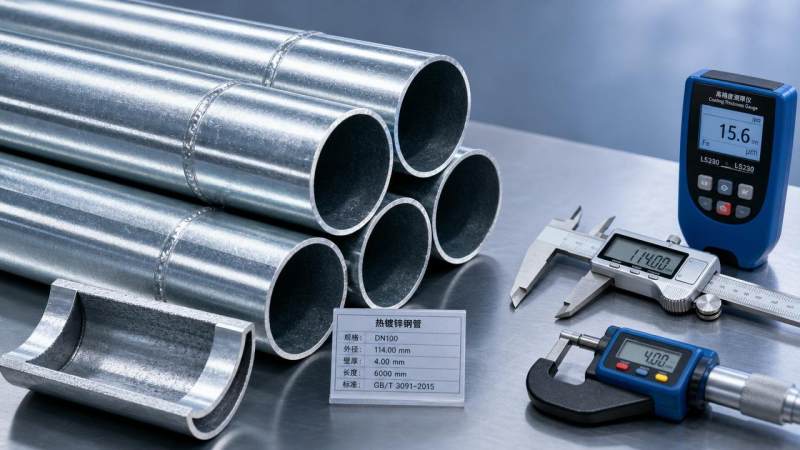
Use calibrated tools to check outer diameter, wall thickness, length, and straightness. For threaded pipe, confirm thread accuracy and coupling fit. A recurring field issue with galvanized pipe for water supply is that minor dimensional deviations create sealing problems at scale, especially when mixed suppliers are involved in the same project.
Verify coating performance
Where specification requires it, use coating thickness gauges or coating mass verification methods. If adhesion is in doubt, additional testing may be needed according to the governing standard. Consistency matters as much as average value; a batch with acceptable average zinc coating can still fail in service if low-protection areas are scattered throughout the pipe body or weld zone.
In the broader galvanized steel supply chain, upstream coating quality often begins with well-controlled raw material. For projects that also involve fabricated galvanized components, buyers may evaluate coil-based input materials such as Steel Coil Galvanized. Typical grades include DX51D+Z, DX52D+Z, SGCC, S250GD+Z, and S350GD+Z, with zinc coating ranges such as 60-275g/m² for hot galvanizing and sizes from 0.12mm to 3.5mm in thickness. While coil and finished pipe are different products, understanding coating standards, substrate grades, and traceability at the raw-material stage helps QC teams build a more complete risk picture.
Use selective destructive or pressure-related testing when needed
For critical applications, sampling plans may include flattening tests, hydrostatic tests, mechanical tests, or metallographic checks on weld areas. These are not required for every incoming batch, but they are valuable when supplier history is limited, specification compliance is doubtful, or the project carries high safety consequences.
Application Categories and Inspection Focus
Practical Recommendations for QC and Safety Teams
First, define acceptance criteria before shipment, not after arrival. Purchase documents should specify standard, size tolerance, galvanizing method, coating requirement, mechanical properties, test frequency, and traceability expectations. Second, inspect by batch and by sampling position. Defects are often unevenly distributed, especially in mixed-bundle or rushed shipments.
Third, align inspection depth with risk level. Not every galvanized pipe for water supply requires the same level of testing. A temporary non-critical line may justify a lighter inspection plan than a long-service industrial system with difficult maintenance access. Fourth, pay attention to storage after receipt. Pipes should be kept dry, ventilated, and protected from standing water and corrosive contaminants. Otherwise, avoidable staining and coating damage may be mistaken for manufacturing defects.
Finally, build supplier feedback loops. If recurring issues appear in zinc coverage, end finishing, or dimension control, report them with photos, measurements, and batch numbers. Over time, a data-based supplier evaluation system helps reduce incoming variability and strengthens safety assurance.
Conclusion
Galvanized pipe for water supply remains a useful solution where durability, strength, and corrosion resistance are required, but its reliability depends on more than the presence of zinc alone. Coating defects, dimensional errors, weak welds, unsuitable steel grades, and transport damage can all undermine performance. For quality control personnel and safety managers, the most effective approach is a structured inspection routine that combines documentation review, visual checks, dimensional verification, and targeted testing.
When projects involve international steel sourcing, working with experienced manufacturers that understand ASTM, EN, JIS, and GB requirements can improve consistency, but final responsibility still rests on clear specifications and disciplined verification. By checking the right points early, teams can reduce failure risk, extend service life, and ensure that galvanized pipe for water supply performs as intended in real operating conditions.
Please give us a message


Please enter what you want to find