Galvanized pipe for water supply remains a widely used solution in construction and utility systems, but threading problems can lead to leaks, weak connections, and costly delays. For buyers comparing galvanized steel price, evaluating a steel pipe supplier, or managing galvanized steel for construction projects, understanding these common issues is essential for safer installation, better performance, and long-term cost control.
In water distribution networks, threaded galvanized pipe is still common in low-rise buildings, renovation projects, fire protection branches, maintenance works, and utility retrofits. While the pipe body may meet ASTM, EN, JIS, or GB requirements, connection failure often starts at the thread. A small error of 1-2 thread turns, poor zinc condition at the pipe end, or incorrect sealing practice can reduce joint reliability and increase rework.
For operators, threading problems slow installation. For quality teams, they raise inspection risk. For procurement and project managers, they affect budget, delivery schedules, and supplier evaluation. For distributors and end users, they influence long-term maintenance cost. The practical value of this topic is not theoretical; it directly affects leakage rates, replacement frequency, and the service life of water supply systems.
This article explains the most common threading problems in galvanized water pipe, how to identify them, which standards and tolerances matter, and what buyers should verify before placing an order. It also connects these issues to material selection, quality control, and sourcing strategy for steel-related construction projects.
Why Threading Quality Matters in Galvanized Water Pipe Systems
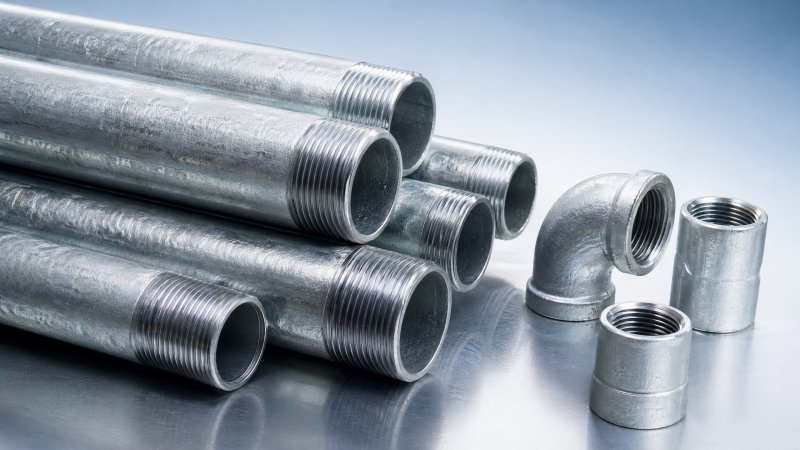
Threaded joints are load-bearing connection points that must resist internal pressure, installation torque, vibration, and environmental exposure at the same time. In many building water lines, nominal pipe sizes from 1/2 inch to 2 inch are regularly connected by threads rather than welding or grooved couplings. If the thread geometry is inaccurate, even a well-coated pipe can fail early at the connection instead of along the pipe wall.
A common misunderstanding is that zinc coating alone guarantees corrosion resistance. In reality, the pipe end is a sensitive zone. Cutting and threading remove part of the coating, expose fresh steel, and create stress concentration. If the thread crest is torn, too thin, or over-cut, sealing compounds may not compensate for the mechanical weakness, especially under pressure fluctuations of 0.6-1.6 MPa that are typical in many utility and building systems.
From a purchasing standpoint, threading quality also influences hidden cost. A lower unit galvanized steel price may look attractive, but if 3%-5% of joints require rework on site, labor, delay, and replacement costs can quickly exceed the initial savings. This is why technical assessment teams often review end-finish quality, thread accuracy, and packaging protection together, not as separate items.
For exporters and global buyers, the issue becomes more important when projects span multiple standards. A steel pipe supplier serving North America, Europe, the Middle East, and Southeast Asia may need to align product dimensions, threading practice, and inspection methods with different project specifications. That is where stable manufacturing control and clear communication reduce sourcing risk.
Main performance risks caused by poor threading
- Leakage at the first 24-72 hours of pressure testing due to incomplete sealing engagement.
- Reduced pull-out resistance when thread depth is insufficient or inconsistent.
- Accelerated corrosion at bare or damaged ends after installation in humid service environments.
- Cross-threading during assembly, especially in fast-track construction schedules with high labor turnover.
The table below summarizes how common thread-related defects affect both installation and lifecycle cost in galvanized steel for construction applications.
The key conclusion is simple: threading quality is not a minor finishing detail. It is a performance-critical factor that connects manufacturing discipline to project safety, maintenance frequency, and total installed cost.
Common Threading Problems and Their Root Causes
Most threading failures fall into a limited number of patterns, and each pattern usually points to a specific process weakness. When technical evaluators inspect a steel pipe supplier, they should look beyond visual appearance and ask how cutting, deburring, threading speed, lubrication, and post-thread protection are managed. Good results come from process consistency, not from a single final inspection.
1. Incorrect thread depth and taper
If the die setting is wrong or the machine is worn, thread depth may be too shallow or too deep. Shallow threads reduce engagement length, while over-cut threads weaken the pipe end. In practical field assembly, either issue may show up after 3-4 turns, when the fitting suddenly feels too loose or too tight compared with normal installation behavior.
2. Burrs, torn edges, and rough finish
Rough threads usually result from dull tools, poor chip removal, or insufficient lubrication. Burrs may cut sealing tape, contaminate the line, or prevent proper make-up. In drinking water systems, this is not only a workmanship issue; it can also affect cleanliness and commissioning efficiency.
3. Zinc damage near the threaded section
Galvanized pipe threading inherently disturbs the coating near the end. The problem becomes serious when the coating flakes excessively, when bare steel is left unprotected, or when the threaded end is stored in damp conditions before installation. In coastal or high-humidity areas, that exposed zone can become the first corrosion point.
4. Out-of-round pipe ends and poor cutting alignment
If the pipe end is not square or the tube is slightly oval, the thread may start unevenly. This increases cross-threading risk and causes mismatch with couplings or valves. On busy project sites, installers may try to force the connection, creating damage that is incorrectly blamed on fittings instead of the pipe.
Typical root causes in production and handling
- Worn threading dies after long production runs without timely replacement.
- Incorrect feed speed, especially when switching between different pipe wall thicknesses.
- Insufficient cooling or lubrication, leading to tearing and overheating.
- Inadequate end protection during packing, loading, or container transport over 2-6 weeks.
For buyers managing broader steel packages, connection quality should also be considered alongside associated fabricated components. In projects that combine pipes with support plates, mounting details, or equipment bases, suppliers with broader steel processing capability can simplify coordination. For example, a project sourcing pipe systems may also require structural support materials from a Mild Steel Plate Supplier for support plates, mechanical mounting plates, racks, or bridge-related components, especially in grades such as A572 or S355JR.
Those plate products are commonly used in construction, bridges, heavy machinery, transmission towers, and equipment frames. Typical dimensions such as 100mm-3000mm width, 1m-12m length, and 0.1mm-400mm thickness allow matching support design to pipe routing and load conditions. When procurement consolidates such items under one reliable exporter, coordination risk and delivery fragmentation can often be reduced.
Inspection Methods, Standards, and On-Site Acceptance Checks
A frequent project mistake is relying only on mill documents while skipping practical end inspection. For threaded galvanized pipe, acceptance should combine document review, visual checks, dimensional verification, and trial assembly. This approach is useful for procurement teams, quality inspectors, and contractors because it catches functional defects before large-scale installation begins.
At minimum, inspectors should review the applicable material and dimensional standards, verify nominal size and wall thickness, and inspect the thread zone for burrs, coating damage, and deformation. For medium-volume deliveries, checking 3%-10% of randomly selected pieces is a common practical range, depending on project criticality and supplier consistency. Higher-risk applications may justify a larger sampling rate.
Recommended acceptance checklist
- Confirm pipe size, specification, and standard markings match purchase documents.
- Check thread starts cleanly, with no obvious flattening, tearing, or broken crests.
- Inspect coating continuity near the end and look for red rust, white rust, or flakes.
- Use trial coupling or gauge checks on sample pieces to verify fit and engagement.
- Review packing protection, especially cap use and bundling condition after transport.
The following table offers a practical field-oriented framework for evaluating threaded galvanized water pipe before installation starts.
For international projects, it is also useful to work with manufacturers that already operate under major standards such as ASTM, EN, JIS, and GB across different steel product lines. This is relevant not only for pipe but also for related structural items. In complex packages involving base plates or support frames, sourcing from a supplier with experience in low-carbon and low-alloy high-strength steel can improve compatibility and documentation control.
Where support structures are part of the same procurement scope, buyers often compare plate grades, strength levels, and fabrication suitability. For example, products from a Mild Steel Plate Supplier may offer yield strength options from 42 Ksi to 65 Ksi, tensile strength from 60 Ksi to 80 Ksi, and elongation from 15% to 20%, depending on grade. These ranges help engineers match structural supports to water system loads without over-specifying material.
How Buyers and Project Teams Can Prevent Threading Failures
Preventing problems starts before the purchase order is issued. The most effective strategy is to define acceptance expectations at the inquiry stage, especially for projects with tight installation windows or remote delivery locations. If replacement takes 3-5 weeks due to export lead time, a preventable thread defect becomes a schedule problem, not just a quality problem.
Specify the right technical requirements
Buyers should confirm nominal size range, wall thickness, end finish, thread type, and whether fittings are included or sourced separately. It is also wise to ask for photos of threaded ends, packing method, and inspection records. For critical water supply work, a pre-shipment sample or first-article review can reduce the risk of batch-level mistakes.
Assess the supplier beyond price
A supplier should demonstrate stable production capacity, quality control discipline, and familiarity with export packing. The lowest galvanized steel price is not always the lowest project cost. Buyers should compare at least 4 dimensions: unit price, reject risk, delivery reliability, and documentation accuracy. This is especially important for distributors and project contractors who cannot afford field claims.
Protect threaded ends through logistics and storage
Even correctly threaded pipe can deteriorate if end caps are missing or bundles shift during transport. Long transit routes from China to North America, Europe, or the Middle East may take 20-45 days depending on port and vessel schedule. During that period, end damage, moisture exposure, and impact can turn good production into poor site performance.
The table below shows a practical procurement framework that links technical quality to commercial decision-making.
For many B2B buyers, the best sourcing outcome comes from working with manufacturers that understand both product detail and project delivery. Hongteng Fengda, as a structural steel manufacturer and exporter from China, supports global construction, industrial, and manufacturing buyers with stable production, customized solutions, and compliance-oriented quality control across multiple steel categories.
Installation Best Practices and FAQ for Field Teams
Even when the pipe is manufactured correctly, field practice still determines final performance. Installers should avoid forcing joints, mixing incompatible fittings, or using excessive sealing material to hide dimensional problems. A disciplined installation approach usually reduces startup leaks and protects the threaded zone from unnecessary damage.
Best practices during assembly
- Clean the thread before sealing to remove chips, dust, oil residue, or flaked zinc.
- Use suitable sealing tape or compound in controlled quantity rather than excessive build-up.
- Hand-start the connection first to detect cross-threading before wrench tightening.
- Stop if unusual resistance appears in the first few turns and inspect both mating parts.
Pressure testing should not be treated as the first quality check. It should confirm a process that was already controlled during receiving, staging, and assembly. On larger sites, segment testing in 2-3 zones can isolate faults faster than waiting for full-system commissioning.
FAQ 1: How can I tell if a thread problem comes from the pipe or the fitting?
Use a trial fit with at least 2-3 different fittings from the approved batch. If one pipe end repeatedly binds or feels loose across multiple fittings, the pipe is more likely the issue. If several pipe samples behave normally except with one fitting, inspect the fitting thread for damage or dimensional error.
FAQ 2: Are threading problems more common in small-diameter galvanized pipe?
Yes, smaller diameters such as 1/2 inch, 3/4 inch, and 1 inch often show problems more quickly because the thread area is smaller and installers may overtighten to stop minor seepage. That makes process accuracy and careful assembly especially important in light commercial and residential water systems.
FAQ 3: What should procurement teams ask before ordering?
Ask about applicable standards, threading method, inspection practice, end protection, transit packaging, and whether sample approval is possible. Also verify lead time, which may range from 2-6 weeks depending on specification, quantity, and whether the order includes other structural steel items.
FAQ 4: When should a threaded pipe be rejected outright?
Reject the pipe if threads are visibly torn, heavily rusted, severely out of round, or unable to achieve normal engagement with approved fittings. If the coating near the end is extensively peeled and project specifications do not allow repair, replacement is usually safer than field improvisation.
Threading problems in galvanized pipe for water supply are manageable when buyers, inspectors, and installers focus on the right details: geometry, coating condition, fit-up behavior, logistics protection, and supplier process control. These factors have direct impact on installation speed, leak prevention, maintenance cost, and project schedule reliability.
For global buyers seeking dependable steel supply, Hongteng Fengda provides structural steel products, customized solutions, and quality-focused export support for construction and industrial projects. If you need help evaluating galvanized pipe quality, coordinating related steel components, or planning a cost-effective sourcing package, contact us now to get product details, technical support, or a tailored solution for your project.
Please give us a message


Please enter what you want to find