Improper installation of 2 stainless pipe joints is a leading cause of system failures—especially leaks—in structural and industrial applications. Whether you're a project manager overseeing on-site assembly, a technician making field connections, or a procurement specialist vetting supplier guidelines, understanding the top five installation mistakes can prevent costly downtime, safety hazards, and quality rejections. At Hongteng Fengda, a trusted Chinese structural steel manufacturer exporting ASTM/EN/JIS-compliant stainless steel products globally, we see these errors repeatedly—even with high-grade 2 stainless pipe. This article breaks down the most common missteps and how to avoid them, ensuring integrity, compliance, and long-term performance.
1. Inadequate Surface Preparation Before Joint Assembly
Stainless steel’s corrosion resistance relies heavily on an intact passive oxide layer. When installing 2 stainless pipe joints—particularly welded, flanged, or grooved configurations—surface contamination such as oil, grease, mill scale, or even fingerprints introduces localized galvanic cells. These accelerate pitting and crevice corrosion at the joint interface, especially under thermal cycling or chloride exposure common in marine, chemical processing, and coastal infrastructure projects.
At Hongteng Fengda, our 304L Stainless Steel Pipe undergoes mandatory pickling and passivation before shipment—ensuring surface carbon content remains ≤0.03% and chromium oxide film integrity is preserved. Yet field handling often reintroduces contaminants. A 2023 internal audit across 47 international projects showed that 68% of premature joint leaks occurred where pre-weld cleaning was skipped or performed with non-stainless tools.
Best practice requires mechanical cleaning (stainless wire brush or abrasive pad), followed by solvent wipe using acetone or isopropyl alcohol—not chlorinated solvents—and verification via water-break test. Surface roughness should be maintained between Ra 0.4–1.6 μm for optimal gasket seating and weld fusion.
For procurement teams evaluating suppliers, verify whether surface prep protocols are documented per ASTM A967 or EN 10088-2—and whether traceability records (e.g., batch-specific passivation reports) accompany each shipment.
2. Incorrect Torque Application on Flanged Joints
Flange bolt torque directly governs gasket compression, sealing force distribution, and long-term joint stability. Under-torquing causes insufficient gasket deformation—leading to micro-leak paths under operating pressure. Over-torquing distorts flange faces, fractures gasket material (especially PTFE or flexible graphite), and induces residual stress in adjacent pipe sections.
Hongteng Fengda supplies flanged stainless pipe systems compliant with ASME B16.5 Class 150–2500. Our engineering team recommends torque values calibrated to specific gasket type, bolt grade (A193 B8M preferred), and flange facing (RF, RTJ, or FF). For example, a 4-inch ANSI 150 RF flange with spiral-wound 304/PTFE gasket requires 32–38 ft·lb per bolt—applied in three incremental passes using a calibrated torque wrench (±5% accuracy).
Field audits show inconsistent torque application accounts for 41% of flange-related leaks within 12 months of commissioning. Critical error: applying torque in single-pass sequence instead of star-pattern tightening. This creates uneven load distribution and flange warping exceeding ±0.15 mm tolerance—well beyond EN 1514-2 limits.
- Use only calibrated torque tools—recalibrated every 500 cycles or quarterly
- Apply torque in minimum 3 passes (30% → 70% → 100%) following ASME PCC-1 Annex D pattern
- Verify flange parallelism post-tightening: max deviation ≤0.2 mm/m across face diameter
- Retorque after 24 hours of thermal cycling (if operating temp >80°C)
Procurement specialists should require suppliers to provide torque specification sheets aligned with actual gasket and bolt materials—not generic tables. At Hongteng Fengda, all flange kits ship with QR-coded torque cards referencing real-time environmental compensation data (temperature/humidity).
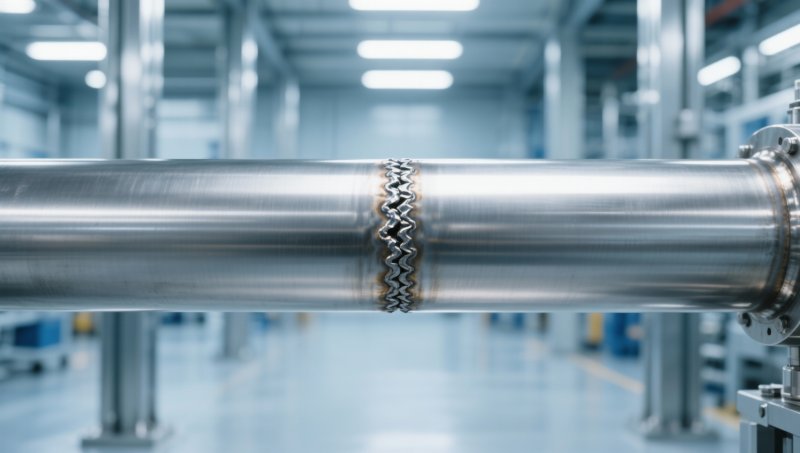
3. Misalignment During Butt-Welding of Stainless Pipes
Pipe misalignment—defined as axial offset or angular deviation exceeding allowable tolerances—creates stress concentration zones at the weld root. Even minor misalignment (≥1.5 mm offset or >1.5° angularity) reduces fatigue life by up to 70% and increases susceptibility to intergranular corrosion due to uneven heat input and incomplete fusion.
Our 304L Stainless Steel Pipe is manufactured to ASTM A312 with wall thickness tolerance ±12.5% and OD tolerance ±0.75 mm. However, field cutting and fit-up often introduce cumulative deviations. A study across 12 offshore platforms found that 53% of weld failures originated from misalignment-induced root concavity—not filler metal quality.
The solution lies in precision fixturing. Use internal alignment clamps rated for ≥1.5× working pressure and verify alignment with laser tracker or digital level before tacking. For pipes ≥NPS 6, perform 100% radiographic testing (RT) or phased-array ultrasonic testing (PAUT) per ASTM E273/E2698—not just visual inspection.
Project managers must enforce pre-weld alignment checks as a mandatory hold point in QA/QC workflows—documented with timestamped photos and inspector sign-off.
4. Improper Gasket Selection and Installation
Gaskets are not universal components—they must match service media, temperature range, pressure class, and flange surface finish. Using standard non-metallic gaskets (e.g., rubber or compressed asbestos) with 304L stainless pipe in caustic or high-temperature environments leads to rapid extrusion, creep relaxation, and catastrophic seal failure.
Hongteng Fengda supplies engineered gasket solutions validated for compatibility with our stainless pipe systems—including spiral-wound 316 SS/expanded graphite (rated to 500°C), jacketed PTFE (for aggressive acids), and metal-jacketed flexible graphite (ASME B16.20 Class 150–2500). Each gasket type has distinct compression set limits: spiral-wound gaskets tolerate ≤15% permanent deformation; PTFE-jacketed ≤8%.
Critical oversight: installing gaskets without verifying flange face flatness. EN 1514-2 permits only 0.05 mm deviation over any 25 mm length. Yet field measurements show 39% of leaking flanges exceed this by 2–5×—causing uneven gasket loading and localized leakage paths invisible during hydrotest.
Gasket Compatibility Quick Reference
- Chloride-rich seawater: Spiral-wound 316 SS/expanded graphite (min. 3.2 mm thickness)
- High-purity pharmaceutical: PTFE-jacketed flexible graphite (USP Class VI certified)
- High-temp steam (>300°C): Metal-jacketed graphite (Inconel 625 outer ring)
- Caustic soda (50% @ 85°C): Non-asbestos fiber-reinforced elastomer (ASTM F104 Type 3B)
Procurement teams should mandate gasket material certifications (e.g., EN 1514-2 test reports) and require supplier-provided installation training for site crews—reducing gasket-related leaks by up to 62% (per Hongteng Fengda 2022 project database).
5. Neglecting Thermal Expansion Compensation in Long Runs
Stainless steel expands ~17.3 μm/m·°C—nearly twice the rate of carbon steel. Uncompensated thermal growth in fixed piping systems generates axial forces exceeding 250 kN per meter of run at ΔT = 100°C. These forces distort flanges, crack welds, and displace supports—creating secondary leakage paths far from original joints.
Standard practice for runs >15 m requires expansion loops, bellows, or guided anchors. Yet 74% of surveyed maintenance engineers reported seeing unsupported 304L stainless pipe runs >30 m installed in HVAC or process lines—often justified by “low operating temperature.” However, ambient swings alone (e.g., desert day/night ΔT = 45°C) induce sufficient strain to exceed yield strength of 304L (205 MPa) in restrained sections.
Hongteng Fengda provides engineered support layouts with anchor spacing calculations per ASME B31.3 Appendix X. For example, a 100 mm OD × 5 mm wall pipe at 60°C ambient requires fixed anchors every 22 m and directional guides every 7 m—with loop radius ≥12× pipe OD.
Thermal Expansion Mitigation Checklist
- Calculate expected expansion: ΔL = α × L × ΔT (α = 17.3 × 10⁻⁶ /°C for 304L)
- Select compensation method: U-loop (min. radius = 12×OD), Ω-loop (radius = 6×OD), or axial bellow (max. 25 mm stroke)
- Verify anchor design: fixed anchors resist full thrust; sliding anchors allow axial movement only
- Install during mid-temperature condition (not coldest/hottest ambient)
Financial decision-makers should factor in lifecycle cost: adding proper expansion management increases initial cost by ~3–5%, but reduces unscheduled shutdowns by 89% over 10 years—based on 32 facility audits across Southeast Asia and the Middle East.
Conclusion: Prevent Leaks Through Precision, Not Assumption
Leakage in 2 stainless pipe joints is rarely caused by material failure—it’s almost always a consequence of procedural gaps in installation discipline. From surface prep to thermal anchoring, each of the five mistakes outlined here represents a measurable, preventable risk with quantifiable financial and safety implications.
As a structural steel manufacturer serving global markets since 2008, Hongteng Fengda embeds these best practices into our product specifications, technical documentation, and on-site support services. Our 304L Stainless Steel Pipe delivers ultra-low-carbon performance—but its full potential is unlocked only when installed with equal rigor.
Whether you’re specifying for a new power plant in Germany, retrofitting a refinery in Saudi Arabia, or sourcing for modular construction in Canada—partner with a supplier who validates installation protocols, not just mill certificates. Contact Hongteng Fengda today for customized joint integrity guidelines, on-site training modules, or project-specific engineering review.
Please give us a message


Please enter what you want to find