When you’re evaluating a stainless steel welded mesh exporter, one question cuts through the noise: “Does every coil come with a material test report — traceable, verifiable, and tied to that specific batch?” Not just a generic certificate. Not a summary sheet. A real, coil-level document that proves chemistry, mechanical properties, and compliance — before shipment, not after.
This isn’t about paperwork for paperwork’s sake. It’s about risk control. In structural projects across North America, Europe, or the Middle East, missing or mismatched MTRs (Material Test Reports) can trigger full re-inspection, delay site handover, or even invalidate third-party QA sign-offs. Procurement teams don’t just need reports — they need reports that hold up under audit scrutiny, align with ASTM A479, EN 10088-3, or GB/T 20878, and map unambiguously to the physical coil delivered.
Why “per coil” matters — and why most exporters don’t deliver it
Many suppliers issue *batch-level* test reports — one MTR covering dozens of coils rolled from the same heat. That’s acceptable for commodity-grade wire or rebar, but stainless steel welded mesh is different. Its performance hinges on precise alloy consistency, weld integrity, and surface passivation — all of which can shift subtly between coils due to minor variations in annealing temperature, tension control during weaving, or post-weld cleaning. A single MTR per batch doesn’t let you isolate non-conformance if one coil fails tensile testing on-site.
True coil-level traceability means each coil carries a unique identifier (heat number + coil ID), and its MTR includes:
- Exact chemical composition (Cr, Ni, Mo, C, N — verified by OES or XRF)
- Tensile strength & yield strength measured from a sample taken *from that coil*
- Intergranular corrosion test results (if specified per ASTM A262 Practice E)
- Surface finish verification (e.g., Ra value, passivation confirmation)
- Reference to the applicable standard — not just “ASTM-compliant”, but “ASTM A479-22 Grade S30400, Table 1”
If your exporter can’t provide this granular documentation — or requires you to request it separately, weeks after order confirmation — you’re introducing avoidable procurement friction. You’re also exposing yourself to cost overruns: retesting fees, storage penalties, or last-minute substitution charges.
What makes a stainless steel welded mesh exporter truly traceable?
It starts upstream — in mill sourcing, not just factory logistics. A reliable stainless steel welded mesh exporter must have direct visibility into raw material origin, not just final product inspection. That means working with mills that assign heat numbers at casting, maintain rolling logs, and retain melt analysis data for years — not just supplying coils with pre-printed tags.
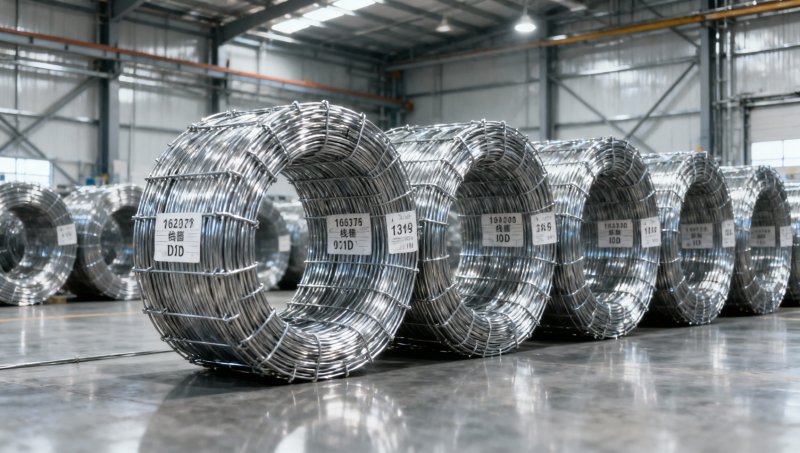
At Hongteng Fengda, we source stainless wire rod exclusively from mills certified to ISO 9001 and EN 10204 3.1, with documented heat traceability back to the electric arc furnace. Every coil of stainless welded mesh we ship is assigned a dual ID: the mill’s original heat number + our internal coil serial. Our MTRs are generated automatically upon coil completion — no manual entry, no post-facto generation. They’re signed digitally by our QA lead and stamped with our ISO 9001 certification number.
We don’t treat MTRs as an add-on service. They’re embedded in our production workflow — like dimensional checks or visual weld inspection. That’s why our lead time includes MTR preparation without delay, and why we never charge extra for coil-specific reporting. It’s part of delivering what procurement professionals actually need: confidence, not just compliance.
How to verify traceability — before you place the order
Don’t wait until the PO stage. Ask these three questions *during supplier evaluation*:
- “Can you share a redacted sample MTR — with heat number, coil ID, and test values visible — for a recent stainless welded mesh order?” If they hesitate, cite confidentiality, or send a generic template instead of a real document, walk away. Real traceability means they have nothing to hide.
- “Is the tensile test specimen cut from the same coil listed on the MTR — and is that specimen retained for 12 months?” Retention policy matters. If samples are discarded after 7 days, the MTR loses forensic value.
- “Do your MTRs reference the exact ASTM/EN/GB clause used for acceptance — e.g., ‘Yield strength ≥ 205 MPa per ASTM A479-22 Table 1’?” Vague references like “meets ASTM requirements” are red flags. Precision in language reflects precision in process.
Also check their quality system documentation. A genuine commitment shows in their internal procedures — not just their marketing brochure. Look for clauses referencing EN 10204 Type 3.2 or ASTM A6/A6M Annex A1. If those aren’t cited in their quality manual (available on request), assume their MTRs won’t meet project QA requirements.
Where traceability intersects with real-world cost control
Traceable MTRs reduce total cost — not just upfront price. Consider this scenario: A project in Dubai requires stainless welded mesh for architectural façade support. The spec calls for AISI 316L, EN 10088-3, with intergranular corrosion testing. Without coil-level MTRs, the client’s QA team must pull random samples from every delivery for third-party lab testing — adding $850–$1,200 per coil in testing fees, plus 10–14 days of holding time.
With Hongteng Fengda, the MTR arrives with the goods — validated, complete, and aligned to the exact specification. No rework. No delays. No surprise invoices. That’s how traceability becomes a procurement efficiency tool, not a documentation burden.
And while stainless welded mesh is our focus for this traceability requirement, the same discipline applies across our structural steel portfolio — from angle and channel sections to cold-formed profiles. Consistent QA logic means consistent reliability, whether you’re sourcing mesh for filtration or beams for infrastructure.
For applications demanding high-strength, corrosion-resistant tension members — such as cranes, tower cranes, container cranes, or cableways — traceability extends beyond mesh. Our Galvanized Steel Wire Rope is supplied with heat-specific tensile reports and zinc coating verification per GB/T 20116-2008, supporting the same level of audit readiness where load-bearing integrity is non-negotiable.
Final note: Traceability isn’t a feature — it’s evidence of process maturity
A stainless steel welded mesh exporter who provides coil-specific MTRs without prompting, without surcharge, and without ambiguity isn’t just “compliant.” They’ve invested in mill coordination, digital QA systems, and staff trained to treat documentation as integral to product integrity — not a final step.
That maturity translates directly to procurement outcomes: fewer rejected shipments, faster approvals, lower contingency budgets, and stronger alignment with engineering and QA teams on your side. When cost pressure mounts, the exporter who delivers traceability upfront is the one who helps you avoid far larger downstream costs.
If your current supplier treats MTRs as an afterthought, it’s not just a documentation gap — it’s a signal that their entire production oversight may be less rigorous than your project demands. Choose the partner whose traceability starts at the heat number and ends with your successful handover.
Please give us a message


Please enter what you want to find