Choosing a reliable steel wire rope manufacturer is more than comparing prices—it is about securing consistent quality, certified production, and dependable delivery for critical industrial and construction applications. For business decision-makers, the right supplier helps reduce sourcing risks, control long-term costs, and ensure project performance, making manufacturer reliability a key factor in successful procurement.
Why does the choice of a steel wire rope manufacturer matter so much?
For procurement managers, project owners, and industrial buyers, steel wire rope is rarely a low-impact item. It is often used in lifting systems, material handling, construction support, marine operations, and heavy-duty equipment where failure can create safety, schedule, and financial consequences. That is why the term steel wire rope manufacturer should be evaluated through operational reliability, not just a unit price comparison.
In many projects, the most expensive mistake is not paying 3% to 8% more for qualified supply; it is accepting unstable quality that leads to early replacement, inspection disputes, or unplanned downtime. A reliable manufacturing partner helps ensure tensile performance, dimensional consistency, corrosion resistance, and packaging integrity across repeated orders, especially when annual procurement volumes extend beyond 50 tons or involve multi-batch deliveries.
For international buyers, the manufacturer also affects documentation quality, standard compliance, and lead-time control. A supplier that can work to ASTM, EN, JIS, or GB references, provide clear inspection records, and maintain stable production scheduling reduces friction across the full sourcing cycle, from sample approval to final shipment.
What business risks are reduced by choosing carefully?
A capable steel wire rope manufacturer lowers risk in at least four areas: technical mismatch, inconsistent batch quality, delivery disruption, and after-sales communication gaps. In practical terms, this means fewer disputes over diameter tolerance, strand construction, lubrication condition, coil length, and loading protection.
- Technical risk: wrong construction, coating, or strength grade selected for the application.
- Supply risk: delayed production that affects installation sequences or vessel schedules.
- Compliance risk: incomplete certificates, missing test data, or unclear standard references.
- Cost risk: lower initial price but higher total cost over a 12- to 24-month use cycle.
For companies managing broader steel procurement, this supplier discipline often reflects wider manufacturing capability. A structural steel manufacturer and exporter with strong quality control culture is typically better positioned to support consistent sourcing across multiple categories, including profiles, beams, and customized fabricated components.
How can buyers tell whether a steel wire rope manufacturer is actually reliable?
Reliability should be judged through evidence, not marketing language. Buyers should review whether the supplier can explain raw material control, production process stability, inspection checkpoints, and shipment procedures in a structured way. A dependable steel wire rope manufacturer can usually answer technical and commercial questions within 24 to 72 hours and provide documentation that aligns with the requested specification.
The first practical sign is process transparency. Can the supplier identify material grade, rope construction, lay direction, coating option, breaking force reference, and tolerance range without vague wording? The second sign is consistency. Can they reproduce the same quality over 3 batches, 5 batches, or recurring monthly orders? The third sign is export readiness. Can they support packaging, marking, trade terms, and inspection paperwork needed for cross-border procurement?
The table below helps decision-makers compare common reliability indicators before placing volume orders.
A reliable assessment often starts with a small trial order, sample review, or a first shipment under strict inspection conditions. For larger procurement programs, many buyers evaluate at least 6 to 10 checkpoints before approving a supplier for repeat orders.
Which documents and standards deserve attention?
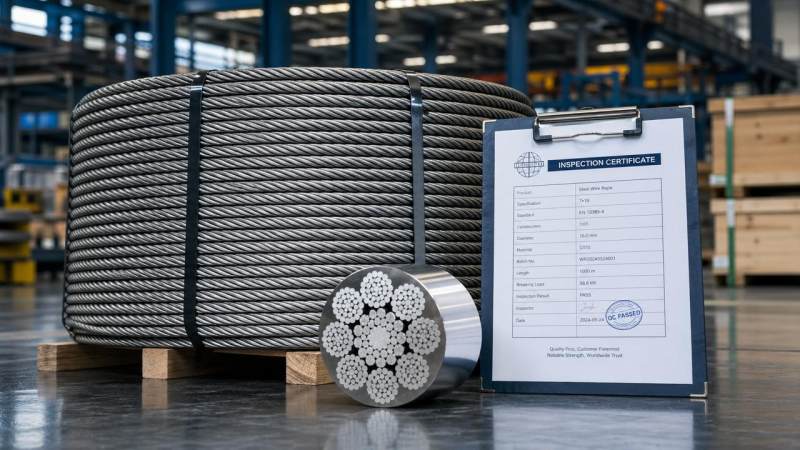
Business decision-makers do not need to inspect every production step personally, but they should verify whether the supplier can provide commercially useful and technically relevant records. This includes material references, test reports where applicable, dimensional confirmation, and packing lists that match the order.
Checklist for supplier qualification
- Specification confirmation by diameter, construction, surface condition, and intended use.
- Standard alignment where required, such as ASTM, EN, JIS, or GB references.
- Inspection or certificate availability based on project or market entry needs.
- Packaging and marking methods suitable for sea freight over 20 to 45 days.
What should buyers compare beyond price when reviewing suppliers?
Price matters, but a professional comparison should include total procurement value. That means looking at specification accuracy, usable service life, lead-time stability, packaging quality, communication efficiency, and the supplier’s ability to support custom requirements. A low quote can become expensive if the rope needs rework, arrives late, or fails project documentation review.
This broader view is especially relevant for buyers who source multiple steel products for one project. For example, wire rope may be one part of a larger structural package that includes channels, beams, or fabricated members. When a supplier group can align quality expectations across product categories, coordination becomes easier and procurement overhead can drop by 10% to 15% over repeated sourcing cycles.
In steel structure buildings and mechanical light industry manufacturing, related support materials also influence project efficiency. Midway through many projects, buyers often need compatible steel profiles such as C Channel Beam for purlins, wall beams, lightweight brackets, and secondary framing. With galvanized coated surfaces, thickness options from 1mm to 12.mm, common lengths of 6m, 9m, and 12m, and processing services such as bending, welding, punching, and cutting, this type of profile can simplify sourcing when steel system compatibility matters.
How do total-cost factors compare in practice?
The comparison below is useful when evaluating a steel wire rope manufacturer alongside broader steel supply considerations. It focuses on cost drivers that affect real purchasing outcomes, not only the initial unit rate.
The same logic applies to related structural profiles. For example, a perforated galvanized C-shaped section with CE, SGS, BV, or ISO-related documentation support and delivery around 15 to 20 days can be easier to integrate into planned construction schedules than material sourced only on the basis of headline price.
For decision-makers, the key question is not “Who is cheapest today?” but “Which supplier is most likely to deliver the right material, in the right condition, on the right timeline, over repeated orders?” That is often where a dependable steel wire rope manufacturer stands apart.
What are the most common mistakes when selecting a steel wire rope manufacturer?
One common mistake is assuming that all steel wire rope products with similar descriptions are interchangeable. In reality, differences in construction, finish, lubrication, tolerance control, and intended duty cycle can significantly affect performance. Buyers who rely on incomplete specification sheets may receive products that are acceptable on paper but unsuitable in service.
Another frequent mistake is evaluating samples but not evaluating batch consistency. A good first sample does not guarantee stable production over the next 3 shipments. Decision-makers should ask how the supplier controls repeatability, manages raw material input, and documents inspections from one lot to the next.
A third issue is separating technical review from logistics review. Even when the product meets specification, poor packing, insufficient corrosion protection, or inaccurate shipping marks can create losses during sea freight or customs handling. For export procurement, technical quality and logistics discipline should be reviewed together.
Which warning signals should not be ignored?
Below is a practical FAQ-style decision table that many buyers use during early supplier screening. It helps translate abstract concerns into visible checkpoints.
Ignoring these signs can lead to slow approvals, replacement purchases, or schedule disruption. For medium and large procurement projects, even a 7-day delay in one steel component can affect multiple downstream activities, especially when installation teams, equipment rental, and transport slots are already booked.
Practical ways to reduce selection mistakes
- Request a formal specification confirmation before quotation approval.
- Review samples together with packaging and marking requirements.
- Start with one controlled order if the supplier is new to your vendor list.
- Track response time, document accuracy, and change control during the first 30 days.
How does a reliable supplier support long-term industrial and construction procurement?
The best steel wire rope manufacturer is not only a product vendor. For many buyers, reliability means the ability to support planning, standard alignment, and related steel sourcing over time. This is especially valuable for companies working across construction, industrial manufacturing, and infrastructure projects where purchasing requirements shift from one phase to another.
A supplier with structural steel manufacturing experience can contribute beyond one item. Hongteng Fengda, for example, serves global buyers with structural steel products and customized solutions for construction, industrial, and manufacturing applications. Its scope includes angle steel, channel steel, steel beams, cold formed steel profiles, and customized structural steel components, helping customers coordinate standard specifications and OEM-oriented needs under one supply framework.
That matters because procurement efficiency often improves when quality control methods, documentation habits, and delivery discipline are shared across product categories. Buyers sourcing for North America, Europe, the Middle East, and Southeast Asia commonly need suppliers that understand international standards, stable production scheduling, and the practical demands of export communication.
What should be confirmed before moving to quotation or cooperation?
Before requesting a final offer, decision-makers should define the commercial and technical baseline. This reduces rework during the quotation stage and helps the supplier prepare a realistic lead time, payment term structure, and shipping plan.
- Confirm core product parameters, expected use conditions, and required standards.
- Clarify whether the order is a sample, a trial batch, or a recurring monthly requirement.
- Define delivery terms such as FOB, CFR, or CIF, and target shipment timing.
- State certificate, inspection, or destination-market documentation needs in advance.
- Ask whether related steel items, processing services, or custom fabrication are needed in the same procurement cycle.
This structured approach makes it easier to identify whether a steel wire rope manufacturer is suitable for one-off purchasing or for longer-term vendor development. In many cases, the stronger suppliers stand out not by claiming to be the biggest, but by answering technical questions clearly and committing to achievable delivery windows.
Why choose us for broader steel sourcing support?
For buyers who value reliability, Hongteng Fengda offers a practical combination of manufacturing discipline, export experience, and flexible supply support. As a professional structural steel manufacturer and exporter from China, we help global customers reduce sourcing risk through stable production capacity, consistent quality control, and dependable lead times across multiple steel categories.
Our business focus covers structural steel products used in construction, industrial, and manufacturing projects, including channel sections, beams, angle steel, cold formed profiles, and customized components. We work with common international standards such as ASTM, EN, JIS, and GB, and we support buyers who need standard materials, OEM-oriented solutions, or processing coordination for project-based procurement.
If you are currently evaluating a steel wire rope manufacturer or planning a wider steel purchasing program, contact us to discuss specification confirmation, product selection, delivery schedules, customized solutions, certification requirements, sample support, or quotation planning. Clear early communication can save weeks in procurement time and help your team choose supply partners with greater confidence.
Please give us a message


Please enter what you want to find