Selecting the right rebar for construction in seismic zones across Southeast Asia is not a matter of preference—it’s a structural imperative. Earthquake-prone countries like Indonesia, the Philippines, Thailand, and Vietnam experience frequent tectonic activity, making ductile, high-performance reinforcement steel non-negotiable for life safety and long-term building resilience. Standard rebar may meet basic strength requirements, but it often fails under cyclic loading—leading to brittle fracture, spalling concrete, and catastrophic collapse during strong shaking. The consequence isn’t just project delay or cost overrun; it’s compromised occupant safety and regulatory rejection at inspection.
Seismic rebar must satisfy three interdependent performance criteria: sufficient yield strength to resist design forces, controlled yield-to-tensile ratio (typically ≤ 1.30), and guaranteed uniform elongation (Agt ≥ 7.5%) to absorb energy without sudden failure. These are not optional extras—they’re codified minimums embedded in national standards. For example, Indonesia’s SNI 2847:2019 mandates ASTM A615 Grade 60 with additional ductility testing; Thailand’s TIS 26–2560 requires EN 10080-compliant B500B steel with bendability verification; Vietnam’s TCXDVN 356:2005 references JIS G 3112 but adds local weldability and low-temperature bend tests for coastal infrastructure. Simply sourcing “high-strength” rebar without verifying these specific seismic parameters carries real risk—especially when imported from suppliers without traceable mill test reports aligned to these regional benchmarks.
Key Seismic Rebar Specifications Across Southeast Asia
While ASTM A615 and A706 are widely recognized, their applicability depends on local adoption and amendment. In practice, most major projects in Jakarta, Manila, and Bangkok require dual compliance: meeting base material standards *and* passing supplementary seismic qualification tests conducted by accredited third-party labs (e.g., SGS, Bureau Veritas, or national metrology institutes). This means:
- Yield strength tolerance: ±5% deviation allowed—but only if lower bound remains ≥ specified grade (e.g., 420 MPa for Grade 60);
- Bendability: Must withstand 180° bending around a mandrel diameter equal to 4× bar diameter without surface cracking;
- Weldability: Carbon equivalent (CE) must be ≤ 0.50 for ASTM A615, and ≤ 0.45 for A706—critical for welded cage assemblies in high-rise foundations;
- Ductility verification: Uniform elongation (Agt) measured per ASTM A370, not just total elongation (A); Agt ≥ 7.5% is mandatory for all bars ≥ Ø16 mm used in plastic hinge zones.
Importers and project engineers often overlook that certification documents alone aren’t sufficient. Mill test reports must include actual Agt values—not just “complies with ASTM”—and must reference the exact heat number tied to shipment batches. Discrepancies between documentation and physical test results have led to rejection at Philippine DPWH site inspections and rework orders on Thai BTS extension projects.
Why Galvanized Reinforcement Isn’t Typically Used in Seismic Concrete
It’s common to consider corrosion protection early—especially in humid, saline, or industrial environments across Southeast Asia. However, galvanized rebar introduces complications in seismic applications. Zinc coating alters bond behavior with concrete, reduces effective cross-section slightly, and can interfere with welding procedures unless strictly controlled. More critically, galvanizing doesn’t improve ductility—and may mask micro-cracks that would otherwise be visible during visual inspection of bend tests. For this reason, most seismic codes—including SNI 2847 and TIS 26–2560—explicitly prohibit galvanized rebar in primary load-resisting elements unless proven through full-scale cyclic testing and approved by the local authority having jurisdiction (AHJ).
That said, galvanizing remains highly relevant for non-seismic structural components where corrosion resistance is paramount. Galvanized Round Steel serves reliably in electric power towers, communication masts, street light poles, and substation ancillary facilities—applications demanding long anti-corrosion life in tropical marine atmospheres. Its hot-dip galvanized surface, combined with tight dimensional tolerances (ISO h8/h9), straightness control, and ultrasonic inspection, ensures consistent mechanical performance in exposed, non-load-critical roles. Where seismic integrity and corrosion resistance intersect—such as marine bridge piers—the solution lies not in galvanized rebar, but in epoxy-coated or stainless-clad alternatives certified to EN 10080 or ASTM A1035.
Material Traceability and Testing Requirements
Seismic rebar procurement demands more than spec sheets. Every ton supplied into a critical structure must carry full traceability: heat number, rolling date, chemical composition, tensile test results (including Agt), and bend test records. In Indonesia, BPPT (National Agency of Applied Science) requires batch-level reporting to the National Construction Quality Assurance System (Sistem Jaminan Mutu Nasional). In Vietnam, Ministry of Construction Circular 06/2021/TT-BXD mandates independent lab verification before concrete placement—no exceptions.
Manufacturers exporting from China must demonstrate alignment with both origin-country quality systems (GB/T 1499.2–2018) and destination-code seismic provisions. Hongteng Fengda’s production process includes online tensile monitoring, automated bend-test stations, and spectrotest antimixing controls—ensuring no misgraded heats enter final packaging. Their ASTM A615/A706 and EN 10080 rebar lines undergo quarterly third-party audits against ISO 9001 and ISO 17025-accredited laboratories, with reports available upon request for engineering review.
Practical Selection Checklist for Project Managers
Before approving rebar delivery for a seismic zone project, verify these five points—not just once, but per shipment:
- Mill test report lists actual Agt value (not just “≥7.5%”) and confirms test method per ASTM A370 or EN ISO 6892-1;
- Yield-to-tensile ratio is calculated from reported values and falls within 1.20–1.30 range;
- Chemical analysis shows CE ≤ 0.45 (for A706) or ≤ 0.50 (for A615), with manganese ≤ 1.60%;
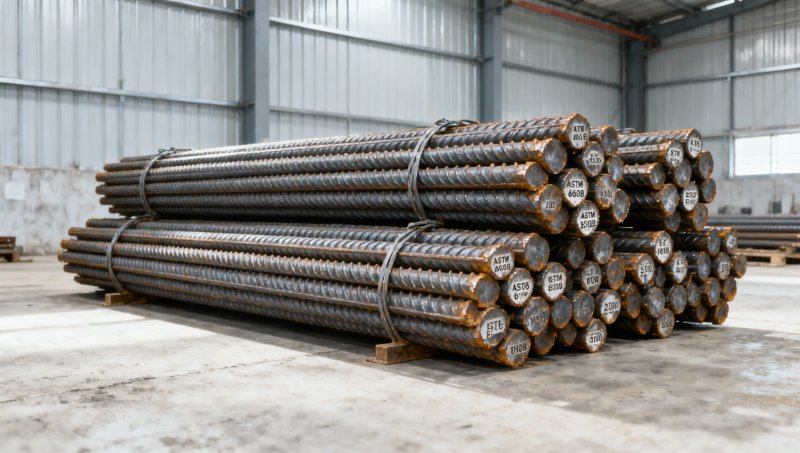
- Each bundle bears legible heat stamp matching report numbers—no painted-over or obscured markings;
- Third-party certificate (e.g., SGS, TÜV) explicitly states compliance with the applicable national standard—not generic “ASTM compliant.”
Failure at any one point invalidates the entire batch for seismic use—even if strength appears adequate. Field bending or welding without prior qualification testing is prohibited under all major Southeast Asian codes. If uncertainty exists about local AHJ interpretation, engage a licensed structural engineer registered in the host country for formal technical review before procurement finalization.
Ultimately, specifying rebar for construction in seismic zones hinges less on sourcing volume or price—and more on verifiable performance data, documented traceability, and alignment with jurisdiction-specific seismic clauses. It’s not about choosing “stronger steel,” but selecting steel that bends predictably, yields consistently, and survives repeated stress reversals. That level of assurance starts at the mill—and ends only after every test report, heat number, and bend specimen has been validated against the precise standard enforced on-site.
Please give us a message


Please enter what you want to find