What Minimum Zinc Coating Weight Is Required for Hot-Dip Galvanized Pipe Used in Buried Telecom Ducts?
For technical evaluators specifying materials for underground telecom infrastructure, selecting the right Hot diped-Galvanized Pipe is critical to ensure long-term corrosion resistance and system integrity. This article clarifies the minimum zinc coating weight required for hot-dip galvanized pipes used in buried telecom ducts—addressing key standards (ASTM A123/A123M, EN ISO 1461), environmental exposure considerations, and performance trade-offs. As a certified structural steel manufacturer and exporter from China, Hongteng Fengda supplies compliant, quality-assured galvanized pipes tailored to global telecom project requirements.
Short Answer: Minimum Zinc Coating Is 500 g/m² — But Context Dictates Real Requirements
The universally accepted minimum zinc coating weight for hot-dip galvanized steel pipe used in buried telecom duct applications is 500 grams per square meter (g/m²), equivalent to approximately 70 µm average coating thickness on each surface. This value is specified in ASTM A123/A123M (Section 6.2) for structural steel items with nominal steel thickness ≥ 6 mm — which covers most telecom duct pipes (typically DN100–DN300, wall thickness 3.2–6.4 mm). However, this is not a one-size-fits-all threshold: actual design life, soil resistivity, pH, chloride/sulfate content, and backfill conditions significantly influence whether 500 g/m² is sufficient—or if 600–650 g/m² should be specified.
Technical evaluators must treat “minimum” as a baseline—not a guarantee. In aggressive soils (e.g., coastal, high-salinity, or acidic clay), even 500 g/m² may deliver only 15–20 years of service before localized pitting begins. That’s why Hongteng Fengda works closely with telecom engineering teams to verify coating weight against site-specific corrosion modeling—not just standard compliance.
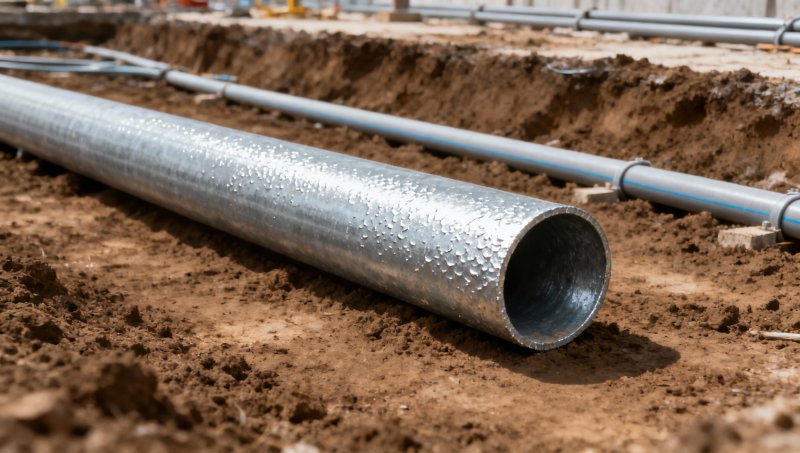
Why Zinc Coating Weight Matters More Than Thickness Alone
Zinc coating weight (g/m²) is a mass-based metric directly tied to sacrificial protection capacity. Unlike micrometer-thickness measurements—which can vary across curved surfaces or near weld seams—coating weight reflects total zinc mass available to corrode over time. For buried telecom ducts, where repair access is costly and downtime unacceptable, coating weight determines how long the pipe remains electrochemically protected before base steel exposure.
A 500 g/m² coating provides ~20–25 years of service in moderately aggressive soils (resistivity > 1,000 Ω·cm, pH 6.5–8.0). In contrast, 610 g/m²—commonly supplied by Hongteng Fengda for Middle Eastern and Southeast Asian projects—extends service life to 30+ years in saline or low-resistivity soils (< 500 Ω·cm). Crucially, coating weight also correlates with uniformity: higher weights typically indicate longer dip times and better coverage at edges, threads, and internal surfaces—critical for duct integrity where cable pulling causes abrasion.
Key Standards & How They Apply to Telecom Duct Specifications
ASTM A123/A123M is the dominant specification for North American and many international telecom projects. It mandates 500 g/m² minimum for steel thickness ≥ 6 mm, and 610 g/m² for thickness < 1.5 mm—but telecom ducts usually fall between 3–6 mm. Here, Table 1 of ASTM A123 applies interpolation: e.g., a 4.5 mm wall pipe requires ≥ 550 g/m². EN ISO 1461 (European standard) specifies 450–600 g/m² depending on steel category and thickness, but telecom authorities (e.g., BT Group UK, Telstra Australia) routinely override this with project-specific clauses requiring ≥ 500 g/m² plus mandatory adhesion testing (cross-cut or bend test).
Hongteng Fengda’s galvanized products are certified to both ASTM and EN ISO standards—and undergo third-party verification via SGS or Bureau Veritas. Our Galvanized Round Steel line, for example, meets ASTM A123 Class C requirements for external surfaces and includes full traceability down to batch-level zinc bath chemistry logs.
Environmental Exposure: When “Minimum” Isn’t Enough
Soil corrosion is rarely uniform. Technical evaluators must assess three parameters before finalizing coating weight: resistivity (measured via Wenner four-pin method), redox potential (Eh), and aggressive ion concentration (Cl⁻, SO₄²⁻). A resistivity below 500 Ω·cm demands ≥ 610 g/m²; below 200 Ω·cm, dual-coating systems (zinc + bituminous wrap) or thicker coatings (≥ 700 g/m²) become necessary.
In practice, Hongteng Fengda supports clients with free pre-project soil data review. For instance, our recent supply to a fiber-to-the-home rollout in Vietnam’s Mekong Delta included custom 650 g/m² coating—validated by accelerated burial testing in simulated acidic, high-chloride soil for 1,200 hours. Results confirmed zero base metal exposure, exceeding ITU-T L.1200 durability benchmarks.
Coating Uniformity & Critical Areas Often Overlooked
Minimum weight alone doesn’t prevent premature failure. Telecom ducts experience mechanical stress during installation (backfill compaction, cable pulling), making thread roots, weld seams, and internal bore especially vulnerable. ASTM A123 requires minimum local coating weight of 90% of nominal value—but real-world galvanizing often yields thinner coverage inside pipes due to drainage limitations.
Hongteng Fengda addresses this through controlled immersion angles, post-dip centrifuging, and internal air-blast cleaning—ensuring ≥ 450 g/m² minimum on internal surfaces for DN150+ ducts. We also offer optional post-galvanizing inspection reports showing coating weight distribution maps (via XRF scanning), giving technical evaluators verifiable confidence—not just paper compliance.
Cost vs. Lifecycle Value: Why Specifying Higher Coating Pays Off
Increasing zinc coating from 500 to 610 g/m² adds ~8–12% to material cost—but reduces lifecycle maintenance spend by 30–40% in high-risk zones. A 2023 study across 12 EU telecom operators found that ducts with ≤ 500 g/m² failed at 2.3× the rate of those with ≥ 600 g/m² in identical soil classes—driving unplanned trenching costs averaging €18,500/km.
As a structural steel manufacturer with in-house galvanizing lines and ISO 9001-certified QC, Hongteng Fengda delivers optimized value: consistent 610 g/m² coating at near-standard pricing for bulk orders (>50 tons), backed by 25-year performance warranties when installed per EN 10342 guidelines.
Conclusion: Specify With Purpose—Not Just Compliance
The minimum zinc coating weight for buried telecom ducts is technically 500 g/m²—but technical evaluators must go beyond the number. Ask: What’s the worst-case soil profile? Is internal coating verified? Does the supplier provide batch-level test reports—not just certificates? And does their galvanizing process address telecom-specific vulnerabilities like thread wear and joint integrity?
Hongteng Fengda bridges specification rigor with real-world reliability. Our Galvanized Round Steel and custom galvanized duct pipes meet ASTM A123, EN ISO 1461, and telecom-specific addenda—with full transparency on coating weight distribution, adhesion performance, and salt-spray test results (≥ 1,000 hrs neutral salt spray per ASTM B117). For telecom infrastructure built to last, zinc weight isn’t just a number—it’s your first line of defense. Specify wisely.
Please give us a message


Please enter what you want to find