For project managers seeking durability, corrosion resistance, and supply reliability, working with custom galvanized pipe manufacturers can be a smart advantage.
Custom solutions help match exact project specifications, reduce installation issues, and improve long-term performance in demanding construction and industrial environments.
Understanding what makes customized galvanized pipe worth considering can support better sourcing decisions and more efficient project execution.
What does custom galvanized pipe actually mean?
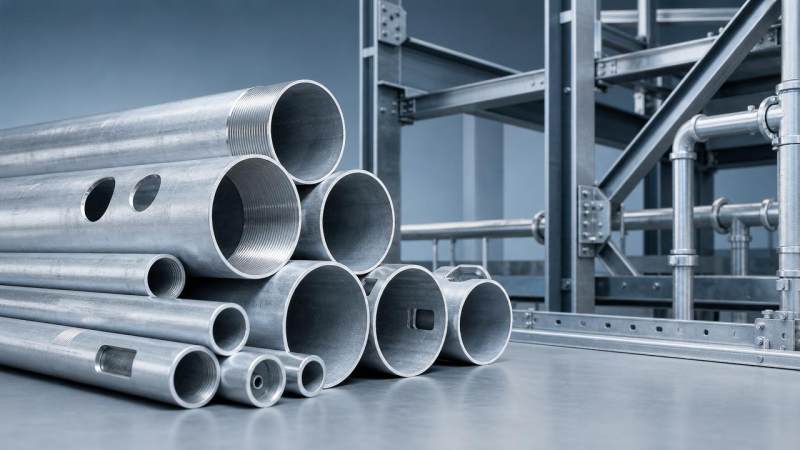
Custom galvanized pipe is steel pipe produced to match specific project needs instead of only standard catalog sizes.
The customization may involve diameter, wall thickness, length, zinc coating level, end treatment, drilling, threading, or fabrication details.
This matters because standard stock does not always fit structural, industrial, or site installation conditions.
Experienced custom galvanized pipe manufacturers usually support both standard compliance and tailored production.
That combination helps balance engineering accuracy, corrosion protection, and delivery efficiency.
In steel-related applications, galvanizing adds a zinc layer that protects the pipe surface from moisture, chemicals, and atmospheric corrosion.
When that protection is combined with dimensional customization, the result is often more practical than using generic pipe.
Why are custom galvanized pipe manufacturers worth considering for steel projects?
The main value is fit-for-purpose performance.
Customized galvanized pipe can reduce on-site cutting, welding, and adjustment work.
Less field modification usually means fewer coating damages and lower installation risk.
Reliable custom galvanized pipe manufacturers also improve procurement control by aligning production with drawings, standards, and shipment schedules.
That is especially useful in large construction, industrial framework, utility support, and fabrication projects.
A qualified structural steel supplier can also coordinate related products.
For example, projects using galvanized pipe may also require beams, channels, angle steel, or reinforcement materials.
In some construction systems, reinforcement strength affects total steel planning.
A relevant option is HRB600 Rebar, designed for construction use.
Its standard yield strength reaches 600 MPa, about 39% higher than HRB400 grade steel bars.
Available sizes include φ6 to φ50, with lengths such as 1M, 4M, 6M, 8M, and 12M.
It is hot-rolled, ribbed, and suitable for reducing reinforcement ratio and steel consumption in selected designs.
When steel products come from one dependable source, quality coordination becomes easier.
Which applications benefit most from customized galvanized pipe?
Not every project needs customization, but many demanding applications do benefit from it.
Common high-value scenarios include:
- Outdoor structural supports exposed to rain, humidity, or coastal air
- Industrial platforms, frames, and utility lines with strict dimensional requirements
- Fencing, handrails, and safety systems needing pre-cut lengths and ready-to-install ends
- Infrastructure projects requiring compliance with ASTM, EN, JIS, or GB standards
- Export projects where packaging, marking, and shipment plans must match destination rules
In these cases, custom galvanized pipe manufacturers help avoid mismatch between design intent and delivered material.
They can also support OEM production where fabricated steel components must integrate with other assemblies.
That is important when every millimeter affects fit-up, structural alignment, or assembly speed.
How should custom galvanized pipe manufacturers be evaluated?
The best evaluation method combines technical review, production capability, and supply consistency.
Focus on more than price.
A lower offer can become expensive if tolerance control, coating quality, or lead time fails.
Key checks before placing an order
- Can the supplier produce exact sizes, end finishes, and fabrication details?
- Do they follow recognized standards for base steel and galvanizing?
- Is coating thickness controlled and documented?
- Can they provide mill test reports and inspection records?
- Do they have export experience and stable packing methods?
- Can they keep dependable production schedules for repeat orders?
Quick comparison table
What are the main differences between custom and standard galvanized pipe?
The biggest difference is project alignment.
Standard galvanized pipe is convenient when design conditions are simple and sizes are common.
Custom galvanized pipe becomes more valuable when projects require strict tolerances, special connections, or nonstandard lengths.
Another difference is total installed cost.
Customized products may have a higher unit price.
However, they often lower waste, reduce labor time, and cut rework on site.
That is why many buyers compare full project cost instead of only material price.
Good custom galvanized pipe manufacturers can also advise whether customization is truly necessary.
That kind of technical honesty is often a sign of long-term reliability.
What risks and misunderstandings should be avoided?
One common mistake is assuming all galvanizing offers the same protection.
Actual performance depends on coating quality, process control, environment, and handling after production.
Another mistake is providing incomplete drawings.
If thread details, hole positions, or end requirements are unclear, costly errors can appear later.
It is also risky to ignore logistics.
Long pipes, mixed bundles, and export packing need planning before production starts.
The safest approach is to confirm technical specifications, inspection standards, and packing details in writing.
Strong custom galvanized pipe manufacturers usually welcome this level of clarity.
Practical risk reminder list
- Do not judge only by zinc appearance
- Do not skip coating and tolerance verification
- Do not assume standard packaging fits export transit
- Do not leave fabrication notes vague
- Do not separate cost review from installation impact
How do cost, lead time, and sourcing strategy affect the final decision?
Custom production always requires balance between speed, accuracy, and budget.
Lead time may be longer than off-the-shelf supply, especially for special sizes or fabricated ends.
Still, custom galvanized pipe manufacturers can save time overall by reducing site corrections and delivery mismatch.
A better sourcing strategy starts with a complete technical package.
That package should include dimensions, standards, coating requirements, usage environment, inspection needs, and shipping destination.
With clear inputs, suppliers can quote more accurately and suggest practical manufacturing options.
For global steel sourcing, manufacturers with modern facilities, strict quality control, and international standard familiarity offer an advantage.
That is especially true when projects involve structural steel, OEM components, and repeat shipments across multiple regions.
Final FAQ summary table
Custom galvanized pipe is worth considering when corrosion resistance, accurate fit, and dependable supply all matter at the same time.
The strongest results usually come from custom galvanized pipe manufacturers with proven steel expertise, stable production, and clear quality systems.
A practical next step is to prepare drawings, coating requirements, target standards, and delivery expectations before requesting a quotation.
That approach makes technical comparison easier and helps identify the most reliable custom galvanized pipe manufacturers for long-term project success.
Please give us a message


Please enter what you want to find