If you are comparing suppliers for structural steel, the real question is simple: can this steel manufacturer deliver repeatable quality at scale, with documentation, customization, and lead times you can trust? That is the standard worth using.
What reliable actually means in steel procurement
In this industry, “reliable” is not a vague service word. It shows up in measurable ways: the order matches the drawing, the mill certificates are complete, tolerances are under control, and the shipment arrives when promised. If any one of those fails, the cost is usually paid downstream by the fabricator, the contractor, or the project owner.
That is why buyers in OEM and construction channels should think beyond unit price. A supplier that looks cheaper on paper can become expensive fast if it creates inspection failures, site delays, or inventory gaps. For many global buyers, the better choice is a steel manufacturer that can prove process discipline, not just quote a competitive number.
Hongteng Fengda fits that profile in the areas buyers usually care about most: structural steel supply, OEM support, and export readiness. Based in China, the company serves global construction, industrial, and manufacturing projects with angle steel, channel steel, steel beams, cold formed steel profiles, and customized structural steel components. The practical value is not the product list itself; it is the ability to source standard and custom items from one controlled production base.
The checks that separate a dependable supplier from a risky one
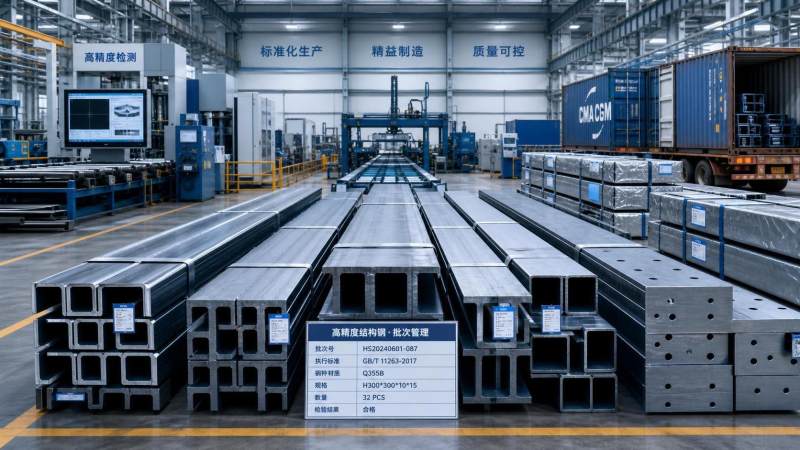
For decision-makers, the first filter is production control. If the manufacturer cannot hold dimensions, grades, and surface quality consistently, the rest of the discussion does not matter. Ask how they inspect incoming material, how they track batches, and what happens when a lot falls outside spec. The answer should sound like a process, not a promise.
Second, look at standards. A serious steel manufacturer should work within recognized frameworks such as ASTM, EN, JIS, and GB when those standards are relevant to the order. That does not mean every order needs every standard. It means the supplier understands the difference between local practice and export requirements, and can document what the buyer needs for customs, QA, and project approval.
Third, pay attention to lead time realism. Many supply chains fail because the supplier says yes too quickly. A dependable partner gives a schedule that reflects real capacity, raw material availability, and fabrication complexity. Stable production capacity matters more than aggressive sales language.
Why OEM buyers should ask different questions
OEM sourcing is where many first-time buyers misjudge the supplier. They focus on whether the steel exists, but the real issue is whether the manufacturer can make it in a way that supports repeat production. That includes drawing interpretation, customization, packaging, labeling, and consistency across reorder cycles.
For OEM work, I would ask three things before anything else: can they follow your technical requirements without drifting from batch to batch, can they support non-standard dimensions, and can they document the output clearly enough for your own quality system? If the answer is uncertain, the risk is not only technical. It can also affect assembly speed, warranty exposure, and customer trust.
This is where a supplier with modern manufacturing facilities and strict quality control has a real advantage. It is not about sounding advanced. It is about reducing variation. Buyers who manage recurring orders know that variation is what breaks margins.
Construction supply chains need more than a strong product
Construction procurement is unforgiving. A project does not wait because one shipment slips or one profile is off by a few millimeters. Buyers in this channel need a steel manufacturer that can keep material flowing, handle export documentation cleanly, and respond when site conditions change.
That is especially true for structural components used in demanding civil work. For example, Steel Sheet Piles are often selected for construction in deep water and for forming cofferdams, where strength, waterproof performance, and installability all matter. In those jobs, the buyer is not only comparing grades like S275, S355, SY295, SY390, or ASTM A690. They are also checking whether the supplier can support long lengths, the right standards, and the project’s actual installation constraints. That is the level of judgment a serious steel partner should bring.
When a supplier can handle products that need EN10248, EN10249, JIS5528, JIS5523, or ASTM alignment, it becomes easier for the buyer to source across different project regions without rebuilding the qualification process every time. That is a real operational gain, not just a technical detail.
Common mistakes buyers make when choosing a steel manufacturer
One common mistake is treating certifications as a substitute for execution. ISO or CE-related credentials matter, but they do not replace inspection discipline, shipment accuracy, or communication quality. Another mistake is overvaluing the first quote. Price is meaningful, but only after you know whether the supplier can actually deliver what the project requires.
Some buyers also underestimate the cost of unclear specifications. If dimensions, tolerances, coating requirements, or packaging expectations are loose, the supplier may still “meet” the order while missing the real need. That is how disputes start. Clear drawings and a disciplined technical review save more money than most pricing negotiations.
There is also a tendency to assume that one supplier can do everything well. In practice, a steel manufacturer may be strong in structural profiles but weaker in special fabrication, or good at standard export orders but less organized for OEM repeatability. The better move is to match the supplier’s strengths to the job instead of forcing a perfect-fit assumption.
How to evaluate fit before placing a large order
Before committing, ask for evidence that reflects your own use case. A mill test certificate is useful, but only if it matches the grade and standard you need. Sample approval helps, but only if the sample represents actual production. Lead time commitments matter, but only if the factory can explain the bottleneck points behind them.
If your project is international, document control becomes part of supplier quality. That means clean communication on grades, standards, origin, packing, and delivery terms. Buyers who work across North America, Europe, the Middle East, and Southeast Asia usually know this already: the more borders involved, the more valuable a supplier becomes when they keep paperwork and production aligned.
Hongteng Fengda’s position as a structural steel manufacturer and exporter from China is relevant here because export buyers often need one partner to bridge production, compliance, and shipping. Stable output, consistent quality, and dependable lead times are not extras in that setting. They are the basis for keeping projects moving.
What a good supplier relationship looks like after the first order
The best steel supply relationships get easier over time. The supplier learns your preferred specs, packing rules, inspection habits, and approval flow. You spend less time chasing status updates and more time managing demand. That only happens when the first order is handled with enough discipline to build trust.
For recurring OEM and construction programs, ask whether the manufacturer can support long-term supply rather than one-off shipments. Can they handle reorders without spec drift? Can they help control cost without weakening the product? Can they stay responsive when the project schedule changes? Those are the questions that matter once procurement becomes part of business continuity.
In the end, a reliable steel manufacturer is the one that makes your own operation more predictable. If a supplier can deliver the right grade, the right documentation, and the right timing, that supplier is already creating value before the steel even reaches the site.
For buyers who want fewer surprises in OEM and construction sourcing, that is the standard to hold: consistency first, price second, and speed only when it does not compromise either of the first two. That is how you choose a steel manufacturer that can actually support the work.
FAQ
What is the biggest warning sign in a steel supplier?
Unclear answers about quality control, batch traceability, or lead time. If the supplier cannot explain its process plainly, the risk is usually higher than the quote suggests.
Should OEM buyers always choose the lowest price?
No. For repeat production, the real cost includes rejects, delays, and inconsistency. A slightly higher price can be cheaper if it reduces those problems.
Why do construction buyers care so much about standards?
Because standards affect approval, installation compatibility, and documentation. A mismatch can stop a project even if the steel itself looks acceptable.
When is customization worth paying for?
When it removes field work, improves fit, or reduces assembly time. If the customization does not simplify downstream work, it may not be worth the extra cost.
What should I confirm before placing a large export order?
Grade, standard, dimensions, packaging, inspection documents, and delivery timeline. Those six items prevent most avoidable disputes.
Please give us a message


Please enter what you want to find