As automotive manufacturers and engineering project managers strive for enhanced fuel efficiency, payload capacity, and overall performance, reducing vehicle weight has become a critical priority across all transportation sectors. Utilizing high-strength steel sheet is a proven, highly effective strategy to achieve significant weight reduction without compromising structural integrity or crash safety. By integrating advanced, lightweight steel solutions into vehicle engineering designs, teams can optimize material costs, reduce energy consumption, and improve overall project outcomes. However, the transition from conventional mild steels to advanced high-strength variants is not a simple drop-in replacement. It requires a comprehensive understanding of material behavior, manufacturing limitations, forming complexities, and supply chain dynamics. Project leaders must navigate these technical challenges to ensure that weight reduction goals are met without introducing new failure modes or production bottlenecks.
The Mechanics of Downgaging
The fundamental principle behind using high-strength materials for weight reduction is downgaging. By selecting a steel sheet with a higher yield strength, engineers can reduce the thickness of a component while maintaining its load-bearing capacity. For instance, replacing a conventional 300 MPa mild steel with an 800 MPa advanced high-strength steel can allow for a thickness reduction of up to 30 to 40 percent. This direct correlation between yield strength and section thickness is what makes modern steel grades so valuable in lightweighting initiatives.
However, downgaging is not just about making things thinner; it is about optimizing the cross-sectional geometry. Thinner materials often require additional geometric stiffening, such as ribs or corrugations, to prevent buckling under compressive loads. This means that the benefits of high-strength steel are fully realized only when paired with intelligent structural design. Project managers must ensure that design teams are not merely specifying stronger materials, but are actively redesigning components to take advantage of the reduced thickness, thereby achieving true mass savings rather than just shifting the weight distribution.
Material Selection and Component Zoning
Selecting the appropriate steel grade requires a nuanced approach to vehicle zoning. A modern vehicle structure is not a monolithic block; it is a carefully calibrated system of different materials tailored to specific functions. The passenger safety cage requires ultra-high-strength steel to resist intrusion during a crash, while the front and rear crush zones need materials that deform predictably to absorb kinetic energy.
When specifying a steel sheet for these different zones, engineers must balance strength with formability. Dual-phase (DP) and transformation-induced plasticity (TRIP) steels offer an excellent combination of high initial yield strength and strong work-hardening characteristics, making them ideal for complex structural components like B-pillars and rocker panels. On the other hand, complex-phase (CP) steels provide superior hole-expansion capabilities, which is critical for components that require extensive flanging or edge stretching during the stamping process.
For project managers, understanding these material nuances is essential for effective communication between design, simulation, and manufacturing teams. Misalignment in material selection can lead to parts that are either too brittle to survive the stamping process or too weak to meet crash simulation targets. Establishing clear material specification matrices early in the project lifecycle helps prevent costly late-stage design changes and ensures that the chosen steel sheet grades align perfectly with the vehicle's performance requirements.
Overcoming Forming and Springback Challenges
One of the most significant hurdles in utilizing high-strength steel sheet is managing springback. As the yield strength of the material increases, so does its elastic recovery after forming. When a stamped or roll-formed part is removed from the die, it tends to spring back to its original shape, leading to dimensional inaccuracies. This phenomenon is particularly pronounced in components with deep draws or sharp bends.
To mitigate springback, manufacturing teams must employ advanced die compensation techniques and precise process controls. In stamping operations, this often involves over-bending the material slightly so that it springs back to the exact target dimension. In roll forming processes, which are frequently used for continuous structural profiles, managing springback requires careful adjustment of the roll gap and forming angles across multiple stands.
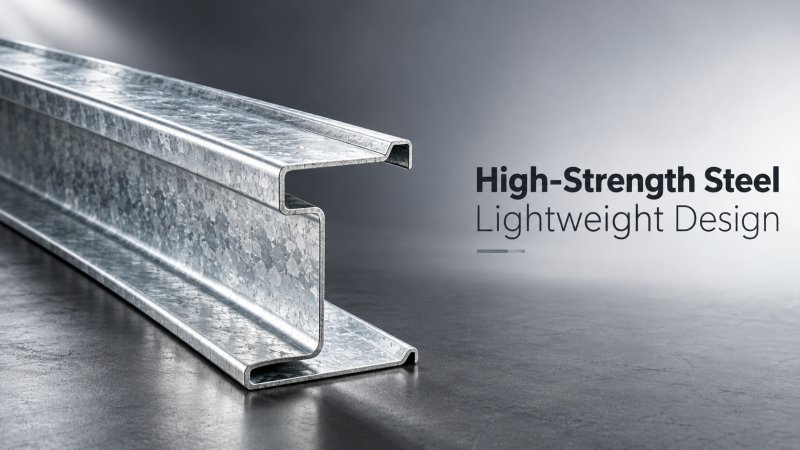
Roll forming is highly effective for producing long, complex structural sections with consistent cross-sections. For example, in the manufacturing of heavy-duty commercial vehicles, specialized transport equipment, or engineering machinery, cold-formed profiles like a Z-beam are extensively used. These Z-shaped steel profiles provide excellent structural rigidity and serve as critical load-bearing elements, such as chassis supports, mechanical columns, or structural arms. The roll forming technology used to produce them allows for the integration of complex features directly into the profile, reducing the need for secondary welding operations and further contributing to overall weight reduction.
Welding and Joining Complexities
The joining process is another critical area where high-strength steel requires special attention. Welding these materials introduces localized heat, which can alter the microstructure of the steel in the Heat Affected Zone (HAZ). In some high-strength grades, particularly those relying on a martensitic microstructure for their strength, the heat from welding can cause softening in the HAZ, creating a weak point that may fail prematurely under load.
To address this, welding parameters must be strictly controlled. This includes optimizing heat input, utilizing precise weld scheduling in resistance spot welding, and ensuring proper fit-up to avoid gaps that require excessive filler material. In many modern lightweight vehicle designs, traditional welding is being supplemented or replaced by structural adhesives and flow drill screwing. These mechanical and chemical joining methods do not introduce the same thermal distortions or microstructural changes as welding, preserving the full strength of the high-strength steel sheet.
Project managers must ensure that the manufacturing facility has the capability to handle these advanced joining techniques. Upgrading welding equipment, training operators on new parameters, and validating joint strength through rigorous destructive and non-destructive testing are all essential steps to guarantee the structural integrity of the final vehicle.
Corrosion Protection in Thinner Sections
When components are downgaged to save weight, the margin for material loss due to corrosion is significantly reduced. A traditional mild steel component might have enough excess thickness to tolerate a certain amount of rust over its lifespan without failing structurally. A high-strength, thin-gauge component does not have this luxury; any corrosion can quickly compromise its load-bearing capacity.
Therefore, robust corrosion protection is non-negotiable. Galvanized coatings are widely used to protect high-strength steel sheet from environmental degradation. The zinc layer acts as a sacrificial anode, corroding preferentially to protect the underlying steel. For applications requiring specific aesthetic or additional environmental resistance, silver finishes or specialized post-treatments may be applied.
When specifying coated materials, project leaders must consider the impact of the coating on the welding process. Zinc coatings can cause electrode degradation during resistance spot welding, requiring more frequent electrode dressing or replacement. Balancing the need for long-term corrosion protection with the realities of high-volume manufacturing is a key decision point that directly impacts both vehicle durability and production efficiency.
Strategic Sourcing and Project Execution
From a project management perspective, the successful implementation of high-strength steel relies heavily on strategic sourcing and supply chain reliability. High-strength materials often have tighter manufacturing tolerances and more complex quality requirements than conventional steels. Ensuring that the supplied steel sheet meets exact thickness, width, and mechanical property specifications is critical to avoiding production delays and quality defects.
When procuring structural components or raw materials, project managers should look for suppliers who can provide consistent quality and adhere to major international standards, such as ASTM, EN, JIS, and GB. Certifications like CE, SGS, BV, and ISO are strong indicators of a supplier's commitment to quality control and traceability.
Furthermore, optimizing material utilization is a key cost-saving strategy. Sourcing materials in customized lengths—for instance, specifying lengths between 2 to 12 meters based on exact production needs—can drastically reduce scrap waste. This is particularly relevant when ordering structural profiles. For instance, when integrating a Z-beam into large-scale steel structure workshops, lightweight roofs, or heavy vehicle frames, having the material cut to precise, customized lengths with a tight tolerance of ±1% ensures minimal waste and maximizes structural efficiency. Reliable suppliers who offer exported standard packaging and dependable lead times help mitigate sourcing risks, allowing project teams to maintain tight production schedules and control overall manufacturing costs.
Part Consolidation and Design Integration
The ultimate goal of using high-strength steel sheet is not just to make individual parts lighter, but to simplify the overall vehicle architecture. Part consolidation is a powerful design strategy where multiple stamped or fabricated components are combined into a single, more complex part. High-strength steels, especially when formed through advanced roll forming or hydroforming, make this consolidation possible.
By reducing the total number of parts, manufacturers can eliminate hundreds of weld joints, reduce assembly time, and decrease the overall weight of the vehicle. Fewer parts also mean fewer tooling requirements, lower inventory costs, and reduced opportunities for assembly errors. However, achieving part consolidation requires close collaboration between product designers and material suppliers. The chosen steel sheet must possess the necessary formability to be shaped into the complex, consolidated geometry without tearing or excessive thinning.
For project managers, championing part consolidation initiatives early in the design phase can yield substantial benefits. It shifts the focus from simply optimizing individual components to optimizing the entire system, leading to more efficient manufacturing processes and a lighter, more cost-effective final product.
Please give us a message


Please enter what you want to find