For a distributor or sourcing agent, the real question behind steel wire mesh is rarely “what is it?” It is usually “which mesh will perform in this job without creating claims, replacement cost, or delivery trouble later?” That matters because the same product family can be used for screening, perimeter protection, machine guarding, animal enclosures, wall reinforcement, concrete support, and many other industrial or construction tasks. The names may sound similar, but the service conditions are not.
In practice, choosing the wrong mesh usually shows up in one of three ways: openings that do not control material flow as expected, wire that corrodes or deforms too early, or a specification that looks acceptable on paper but does not match installation methods on site. For channel partners in the steel market, the value is not in quoting the cheapest mesh. It is in matching mesh type, wire diameter, opening, coating, and fabrication method to the actual duty cycle.
Start with the job, not the catalog
When buyers ask for steel wire mesh, they often describe the product by habit rather than by application logic. A contractor may ask for “welded mesh” when the real requirement is crack control in slab work. A plant buyer may ask for “galvanized mesh” when what they actually need is stable opening accuracy for screening. A distributor who only follows the stated name can end up supplying material that technically fits the order but fails in use.
A better starting point is to separate the application into three broad job types:
- Screening: controlling particle size, separating material, or allowing air/light/liquid passage while retaining solids.
- Protection: preventing access, shielding equipment, supporting safety barriers, or creating enclosed zones.
- Reinforcement: improving crack distribution, dimensional stability, or structural performance in cementitious or fabricated assemblies.
That sounds simple, but it changes the selection process. Screening usually depends first on aperture precision and wear behavior. Protection depends more on impact resistance, rigidity, corrosion exposure, and fixing method. Reinforcement is driven by bond, spacing consistency, weld integrity, and compatibility with the surrounding material.
For screening, aperture accuracy usually matters more than buyers expect
In screening work, many buyers focus on wire thickness because it feels tangible and easy to compare. But in real operating conditions, mesh opening and opening consistency often decide whether the screen will perform. If the aperture is inconsistent, undersized material may not pass efficiently, while oversized material may contaminate the downstream process. That affects throughput, product quality, and maintenance frequency.
For screening applications, buyers should check at least four points early:
- Nominal opening size and tolerance
- Wire diameter and its impact on open area
- Material grade and abrasion environment
- Whether the mesh is woven or welded for the intended use
Woven mesh is often preferred where flexibility and more precise screening behavior are needed. Welded mesh is generally more rigid and easier to fabricate into panels, but it is not always the best answer for fine or dynamic screening. This is one of the common market misunderstandings: “stronger” does not automatically mean “better” if the application depends on controlled separation rather than panel stiffness.
If the screening environment includes vibration, abrasive aggregate, mineral handling, or wet processing, buyers should also ask how quickly the openings may distort over time. Initial dimensions can look correct at inspection, yet service performance can change quickly if the wire lacks adequate wear resistance or if weaving quality is inconsistent.
For protection, rigidity and fixing details matter as much as the mesh itself
Protective applications include machine guards, fencing infill, storage cages, partition walls, road barriers, and industrial enclosures. In these cases, buyers often overemphasize corrosion coating and underestimate mechanical behavior. A mesh panel that looks acceptable in the warehouse may fail once it is exposed to repeated contact, vibration, or poor frame support.
The right question is not only “is it galvanized?” but also:
- Will the panel hold shape after cutting, transport, and installation?
- How is it fixed to the frame or support structure?
- What kind of impact or point load should it resist?
- Is visibility, ventilation, or anti-climb performance part of the requirement?
This is where welded wire mesh often becomes the practical choice, especially for industrial guards and partitions. It offers panel stability, easier installation, and repeatable dimensions. But not all welded mesh performs equally. Poor weld consistency can create weak points at the intersections, and those failures are easy to miss during basic visual inspection.
For outdoor protection systems, coating choice deserves more disciplined review. Electro galvanized mesh may be sufficient for indoor or mild environments, but in coastal, agricultural, chemical, or continuously wet conditions, buyers should be more cautious. Hot-dip galvanized material generally offers stronger corrosion resistance, though coating quality, zinc mass, and post-weld or pre-weld process differences should be confirmed rather than assumed. Exact coating performance claims should be treated as project-specific unless documented by the supplier.
There is also a useful adjacent comparison here. In some protective or barrier systems, especially where tension, suspension, or load-bearing connection points are involved, mesh is only one part of the system. Supporting elements may require rope rather than mesh. In those cases, products such as Galvanized Steel Wire Rope 1470Mpa to 1960Mpa may be relevant as a companion component for cranes, road fences, marine exposure, or heavy-duty industrial installations, particularly when zinc layer thickness must be matched to different corrosion conditions. The point is not to substitute rope for mesh, but to avoid treating all wire-based steel products as interchangeable.
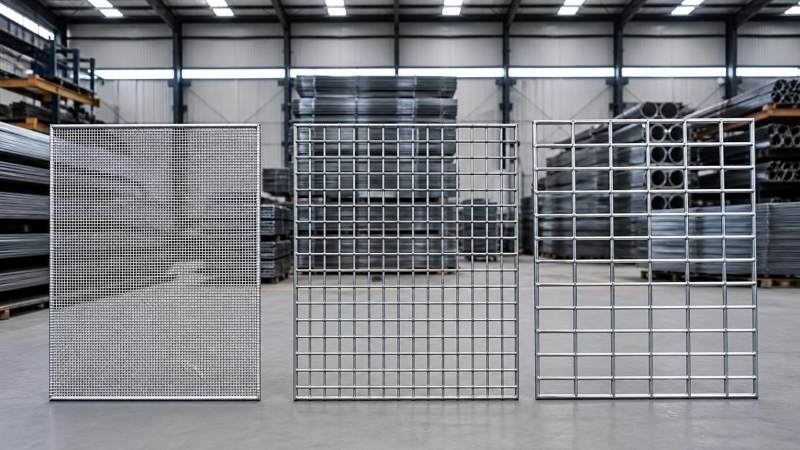
For reinforcement, the wrong mesh can pass delivery inspection and still cause site problems
Reinforcement applications are common in slabs, precast elements, wall systems, masonry support, and secondary concrete works. Here, the selection mistake is often more subtle. Buyers may receive mesh that matches nominal size and quantity, but the product can still create problems during placement, cover control, lap alignment, or bond performance.
For reinforcement work, the critical checks usually include:
- Wire diameter and spacing consistency
- Panel flatness and dimensional tolerance
- Weld strength at intersections
- Surface condition and whether it suits the bonding requirement
- Applicable standard for the target market or project specification
Distributors serving export or project supply chains should be especially careful here. “Equivalent” mesh is not always accepted across regions. A product made to one national standard may still require additional confirmation for another market’s structural documentation, testing method, or engineer approval. For projects governed by ASTM, EN, JIS, or GB frameworks, the practical requirement is not just manufacturing capability but traceable compliance.
This is where supplier discipline matters. A manufacturer with stable process control and documented quality systems can reduce commercial risk for intermediaries far more effectively than a low initial price can. For channel partners handling structural steel and related products, that difference becomes visible when jobs involve repeated lots, OEM fabrication, or public-sector and infrastructure documentation.
Three specification traps that create avoidable claims
1. Confusing opening size with usable opening
Buyers sometimes specify aperture without considering wire diameter, which changes open area and flow behavior. Two meshes can share a nominal opening but perform very differently in screening or ventilation applications.
2. Treating galvanized finish as a single category
Galvanizing is not one uniform performance level. Service life depends on environment, zinc mass, processing route, edge exposure, and handling damage. In corrosive conditions, “galvanized” alone is not a sufficient purchasing criterion.
3. Ignoring downstream fabrication
A mesh that works as a roll product may not behave well once cut into panels, bent, welded into frames, or fastened on uneven supports. Buyers should ask how the product will be processed after delivery, not only how it leaves the mill.
How distributors can qualify demand faster
In real sales work, end users often provide incomplete specifications. Waiting for a perfect RFQ is not always realistic. A more effective approach is to qualify demand with a short set of commercial-technical questions:
- What is the actual use case: screening, protection, or reinforcement?
- Is the environment indoor, outdoor, wet, chemical, coastal, or abrasive?
- Is the buyer using rolls, sheets, or framed panels?
- What matters more in service: precision, rigidity, visibility, impact resistance, or bond performance?
- Which standard, certification, or project approval route applies?
- Is the order for distribution stock or for a named project?
These questions help separate stock-grade demand from project-grade demand. That distinction matters commercially. Stock sales reward broad usability and inventory turnover. Project sales require tighter documentation, more stable lead times, and clearer responsibility for compliance. Mixing the two without stating assumptions is one of the fastest ways to create disputes.
What a reliable supply partner should be able to prove
For agents and distributors, the supplier evaluation process should go beyond product photos and a general materials list. In steel wire mesh supply, a reliable partner should be able to provide consistent dimensions, repeatable coating or surface treatment, clear production capability, and reasonable documentation tied to the destination market.
That is particularly relevant for companies working across structural steel categories. Manufacturers with broader experience in angle steel, channels, beams, cold formed profiles, and custom steel components often understand the project reality behind mesh orders better than traders who only relay specifications. They are more likely to recognize where mesh selection affects fabrication, installation sequencing, and total project efficiency.
For overseas buyers, capacity stability and lead-time control are not secondary concerns. They directly affect the distributor’s credibility. A late mesh shipment can delay concrete work, fencing installation, equipment commissioning, or a larger fabricated steel package. In many cases, logistics discipline is just as important as technical suitability.
Where the decision usually lands
If the application is screening, prioritize opening accuracy, wear conditions, and the right fabrication type before focusing on price. If the application is protection, think in terms of panel behavior, corrosion environment, and fixing method. If the application is reinforcement, verify standards, weld quality, and dimensional consistency before assuming substitution is acceptable.
That is usually enough to move the decision from “mesh as a commodity” to “mesh as a fit-for-purpose steel product.” For distributors and sourcing teams, that shift is where margin protection starts. The best steel wire mesh choice is rarely the one with the shortest description. It is the one that matches the real service condition closely enough that nobody has to revisit the purchase after installation.
Please give us a message


Please enter what you want to find