Choosing the right Steel Wire manufacturer is critical for long-term supply stability, project efficiency, and cost control. At Hongteng Fengda, we help global buyers reduce sourcing risk with reliable production capacity, consistent quality, and customized structural steel solutions built to international standards. From standard specifications to OEM requirements, our manufacturing capabilities are designed to support construction, industrial, and manufacturing projects with dependable lead times and professional service.
For enterprise decision-makers, long-term sourcing is not only about comparing unit prices. It is about evaluating whether a supplier can maintain quality over 12, 24, or even 36 months, respond to engineering changes within days rather than weeks, and deliver steel products that match both project specifications and downstream production schedules. In practice, a capable Steel Wire manufacturer is assessed by broader manufacturing discipline, process control, standard compliance, and export execution.
Although steel wire is often discussed as a distinct category, buyers in construction, industrial fabrication, and manufacturing frequently evaluate suppliers on wider steel processing capabilities. A partner that also understands structural sections, cold formed profiles, welding tolerances, packaging methods, and international documentation usually performs better in long-cycle supply relationships. That is where an experienced Chinese structural steel manufacturer and exporter can create measurable value.
Why Manufacturing Capability Matters More Than Initial Price
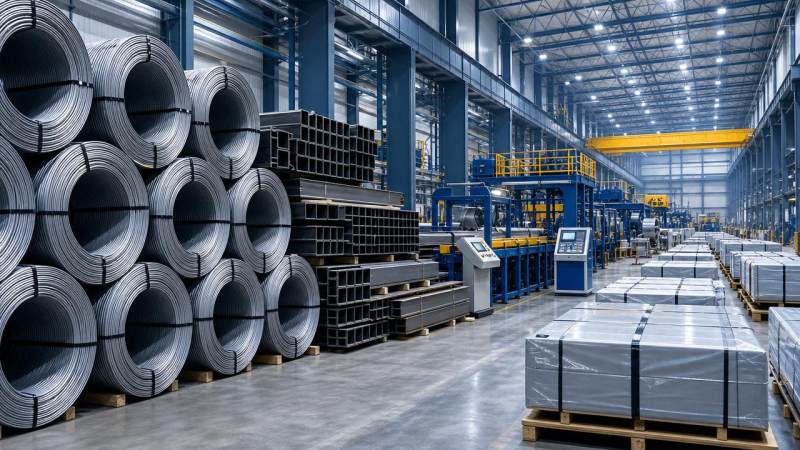
In many procurement reviews, the first comparison starts with price per ton. However, over a 6–18 month supply period, the real cost difference is often shaped by rejected batches, delayed containers, inconsistent mechanical performance, and repeated communication loops. A Steel Wire manufacturer with disciplined production systems can reduce these hidden costs significantly.
The 4 capability areas buyers should verify
- Production capacity stability across peak and off-peak order cycles
- Quality consistency from raw material intake to final inspection
- Flexibility for OEM, custom sizes, and mixed specification orders
- Export execution including packing, documents, and lead time control
For example, if a buyer needs recurring monthly shipments of 300–500 tons, a supplier must do more than quote a competitive rate. It must demonstrate how it allocates production slots, controls thickness tolerance, manages coating or finishing requirements if applicable, and protects delivery schedules when raw material prices fluctuate. These are operational indicators that directly affect project continuity.
Risk increases when capability is narrow
A supplier that only trades material without real production coordination may struggle when orders involve 2 or 3 standards in one shipment, partial customization, or urgent replenishment. By contrast, manufacturers with broader steel processing experience can better coordinate related products such as angle steel, channels, beams, and custom components, which is valuable when buyers consolidate procurement to reduce vendor count.
The table below shows how long-term procurement decisions usually shift when buyers compare headline price against full supply performance.
The key takeaway is straightforward: in B2B steel purchasing, a 2% lower quote can easily be offset by one delayed shipment, one failed inspection, or one urgent replacement order. Decision-makers therefore need to assess manufacturing capability as a cost-control factor, not just a technical detail.
Core Indicators of a Reliable Steel Supply Partner
When screening a Steel Wire manufacturer for long-term business, buyers should build a practical review model. The most effective approach is to focus on indicators that influence quality repeatability, delivery confidence, and contract execution over multiple purchase cycles.
1. Standards and specification coverage
Global buyers often operate across ASTM, EN, JIS, and GB systems. A manufacturer that can work across these frameworks is better positioned to support projects in North America, Europe, the Middle East, and Southeast Asia. It also reduces approval delays when engineering teams need equivalent grades, cross-standard review, or mixed-standard procurement in the same quarter.
2. Production capacity and scheduling discipline
Stable output is essential when procurement plans are spread over 3, 6, or 12 months. Buyers should ask how production slots are allocated, whether urgent orders can be inserted without disrupting existing schedules, and what the typical lead time range is for standard versus custom items. In many steel categories, standard orders may run in 2–4 weeks, while customized fabrication can require 4–8 weeks depending on quantity and processing depth.
3. Quality control at multiple checkpoints
A strong supplier does not rely on final inspection alone. It checks raw material identity, dimensional tolerance, mechanical properties where required, surface condition, and packing integrity. For export orders, even labeling and bundle marking matter because errors here can create customs issues or warehouse confusion at destination.
4. Customization capability
Many enterprise buyers no longer purchase only standard stock. They need pre-cut lengths, special tolerances, bundled project lots, or OEM processing tied to production drawings. A manufacturer that supports both standard specifications and customized structural steel components gives procurement teams more room to optimize inventory and reduce secondary processing time.
The following matrix can help decision-makers evaluate suppliers using measurable procurement criteria instead of general claims.
This framework is especially useful when comparing 3–5 shortlisted suppliers. It helps procurement, engineering, and operations teams align around practical decision points instead of relying on sales language alone.
How Product Range Strengthens Long-Term Supply Security
A frequent mistake in steel sourcing is evaluating one product line in isolation. In reality, projects often require related categories such as beams, channels, angle steel, cold formed profiles, and steel tube products. A supplier with integrated product understanding can support bundled purchasing, reduce communication layers, and simplify quality expectations across items.
This matters even when the original search begins with a Steel Wire manufacturer. Enterprise buyers may later need structural steel components, pipe sections, or fabricated items within the same project schedule. Working with a partner that can coordinate broader steel requirements helps lower administrative cost and improve delivery alignment.
A practical example from industrial applications
For thermal systems, processing equipment, and industrial support frames, buyers often combine structural steel with pipe or tube products. In such cases, procurement teams benefit from suppliers that understand specification matching, dimensional coordination, and export packing for mixed cargo. One relevant option is A36 Steel Pipe, which can be applied in tubular heat exchangers, condensers, and similar heat transfer equipment.
Typical ranges may include outside diameters from 1/8 inch to 3 inches, broader dimensional options such as Diameter 10mm–914.4mm, thicknesses from 1mm–100mm, and unit lengths of 3m, 5.8m, 6m, 11.8m, 12m, or 13.5m depending on order requirements. Common reference standards in such product families include ASTM A106, A53, A179, API 5L, EN10210, JIS G3454, and GB/T 8163. This kind of specification breadth is useful when projects demand compatibility across multiple equipment systems.
Why this cross-category capability matters
When a supplier can manage both structural steel and industrial tube-related requirements, buyers gain 3 advantages. First, they can reduce the number of active vendors. Second, documentation and inspection communication become simpler. Third, shipment consolidation may improve container utilization and reduce handling complexity at destination ports.
- Fewer vendor handoffs during project execution
- Better consistency in packing, marking, and shipping documents
- Improved flexibility for phased deliveries over 2–3 project stages
Operational Factors That Protect Delivery Performance
Even technically qualified suppliers can fail if execution is weak. For long-term contracts, delivery performance depends on how well the manufacturer manages production planning, inspection release, packaging, and export coordination. These details become more important when shipping to multiple destinations or combining standard and OEM products in one order cycle.
Lead time should be broken into 5 steps
- Technical confirmation and drawing review
- Raw material allocation
- Production and in-process inspection
- Final inspection, packing, and document preparation
- Loading, customs coordination, and shipment release
When suppliers only quote a single lead time figure, buyers have limited visibility. A better practice is to request milestone timing. For example, technical confirmation may take 2–3 days, production 10–20 days for standard items, packing and release 3–5 days, and port handling another several days depending on route and booking conditions.
Packaging and export readiness are not minor details
Incorrect bundling, weak moisture protection, or incomplete marks can create warehouse delays, mismatch claims, and handling damage. For enterprise buyers, this affects not only the incoming material but also internal labor efficiency. Good export execution includes clear bundle identification, standard-compliant paperwork, and packing suited to container, break bulk, or project cargo requirements.
Communication response speed influences procurement risk
A responsive Steel Wire manufacturer should be able to confirm key production or documentation questions within 24–48 hours in normal cases. Slow response often signals weak coordination between sales, factory, and quality teams. Over a yearly sourcing program, those delays accumulate into approval bottlenecks and planning inefficiencies.
How Decision-Makers Can Select the Right Supplier
For enterprise procurement, the best supplier selection process is structured and cross-functional. Price should remain a factor, but it should sit alongside technical fit, delivery reliability, and communication quality. A simple 4-part review model often works well for sourcing teams.
Recommended supplier review model
- Technical review: standards, dimensions, tolerances, and OEM capability
- Commercial review: quotation clarity, Incoterms, payment terms, and validity period
- Operational review: lead time, packing method, inspection flow, and document readiness
- Relationship review: communication efficiency, problem-solving speed, and long-term support attitude
Questions worth asking before contract award
Ask for standard coverage, production timing by order type, typical tolerance control points, and how non-conformity is handled if an issue appears after shipment. Also ask whether mixed products can be supplied under one schedule and whether OEM drawings can be reviewed before final quotation. These questions reveal far more than a polished brochure.
Hongteng Fengda supports global buyers with structural steel manufacturing and export experience across multiple regions. With product coverage that includes angle steel, channel steel, steel beams, cold formed steel profiles, and customized structural steel components, the company is positioned to help buyers reduce sourcing fragmentation while maintaining compliance with major standards such as ASTM, EN, JIS, and GB.
For buyers seeking a dependable Steel Wire manufacturer or a broader steel supply partner, the most important capabilities are not marketing claims but repeatable execution: stable production capacity, consistent quality control, specification flexibility, export readiness, and professional communication. These factors shape long-term supply stability far more than a one-time low quote.
If your team is evaluating suppliers for construction, industrial, or manufacturing projects, Hongteng Fengda can support both standard and customized requirements with reliable scheduling and international-grade quality management. Contact us today to discuss specifications, request a tailored sourcing plan, or learn more about integrated structural steel solutions for your next project.
Please give us a message


Please enter what you want to find