Choosing the right steel rebar manufacturer can directly affect project safety, cost control, and delivery reliability. For steel sourcing, basic output is never enough. Real value comes from quality consistency, standard compliance, customization ability, and dependable export execution.
In global construction and industrial supply chains, a qualified steel rebar manufacturer should support both standard orders and project-specific requirements. That matters when schedules are tight, specifications vary, and supply risks can quickly turn into structural or commercial problems.
For structural steel and related carbon steel products, capability must be judged by application scenario. A supplier suitable for domestic low-complexity demand may fail in export projects, engineered fabrication, or mixed-standard environments.
Why application scenarios change how a steel rebar manufacturer should be evaluated
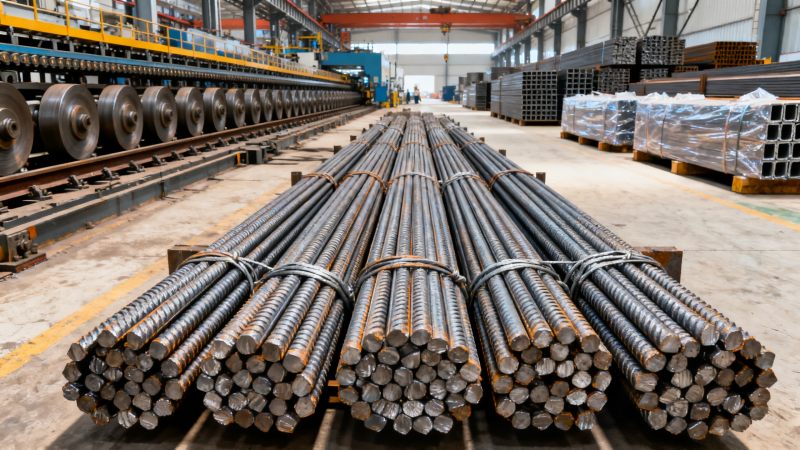
Not every project uses steel the same way. High-rise construction, infrastructure works, industrial fabrication, and export distribution all demand different supplier strengths.
A steel rebar manufacturer serving one-time volume demand may focus on price and tonnage. A supplier for repeated international delivery must also control documentation, packaging, testing traceability, and lead-time stability.
This is especially important in the broader steel industry. Many buyers also source angles, channels, beams, cold formed profiles, and custom steel parts together. Integrated capability reduces communication gaps and shipment fragmentation.
Scenario 1: Large construction projects need consistency more than isolated low pricing
In commercial and residential construction, consistent mechanical performance is critical. Batch-to-batch variation can create inspection delays, welding concerns, and installation inefficiencies.
A capable steel rebar manufacturer should maintain stable chemistry, dimensional accuracy, and surface condition. Mill test reports should be clear, timely, and traceable to each production batch.
Construction projects also need practical coordination. That includes standard lengths, cut-to-order supply, bundled loading plans, and shipment timing aligned with site progress.
Key checks in this scenario
- Production capacity that matches project scale
- Stable dimensional tolerances
- Batch traceability and test documentation
- Reliable loading and delivery planning
Scenario 2: Export projects require a steel rebar manufacturer with standards and documentation discipline
Cross-border supply creates another layer of risk. Products may meet strength requirements but still fail due to incomplete documents, wrong markings, or noncompliant packaging.
For this scenario, a steel rebar manufacturer must understand ASTM, EN, JIS, and GB requirements, plus customer-specific rules. Export capability includes customs support, seaworthy packaging, and accurate labeling.
Hongteng Fengda, as a structural steel manufacturer and exporter from China, focuses on stable production, quality control, and global delivery coordination across North America, Europe, the Middle East, and Southeast Asia.
This matters when steel procurement includes multiple product categories. A supplier that can combine structural sections and related carbon steel items often lowers sourcing complexity and transit risk.
Scenario 3: Mixed-use industrial demand often depends on customization support
Industrial applications do not always follow fixed catalog specifications. Equipment supports, rails, water systems, handrail components, and fabricated assemblies may need special grades, lengths, or surface treatments.
In this context, the best steel rebar manufacturer is often the one that can coordinate custom processing without losing quality control. Flexibility should never mean uncontrolled variation.
A good example is Q235 Carbon Steel Round Bar, which can support construction, decoration, water supplying, railing, staircase, fence, furniture, and shipment-related needs.
It is available in carbon steel grades including Q235, S235JR, S355JR, ST37, ST52, Gr.B, X42 to X70, and 30CrMo. Common lengths include 2m, 5m, 6m, and 12m.
Diameter options range from 5mm to 2500mm. Surface choices include passivation, oiling, lacquer sealing, phosphating, untreated, galvanized, PVC, black painting, and anti-rust oil.
For mixed-use projects, this kind of product range shows why customization and standards coverage matter. It supports applications beyond one single construction scenario.
How capability priorities differ across real steel sourcing scenarios
Practical selection advice for different steel buying situations
The strongest steel rebar manufacturer is not always the one with the lowest quote. The better choice depends on where failure would create the highest cost.
If delivery timing is the biggest risk
- Ask for monthly output capacity
- Confirm rolling production schedules
- Review past export lead-time performance
If compliance is the biggest risk
- Check standard coverage like ASTM, EN, JIS, and GB
- Request sample test certificates
- Verify heat number and batch trace systems
If application diversity is the biggest risk
- Review available grades, sizes, and finishes
- Check whether OEM or custom fabrication is supported
- Confirm packaging for mixed-product shipments
Common mistakes when judging a steel rebar manufacturer
One common mistake is comparing only unit price. Lower initial pricing can hide higher costs from delays, re-inspection, replacement, and fragmented logistics.
Another mistake is assuming every steel rebar manufacturer can handle export documentation correctly. In reality, paperwork quality often separates smooth transactions from expensive hold-ups.
A third oversight is ignoring adjacent product capability. Many steel projects include beams, channels, angle steel, cold formed sections, and custom components in the same supply plan.
When one supplier can align specifications across these categories, quality coordination improves. It also simplifies communication, packaging, and delivery sequencing.
What long-term partnership value looks like in steel supply
A dependable steel rebar manufacturer should help reduce sourcing risk over time. That means stable quality, responsive technical communication, and predictable execution across repeated orders.
For global steel projects, long-term value comes from more than production. It includes issue prevention, specification understanding, packaging discipline, and the ability to adapt without losing consistency.
Hongteng Fengda supports this approach through structural steel manufacturing, export service, customized solutions, and strict quality control aligned with major international standards.
Next steps for evaluating the right steel rebar manufacturer
Start by matching supplier capability to your application scenario. Define whether quality consistency, export compliance, customization, or lead-time stability matters most.
Then request technical documents, standard references, sample specifications, and delivery details. Compare real execution ability, not just catalog claims.
The best steel rebar manufacturer is the one that fits project reality, supports steel system needs, and performs reliably across the full order cycle.
Please give us a message


Please enter what you want to find