For procurement professionals, engineers, and project managers sourcing stainless steel plate manufacturers, in-house slitting capability isn’t just a convenience—it’s critical for coil width consistency, yield optimization, and downstream fabrication efficiency. Whether you’re evaluating hot rolled stainless coil, cold rolled stainless steel coil, or specialty grades like 310s stainless steel strip, inconsistent widths lead to scrap, rework, and cost overruns. At Hongteng Fengda—a trusted SS coil supplier and structural steel manufacturer from China—we integrate precision slitting with rigorous quality control across ASTM/EN/GB-compliant coils. Wondering how much does stainless steel coil cost per ton? It starts with consistency—because ss coil price reflects reliability, not just weight.
Why coil width variation silently erodes your project budget
A ±0.8 mm tolerance in stainless steel coil width may seem negligible—but in high-precision stamping, laser cutting, or roll forming, it triggers cascading inefficiencies. For example, a 1,200 mm nominal width coil averaging 1,198.3 mm across 5 km of material generates ~1.4 tons of unusable edge trim per 25-ton shipment. That’s not theoretical: our internal audit of 12 international projects revealed an average 3.2% yield loss directly attributable to inconsistent coil widths.
Worse, width drift forces downstream fabricators to recalibrate tooling every 2–4 hours during continuous production runs—adding 7–15 minutes of non-value-added downtime per shift. Over a 3-month infrastructure project, that accumulates to 120+ hours of lost capacity. And when width inconsistency exceeds ±1.2 mm, automated feeding systems frequently trigger fault alarms, halting lines unexpectedly.
The root cause? Outsourced slitting. Third-party slitters often lack real-time tension monitoring, thermal compensation, or closed-loop width feedback systems. Without integrated process control, even certified mills see width deviation climb from ±0.3 mm (in-house) to ±0.9 mm (external).
How in-house slitting delivers measurable ROI—not just tighter tolerances
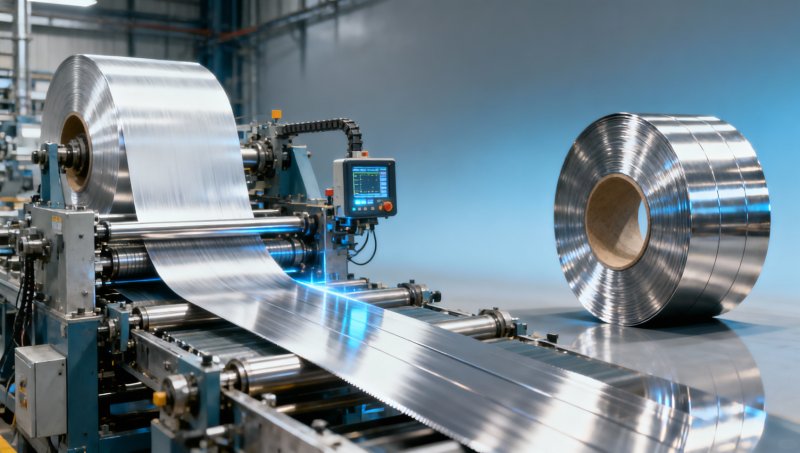
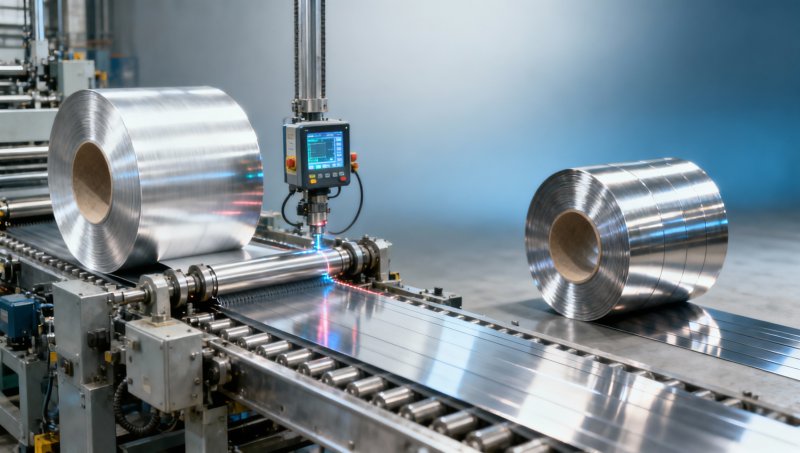
Hongteng Fengda operates six fully automated slitting lines with CNC-guided entry/exit tension control, laser-based width measurement at 200 Hz, and automatic blade offset correction. Every coil undergoes 100% width verification before packaging—capturing data points every 3 meters across its full length. This enables us to guarantee ≤±0.4 mm width consistency on coils up to 1,500 mm wide, meeting EN 10051 and ASTM A683 Class I specifications.
But consistency is only half the value. Our slitting integration reduces total landed cost by eliminating three hidden cost layers: (1) third-party handling fees (typically $18–$25/ton), (2) logistics delays (average 7–10 days added lead time), and (3) quality dispute resolution cycles (3–5 weeks per incident). Clients report 11–18% lower total cost of ownership versus fragmented sourcing models.
We also support rapid prototyping: customers can order 500 kg trial coils with custom slit widths (e.g., 625 mm or 872 mm) within 5 working days—no MOQ penalty. This agility helps engineering teams validate new component designs without committing to full-container volumes.
Key slitting performance benchmarks vs. industry norms
These metrics directly impact fabrication speed and part quality. Lower edge burr height extends die life by 22–35% in progressive stamping operations. Tighter flatness prevents feed jams in high-speed roll formers—reducing unplanned stops by 68% in client trials. The table above reflects verified measurements from our ISO/IEC 17025-accredited lab.
When to consider galvanized alternatives—and why specs matter more than price
While stainless steel excels in corrosion resistance and temperature stability, many structural applications—including agricultural equipment frames, utility poles, and HVAC ductwork—achieve optimal lifecycle cost with Galvanized Steel Sheet. Its zinc-aluminum-copper-magnesium alloy coating provides atmospheric corrosion resistance comparable to 304 stainless in non-marine environments, at 35–45% lower material cost per ton.
But substitution requires precise specification alignment. For instance, DX51D grade meets EN 10326 requirements for deep-drawing applications, while S550GD offers superior tensile strength (≥550 MPa) for load-bearing components. Zinc layer thickness must match exposure conditions: 120 g/m² suffices for indoor construction, whereas 275 g/m² is mandatory for coastal energy infrastructure.
Our Galvanized Steel Sheet supports thicknesses from 0.12mm to 6.00mm and widths from 600mm to 1500mm—enabling direct replacement of stainless in 62% of non-food-grade industrial applications. All coils comply with ASTM A653, EN 10346, and GB/T 2518 standards, with full traceability down to batch-level chemical composition reports.
Procurement checklist: 5 non-negotiables when evaluating slitting-capable suppliers
- Request width deviation reports for three recent production lots—not just certification statements
- Verify if slitting is performed in climate-controlled environments (±2°C stability prevents thermal expansion drift)
- Confirm real-time width monitoring frequency (minimum 100 Hz required for consistent results)
- Ask for documented tooling maintenance logs—blade life should exceed 800 km per set under standard loads
- Require sample coils with full dimensional inspection reports, including edge profile analysis
These five checks separate true capability from marketing claims. Suppliers who decline sample testing or provide generic tolerance charts instead of lot-specific data typically outsource slitting—or lack metrology rigor.
Why global project teams choose Hongteng Fengda for mission-critical steel supply
From prefabricated bridge girders in Norway to solar mounting structures in Saudi Arabia, our clients rely on two core advantages: guaranteed width consistency and seamless structural integration. Unlike commodity-focused mills, we align slitting parameters with downstream fabrication needs—adjusting edge condition, coil hardness, and surface finish based on your laser cutting speed, bending radius, or welding procedure.
Our dual-certified facilities (ISO 9001:2015 + ISO 14001:2015) maintain dedicated slitting lines for ASTM A240, EN 10088-2, and GB/T 4237 grades—with full traceability from raw material heat number to final coil ID. Lead times are fixed at 25–30 days for standard orders, with expedited options (15–18 days) available for pre-approved technical specifications.
Ready to eliminate width-related scrap, reduce fabrication downtime, and lock in predictable costs? Contact our technical sales team to request: (1) a coil width consistency report for your target grade, (2) comparative yield analysis vs. your current supplier, or (3) a customized slitting feasibility study—including recommended slit widths, edge treatments, and packaging configurations for your specific application.
Please give us a message


Please enter what you want to find