When upgrading or expanding existing facilities, project managers must ensure structural integrity without exceeding budgets. Reinforcing current frameworks with additional steel beams is a highly effective, cost-efficient solution to enhance load-bearing capacity and extend infrastructure lifespan. However, the success of such interventions relies not merely on adding more steel, but on achieving precise load redistribution, ensuring seamless integration between old and new elements, and managing complex on-site constraints. A reinforcement project is only as strong as its weakest connection and its most inaccurate assumption about the existing structure. As a trusted structural steel manufacturer, Hongteng Fengda supplies premium, internationally certified steel beams tailored to your exact engineering specifications, helping you mitigate sourcing risks and deliver reinforcement projects safely, on time, and to the highest global standards.
Load Path Redistribution and Deflection Compatibility
Adding steel beams to an existing structure fundamentally alters the original load path. Project managers must recognize that simply placing a new beam adjacent to an old one does not automatically double the capacity. The critical factor is how the new beam interacts with the existing framework, particularly regarding deflection compatibility. Existing beams have already undergone initial deflection under dead loads. If a new steel beam is installed without accounting for this existing deformation, it will remain unstressed until the original beam deflects further under new live loads. This means the new beam fails to share the existing dead load, effectively reducing its contribution to the overall reinforcement. To achieve true composite action, engineers often need to specify pre-cambered steel beams or implement jacking systems during installation to induce initial stress in the new members. Additionally, the orientation of the added beams matters. Reinforcing the strong axis improves vertical load capacity, but if lateral torsional buckling is the governing failure mode, adding beams to the weak axis or introducing lateral bracing becomes the necessary focus. Understanding these mechanical behaviors is essential for project managers when reviewing design proposals and approving installation sequences.
Temporary Shoring and Load Transfer Mechanisms
The physical installation of additional steel beams introduces significant temporary loading conditions that are frequently underestimated. Before the new beams can be fully integrated and share the load, the existing structure may need to be temporarily relieved of its stresses. This requires the design and implementation of temporary shoring systems. Project managers must ensure that the shoring design accounts for the actual load transfer sequence. If shoring is removed prematurely or in the wrong sequence, it can cause sudden load shifts, leading to localized overstressing or even progressive collapse. Furthermore, the placement of temporary shores must not interfere with ongoing facility operations or block critical access routes. In facilities with sensitive equipment or continuous processes, the vibration generated by driving temporary piles or adjusting hydraulic jacks can disrupt operations or damage nearby machinery. Coordinating the shoring plan with the installation sequence of the new steel beams, while considering the operational sensitivities of the facility, is a vital project management task that directly impacts both safety, schedule, and business continuity.
Connection Design and On-Site Constructability
The connection between the new steel beams and the existing structure is where most reinforcement projects face execution risks. In brownfield projects, accessing the connection points is often hindered by existing piping, electrical trays, HVAC ducts, or operational equipment. Welding in confined spaces introduces quality control challenges, particularly regarding residual stresses and heat-affected zones in older steel that may have unknown material properties or existing micro-cracks.
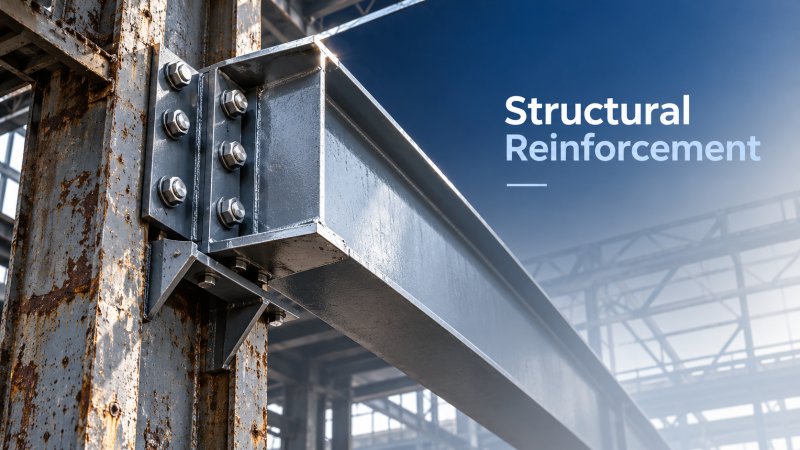
When connecting new steel beams to existing concrete or masonry structures, the complexity increases. Project managers must ensure that the design incorporates appropriate anchoring systems, such as chemical anchors or through-plates, and that the existing concrete has sufficient compressive strength and edge distance to resist the pull-out and shear forces. To mitigate these risks, bolted connections using high-strength friction grip bolts are often preferred for steel-to-steel connections due to their predictable execution and ease of inspection. However, this requires precise hole alignment. To minimize on-site adjustments and rework, project managers should prioritize sourcing pre-fabricated steel beams with pre-drilled holes, customized profiles, and trial assembly verification at the manufacturing facility. This shifts the complexity from the construction site to the controlled environment of the steel plant, ensuring tighter tolerances and faster installation.
Material Matrix and Corrosion Mitigation Strategy
While the primary load-bearing steel beams require high strength and specific structural grades to meet design loads, the secondary elements and connection accessories in a reinforcement project are equally critical for long-term durability. In environments prone to moisture, chemical exposure, or coastal conditions, corrosion at the connection points or secondary framing can compromise the entire reinforcement effort over time. For secondary structural components such as purlins, bracing, grating supports, or protective cladding, utilizing materials with superior corrosion resistance is a strategic decision that optimizes lifecycle costs. For instance, integrating DX53D Galvalume Steel Coil for these auxiliary parts provides excellent adhesion and high heat reflectivity, ensuring that the supporting framework does not degrade prematurely. The aluminium-zinc coating on such materials offers a robust barrier against environmental factors, significantly extending the maintenance intervals for the secondary structure. This approach balances the high strength of primary structural beams with the durability of secondary elements, providing a comprehensive solution that reduces future maintenance interventions and protects the overall investment in the reinforcement project.
Evaluating Existing Capacity and Code Compliance
A common misconception in structural reinforcement is assuming that the existing columns and foundations have unlimited reserve capacity. Adding steel beams increases the load transferred to the supporting columns and, ultimately, the foundations. If the original structure was already operating near its design limits, or if material degradation has occurred over time, the additional loads can trigger progressive failure. Furthermore, building codes evolve. A structure designed under an older code may not meet the load factors and safety margins required by current regulations. When reinforcing, the entire structural system is often required to comply with the latest standards, which can inadvertently reveal deficiencies in the original design. Project managers must mandate comprehensive condition assessments before finalizing the reinforcement design. This includes non-destructive testing of existing steel for section loss due to corrosion, ultrasonic testing for internal flaws, and verification of foundation settlement. The reinforcement design must be based on the actual residual capacity of the existing structure, not the theoretical original design. Ignoring this step is a primary cause of reinforcement project failures, where the new beams perform adequately, but the supporting columns or foundations fail under the increased cumulative load.
Supply Chain Management and Delivery Control
Reinforcement projects often operate on tight schedules, especially when they are tied to planned plant shutdowns or operational expansions. The procurement of structural steel is a critical path activity. Project managers must evaluate suppliers not just on unit price, but on their ability to deliver customized, pre-fabricated components within strict timeframes. Delays in receiving steel beams can cascade into extended shutdowns, resulting in massive financial losses. It is crucial to work with manufacturers who possess modern rolling and fabrication facilities, allowing them to control the entire process from raw material selection to final drilling, welding, and coating. Furthermore, ensuring that the supplied materials comply with relevant international standards, such as ASTM, EN, or JIS, and are accompanied by verifiable mill test certificates, eliminates compliance risks during final inspections. When sourcing from international exporters, project managers must also factor in logistics, customs clearance, and potential port congestions. Reliable lead times, consistent quality, and transparent communication are non-negotiable when the project schedule is directly linked to facility revenue and operational targets.
Quality Control and Execution Inspection
Executing a structural reinforcement project requires rigorous quality control at every phase, from material fabrication to final installation. Project managers should establish a comprehensive inspection and test plan (ITP) that covers both the manufacturing facility and the construction site. During fabrication, this includes verifying material traceability, checking dimensional tolerances of pre-drilled holes, and reviewing welding procedures for any custom connections. Once materials arrive on site, visual inspections and non-destructive testing (NDT) of field welds are mandatory to ensure that the connections perform as designed. For bolted connections, verifying the correct torque or tension in high-strength bolts is critical, as under-tightened bolts can lead to slip and load redistribution, while over-tightened bolts can cause thread failure. Maintaining detailed documentation of all inspections, material certificates, and as-built drawings is not just a regulatory requirement; it provides a vital baseline for future maintenance and any subsequent structural modifications.
Reinforcing existing structures with additional steel beams is a complex engineering and logistical challenge that requires a holistic approach. The decision to proceed should be based on a clear understanding of load path alterations, deflection compatibility, and the true residual capacity of the existing framework. By focusing on precise fabrication, strategic material selection for secondary components, rigorous condition assessment, and reliable supply chain execution, project managers can ensure that the reinforcement achieves its intended structural benefits without introducing new risks. The ultimate goal is to extend the functional life of the facility safely, efficiently, and within the allocated budget, transforming an aging asset into a reliable component of modern industrial operations.
Please give us a message


Please enter what you want to find